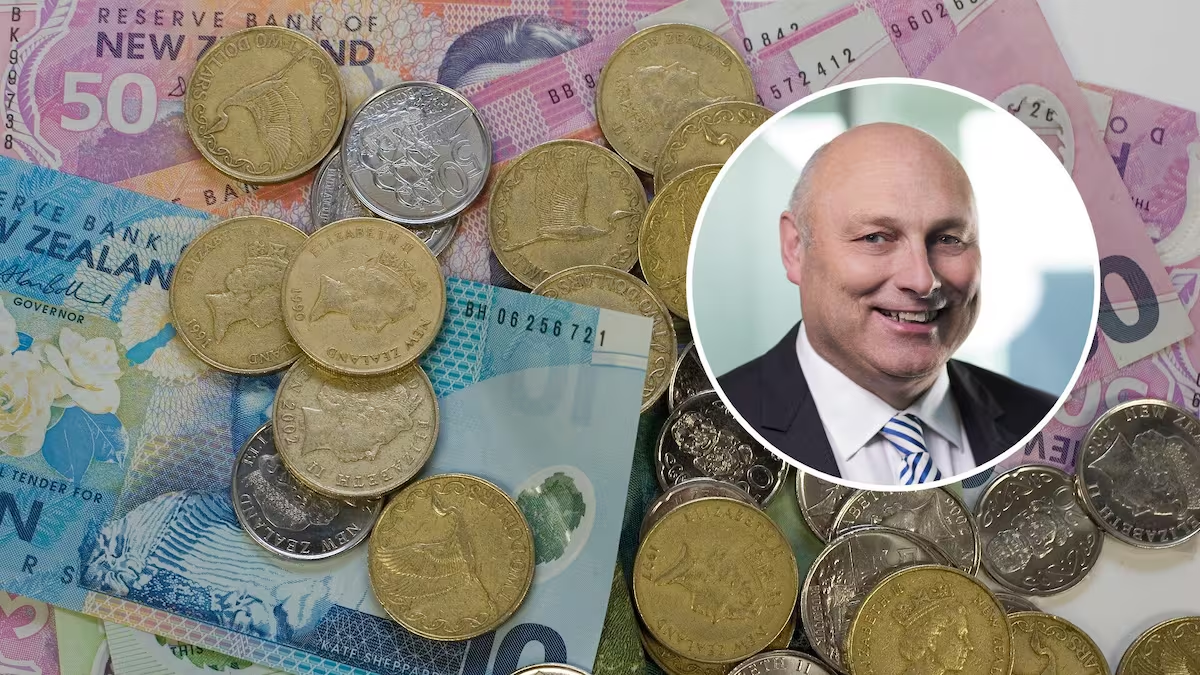
Inland Revenue needs to be asking questions about how billions of dollars in tax debt has been allowed to accumulate, one economist says.As of March this year, more than half-a-million people had debt to Inland Revenue. Overall tax debt sat at $9.4 billion, of which Inland Revenue said 62 percent, or $5.9b, was collectable.Total tax debt was less than $6b in 2023.Micro and small-to-medium businesses were responsible for 65 percent of outstanding tax debt, and GST and employer deductions such as PAYE were 57 percent of overall debt.The rate of tax debt increase has slowed to 1.6 percent a year by March this year, down from 27.1 percent a year in the year to March 2024.Simplicity chief economist Shamubeel Eaqub said it was noticeable that many insolvency requests were now initiated by Inland Revenue. But he said it did not necessarily mean the tax owing would be paid."When businesses are wound up it doesn't necessarily mean the whole liability will be paid off. I think what they're experiencing is that they're not getting full coverage of the debts owed to IRD."He said questions should be asked about how the debt had gone to this level. "How is it that businesses are essentially allowed to trade while insolvent? Is it too easy to start businesses in New Zealand? And what are the obligations of starting a business?"Paying your taxes is not some kind of optional expenses it's actually a necessity, first-ranking kind of obligation."Chartered Accountants Australia New Zealand lead John Cuthbertson said debt had ballooned in the past four years, mostly as a result of Covid.Chartered Accountants Australia New Zealand lead John Cuthbertson.Supplied / Chartered Accountants Australia New Zealand"You can track it back to the government and the various government departments, including Inland Revenue, taking a more softly, softly approach on taxpayers."The government has clearly put a line in the sand in the sense that in the last two to three Budgets they've allocated additional revenue to Inland Revenue for compliance activity but also for debt collection."There's an expectation of a return on investment in some cases as high as 12 to one... there's a definite desire to drive that debt down."He said his organisation had suggested that a solution could be to stop offering businesses the temptation of spending money that should be paid in PAYE and GST by not letting them have access to those funds."When you look at the tax debt, it's quite scary, it's predominantly owed by micro and SME businesses and it's predominantly in the area of PAYE... what that tells us is over a period of time, those businesses effectively were not viable and were using those forms of tax as cash flow. They were in essence competing on an unfair basis against other businesses who were doing the right thing."Eaqub said while Inland Revenue had taken a softer approach during the Covid years, businesses' obligations never went away and they had access to government support.Simplicity chief economist Shamubeel Eaqub.Supplied"If your business is in trouble you can reach out to people voluntarily. I feel like businesses wait and kind of hide and hope things will get better but it doesn't, right? Surely that should be the first kind of signal of risk, I can't pay my PAYE and GST, which is not my money, I'm stealing, maybe I shouldn't do this."Insolvency practitioner Keaton Pronk said whether Inland Revenue could recover tax debt from a liquidated business would often depend on the age of the debt."If they act promptly when a business falls into arrears there is a better chance of collection as the business may still be trading and have its assets. If it is an older debt there is a much higher chance the business will have closed up shop and disposed of all its assets and paid other creditors in preference to the IRD."In my experience a lot of the businesses that end up in liquidation do not pay a distribution to creditors, particularly if it is a creditor-initiated liquidation through the High Court."Inland Revenue said it could only write off tax debt if a liquidation was finalised and it was confirmed there were no further funds available, or in a bankruptcy in the same conditions, where taxpayers were in hardship or where taxpayers had died."The Tax Administration Act states the Commissioner has an obligation to collect the highest net revenue for the Government but does give the Commissioner discretion to write off tax debt that is uneconomic to pursue."Inland Revenue said while debt growth had slowed the total amount owing was likely to increase over this year as more fell due."Forecasts indicate that the ratio of tax debt to revenue will continue to rise in the near term. This is broadly consistent with trends observed across OECD countries, where prolonged economic pressures have contributed to higher levels of tax debt."It said sometimes debt was non-collectable while it was tied up in disputes, insolvency processes or legal action. It could become collectable again in future.Sign up for Money with Susan Edmunds, a weekly newsletter covering all the things that affect how we make, spend and invest money.
Our tax debt: How did this happen?
Inland Revenue needs to be asking questions about how billions of dollars in tax debt has been allowed to accumulate, one economist says.
854 words~4 min read