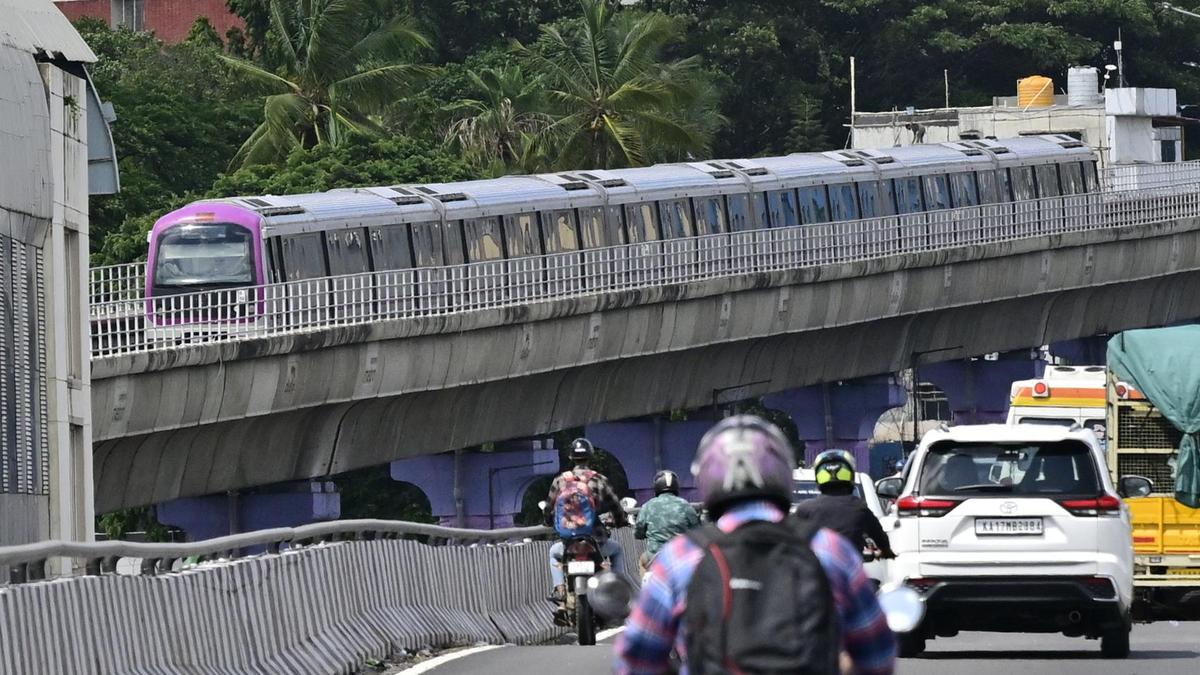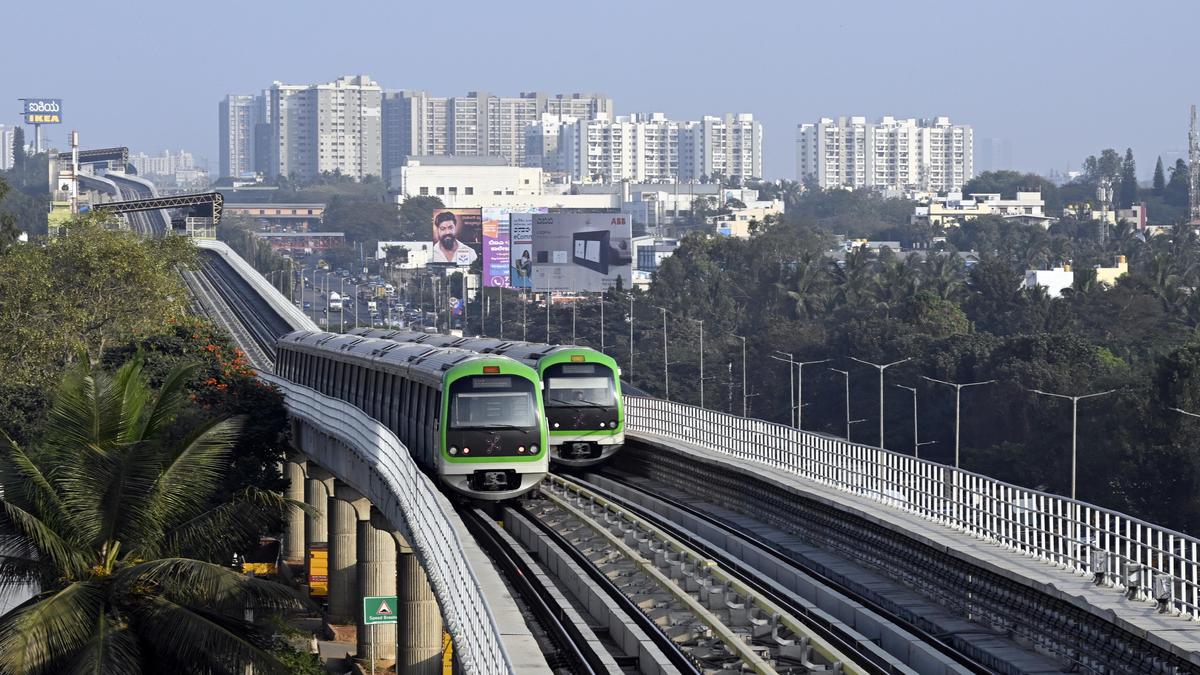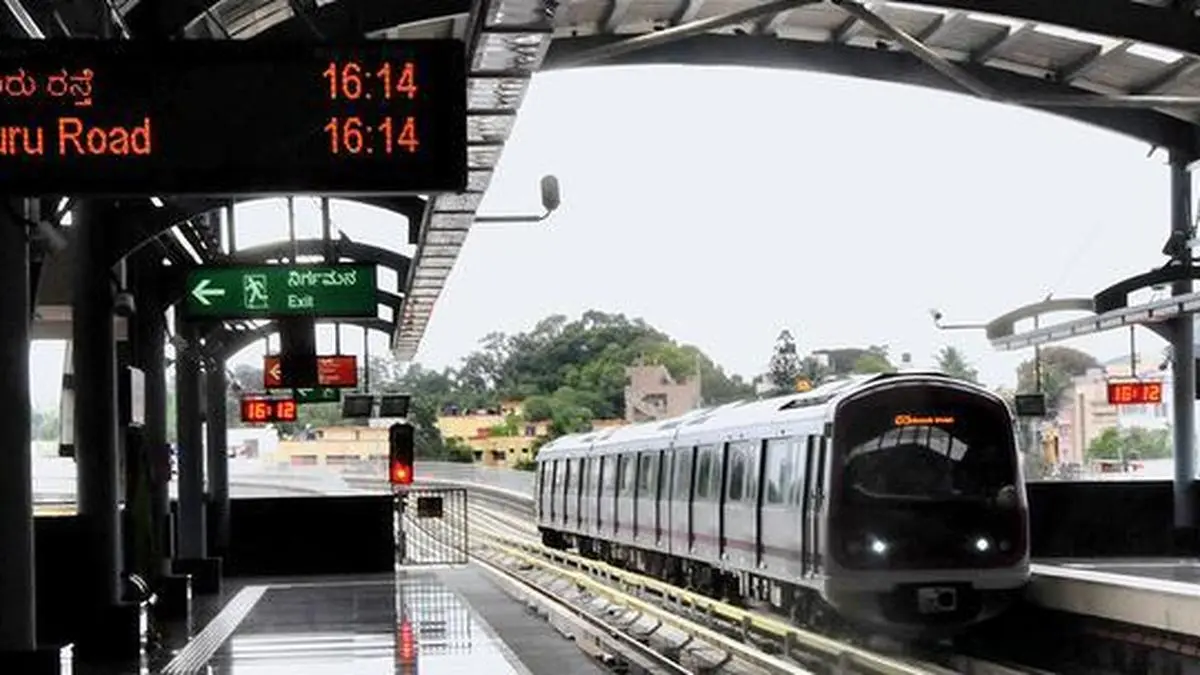
BMRCL is a 50:50 JV of Government of India (GoI) and Government of Karnataka (GoK).
| Photo Credit:
A report by Comptroller and Auditor General (C&AG) has said that Bangalore Metro could not attract enough private vehicle users that can result in an overall increase in public transport ridership.“BMRCL (Bangalore Metro Rail Corporation Limited) could not achieve the projected ridership and Peak Hour Peak Direction Traffic (PHPDT) against the year 2007 even by the year 2023 due to non-integration of Metro with Bengaluru Metropolitan Transport Corporation, lack of last mile connectivity, lack of adequate parking facility, etc,” the report tabled in Parliament said.Further, the feeder modes to Metro were poorly organized and lacked connectivity with interior residential zones. Further, footfall in BMTC buses reduced from 51.30 lakh per day in 2014-15 to 27.49 lakh per day in 2022-23. “Even after introduction of Metro, the combined ridership of BMTC buses and Metro is lesser than the earlier ridership of BMTC buses, which indicates that the Metro has not been able to attract enough private vehicle users that can result in an overall increase in public transport ridership,” it said.BMRCL is a 50:50 JV of Government of India (GoI) and Government of Karnataka (GoK). The commercial operations of Phase 1 commenced in a phased manner from October 2011 and were completely operational in June 2017 for a total length of 42.30 km. The commercial operations of Phase 2 were partly commenced during January 2021 to March 2023 for a length of 27.36 km and balance length is planned to be completed by December 2026.The Performance Audit was conducted covering planning, implementation, monitoring and operations of Phase 1 and 2 (excluding 2A and 2B) since inception up to March 2021. The physical and financial progresses of selected contracts were reviewed up to March 31, 2023.According to the report, BMRCL did not have a Procurement Manual. Further, there was no uniformity in preparation of cost estimates and there were no established guidelines for deciding project duration, size of Package, time period allowed for sale of tender documents and for regulating release of advances to contractors and fixation of interest rates on advances.BMRCL included taxes amounting to over ₹1000 crore in the cost estimates of nine civil contracts resulting in increase in project cost by over ₹1200 crore.There was impact on revenue too. “Actual Non-Farebox Revenue (Non-FBR) on actual Farebox Revenue (FBR) was in the range of 8.85 to 49.54 per cent but when compared to the estimated minimum 10 per cent on the projected FBR, BMRCL achieved Non-FBR between 1.39 and 8.62 per cent,” it said.eight parcelsIn Phase 1, out of the identified eight parcels of 42.60 acres, only one property (14 acre) was developed. Further, financial viability of corridors under Phase 2 was considered, with income projections of over ₹21200 crore during 2016-17 to 2041-42 from Property Development in an additional 55 hectare of land, which was yet to be acquired as of March 2023.BMRCL developed built-up area of 2.46 lakh sft in the Metro stations for Property Development, of which 2.23 lakh sft built-up area had been lying vacant for years, thereby losing the opportunity to earn Non-FBR (lease rent) of ₹38.53 crore during the period 2019-22. Further, there was no guiding Asset Management Policy to monetize the empty spaces in stations/ areas identified for Property Development, the report added.Published on August 10, 2026