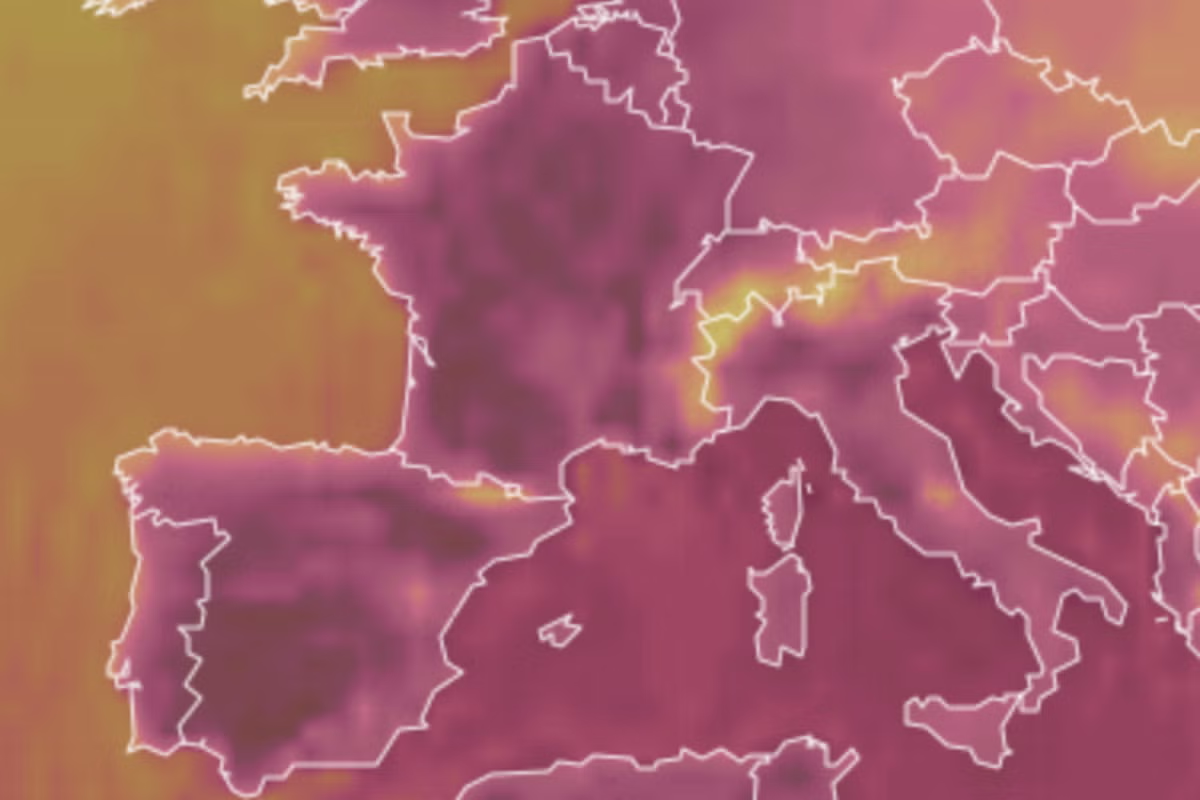
The U.K. and France are bracing for the fifth heat wave of the season, adding to an intense stretch of hot weather that has repeatedly sent temperatures soaring across Europe since May.National weather agency Météo-France is warning about temperatures approaching 40 C (104 F) from Tuesday onward in southeastern France. And in the U.K., an amber heat health alert for most of England will be in place beginning Tuesday as temperatures are forecast to climb to 36 C (96.8 F) later this week.Across Europe, the extreme heat began in May and has contributed to major wildfires, prolonged drought and new national temperature records, as well as thousands of projected heat-related deaths.Globally, so far this is the third-hottest year, behind 2024 and 2025, climate statistics show. But 2026 still has time to catch up. Thanks to the one-two punch of accelerated human-caused global warming and a supersized El Niño — a periodic warming of parts of the Pacific that leads to temperature variations around the globe — there’s an increasing chance that by the end of the year, 2026 could become the hottest year on record, scientists said.Last month saw the highest average sea surface temperature ever recorded for July across the extrapolar oceans, or the oceans free of seasonal sea ice, according to the European climate agency Copernicus.That was partially fueled by developing El Niño conditions in the equatorial Pacific, the service said. The new average record for July is 20.96 degrees Celsius (69.73 degrees Fahrenheit), which beat the 2023 record of 20.89 C (69.60 F).But last month’s average surface air temperature globally was 16.90 C (62.42 F), making it only the joint second warmest July on record, tied with July 2024, Copernicus reported.A person rests from the sun in the shade of a building, in central London in June.Brook Mitchell / AFP via Getty ImagesIn Western Europe, meanwhile, the average temperature record for the June-July period hit 21.62 C (70.92 F), Copernicus said, toppling the 2022 record.“Persistent high-pressure systems trapped heat over western Europe, the extreme temperatures also amplified widespread drought. As soils dry out, they lose their ability to provide natural cooling, allowing heat to build more readily,” said Samantha Burgess, strategic lead for climate at the European Centre for Medium-Range Weather Forecasts.“This is a clear example of how climate change is intensifying heat extremes, with heat and drought increasingly reinforcing one another.”In France alone, heat wave alerts were issued for the first time on record in May, when more than half the country recorded new monthly temperature highs. The heat intensified in June, a period during which at least 5,700 more deaths than usual were recorded, according to France’s public health agency.Météo-France said June 23 was the hottest day ever recorded in the country. Temperatures climbed as high as 44.3 C (111.7 F) in the southwest.Two other heat wave episodes were recorded in July, amplifying a historic wildfire in southwestern France that forced 220,000 people to flee their homes in one of the continent’s biggest evacuation efforts since World War II.Temperatures were slightly cooler in the U.K. on Monday but the country readied for its fifth heat wave in an exceptionally hot and dry summer, with half of England and all of Wales plunged into drought.The heat alert warns that significant impacts on health services, including a rise in deaths among older and vulnerable people, are likely.Two record-breaking heat waves in May and June led to more than 2,800 excess deaths linked to extreme temperatures.
U.K. and France prepare for another heat wave as western Europe sets new temperature record
The heat waves toppled an average temperature record for the June-July period set in 2022, according to the European climate agency Copernicus.
578 words~3 min read