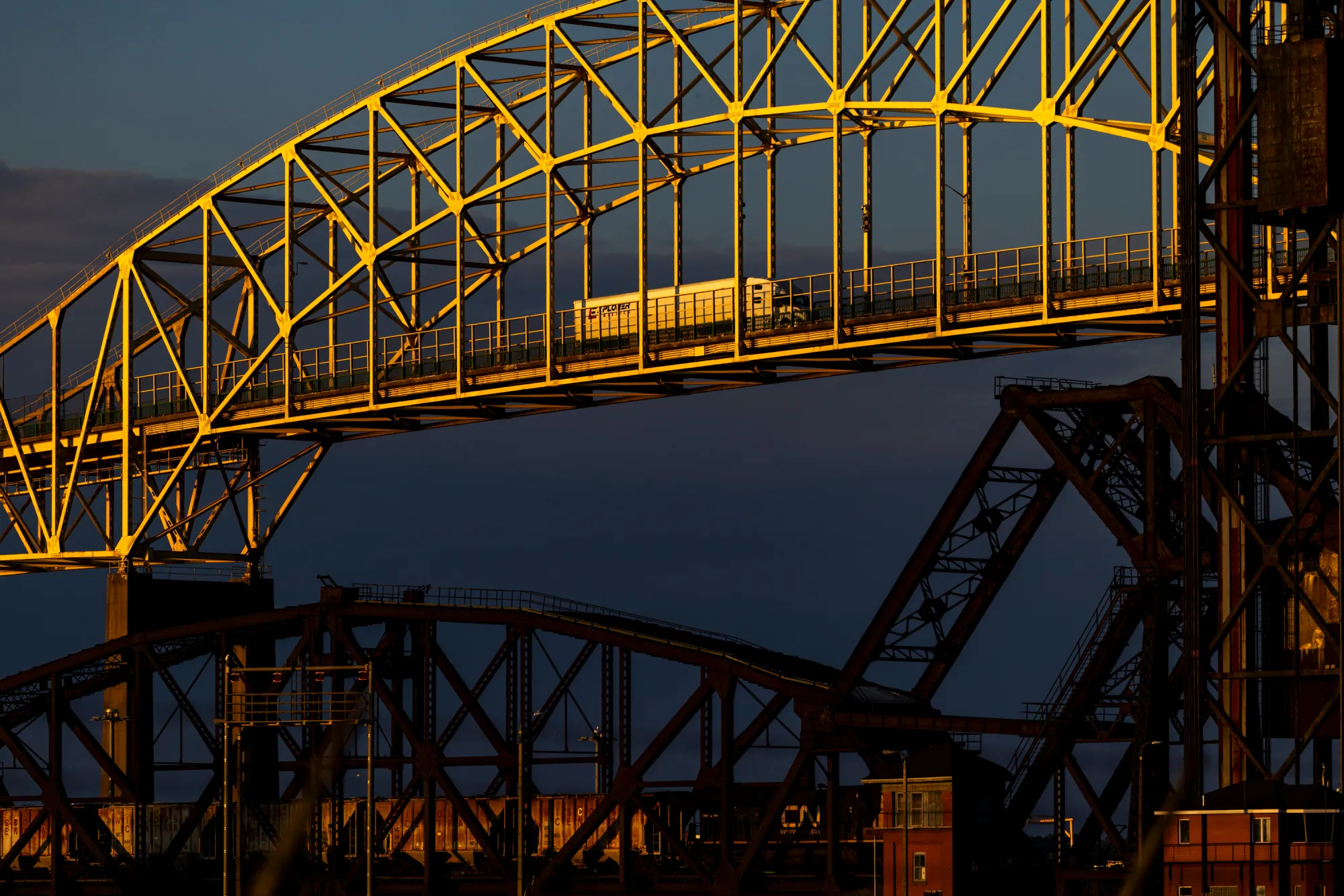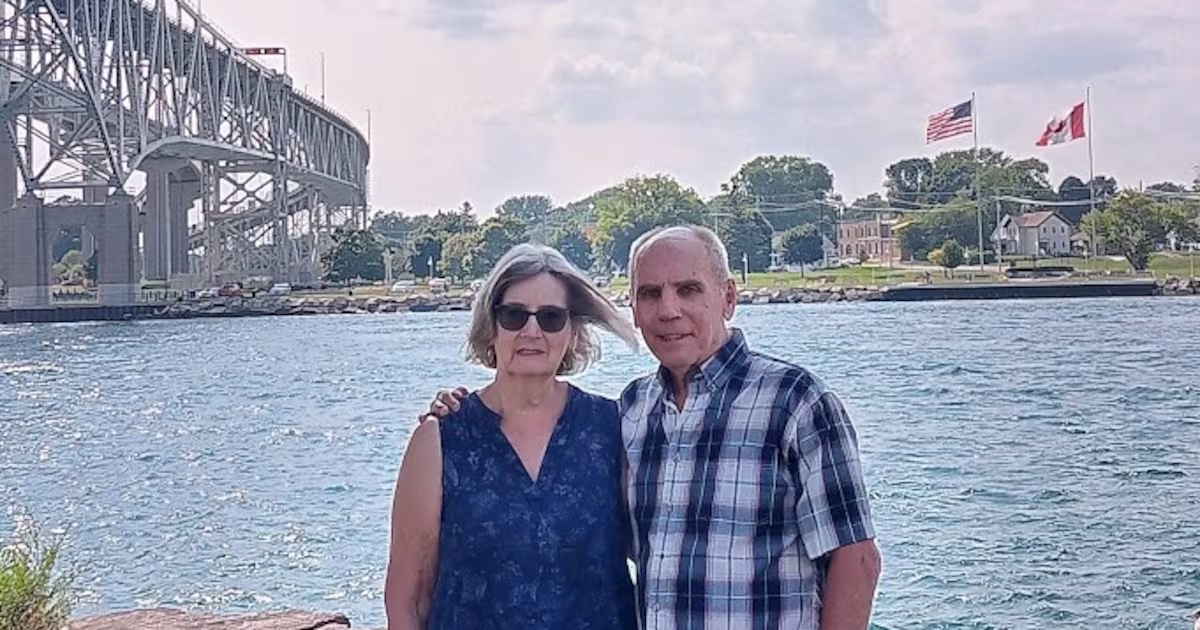
The day we arrived in Sarnia, Ontario, at the end of January 1972, we marvelled at the sun shining down from a clear blue sky, reflecting brightly off recently fallen pure white snow while a biting wind blowing off Lake Huron took our breath away. The contrast to the often dark, wet and dreary days of winter in Belfast made an immediate impact. I turned to Dorothy and said, “This is what winter is meant to be like”.This small city of just 75,000 sits at the border between Canada and the US. On the opposite side of the Bluewater Bridge spanning the St Clair river is Port Huron, Michigan. The cities are situated on Lake Huron, which has a surface area well over half of Ireland and is one of the five Great Lakes, which together hold a fifth of all the fresh water on the planet. I had no idea where in Ontario this city was when I applied to manage a microbiology lab at St Joseph’s Hospital in Sarnia. The lab director interviewed me at Belfast’s Europa Hotel, and when I told him my wife was also qualified, he said there was likely a job for her in the biochemistry lab. And there was. Dorothy and I had been married just 16 months when we emigrated. I was 24, she was 21. We had met while studying in Belfast and working as student lab technicians. Moving to a new country always brings challenges. We struggled to be understood at times due to our Belfast accents. But as two Protestants from Northern Ireland moving to work at a Catholic Hospital in Canada, we were apprehensive about how we would be received. In our Belfast lab, the staff had been both Protestant and Catholic. We worked well together and often socialised after work. Even when the Civil Rights marches in 1968 began, marking the beginning of the Troubles, we never allowed politics or religion to come between us. But in Canada, the nightly TV news regularly showed distressing scenes from the Troubles, adding to our worries about how we would be treated. After all, I had grown up on Belfast’s Shankill Road until my neighbourhood was demolished as part of the city’s controversial redevelopment. It was galling to hear the Shankill described as a Protestant “ghetto” on news broadcasts in Canada. Despite the Shankill’s negative reputation, my parents taught their children to respect all people. One of my sisters and a brother married Catholics. [ Moving to Canada: Here is what Irish people need to knowOpens in new window ]But in the hospital run by the Sisters of St Joseph, with many nuns among its staff, our concerns were soon set aside. There was no judgment about our roots. Instead, we were warmly welcomed. Sister Ilene managed the blood bank down the hall from our lab. She always offered a little glass of sherry to those of us who volunteered to work on Christmas Day. Our first child was born almost a decade after we arrived. We made a conscious decision to give them Irish names, Ciara and Kevin. They are proud of their Irish ancestry. And this year Ciara received her Irish passport. We have three grandchildren here too, Sean, Finn and Mia. As Canadians now more than half a century on, we enjoy how diverse and secular this society is. We had always felt uncomfortable with Northern Ireland’s social restrictions and sectarianism.But we have remained connected to Ireland. Even though there are no formal Irish clubs here, I made Irish friends through the local rugby club. We still follow Ulster and Irish rugby, proud of its inclusivity of both parts of the island. And Dorothy connects with Irish friends through her book club, whose other members are all women from the Irish Republic.I journeyed more deeply into Canada’s secularism on retirement at 55. I became a licensed officiant with the local Unitarian Fellowship, a congregation of “free thinkers”. This allowed me to officiate “non-traditional” marriage ceremonies and non-religious funerals. I conducted the first marriage ceremonies for gay and lesbian couples in Sarnia, when same sex marriage became legal in Ontario in 2003.[ Moving to Canada from Ireland: ‘Nobody prepared me for bears; they just walk about’Opens in new window ]Rather than being a total move away from Ireland, this connected me to an Irish history we had never learned at school. Becoming a Unitarian opened my eyes to the important role played by Irish Unitarians and Non-Subscribing Presbyterians in Irish history, including the 1798 rebellion.In the past, many Canadians crossed the border frequently to shop, visit friends and family, or for business or leisure. As a result of Donald Trump’s trade war and threats of annexation, we are two of a great many Canadians who now refuse to cross the bridge to Port Huron in protest. We also fear being harassed at the border, where guards can demand to check our mobile phones for social media posts. The boycott has had a detrimental effect on the Port Huron and other border towns.The beauty and appreciation of nature is ever-present in Canadian life. Much of this part of Ontario is flat farmland. The absence of hills and mountains was a difficult psychological adjustment for us from the ever-present backdrop of Belfast’s Black Mountain. But Lake Huron is blessed with many sandy beaches and parks and there is no greater delight than to swim in its cool water (except in winter). My love for the environment and concern about climate change saw me dabble in politics, running as the first candidate in Sarnia for the Green Party of Canada. I ran in three federal elections but was never elected.Nevertheless, an awe and respect for the natural world are values we passed on to our children. Our son now lives in Alberta, more than 3,000km from Sarnia, and whenever we visit, we always try to make time to enjoy the splendour of the Rocky Mountains.Through the acceptance and support we received, Sarnia and its people wove into our hearts. Though we often visit our families scattered across the island of Ireland, this small lakeside city that welcomed us with open arms is proudly our home.
Irishman in Canada: We no longer cross the river to shop in Michigan because of Trump
We enjoy Canada’s diversity, we had always felt uncomfortable with Northern Ireland’s social restrictions
1,034 words~5 min read