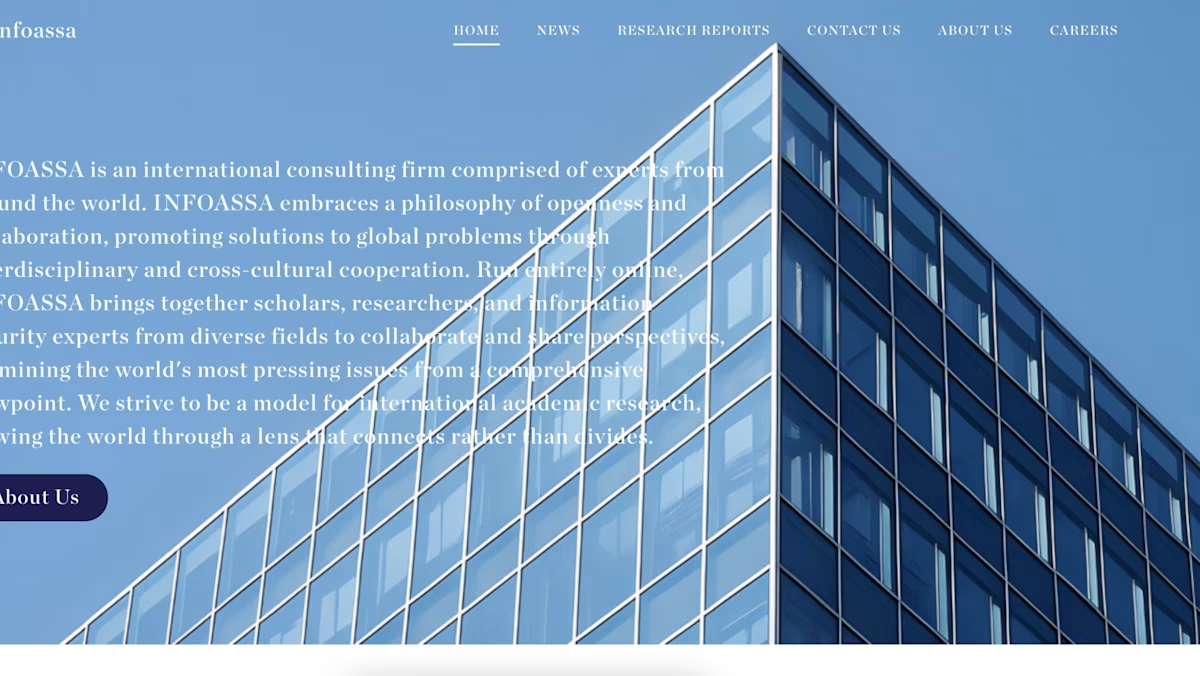
SINGAPORE: At first, nothing about the job advertisement seemed unusual to Maria, a former United States government employee. With her history of working on Indo-Pacific issues, the remote policy analyst role at Infoassa, a think-tank supposedly based in Singapore, seemed perfectly aligned with her background and research interests. But in the weeks after sending in her application in mid-July, her suspicions began to mount.The representative from Infoassa had replied from a personal Gmail account, not an organisational one. He offered US$500 as “reward” if she passed a writing test based on a planned September summit between US President Donald Trump and his Chinese counterpart Xi Jinping, which included a request to analyse Washington’s “pressure tactics” without using publicly available information.She couldn’t find much about Infoassa online beyond its website, and friends in think-tank circles told her they’d never heard of it. Then there was a distant memory from early in her career: A cautionary tale she’d heard about an American graduate student tapped to become part of an espionage operation.
That's when it dawned on Maria, who requested that she not be identified by her real name in this piece: What if this was a recruitment attempt by a foreign intelligence agency?“I thought, what if this is part of a broader pattern? Maybe it starts with benign reports, and then that’s how they hook you in,” she told CNA in an interview.Infoassa began establishing its online presence from September 2025, when it registered its domain name. Across its website and recruitment advertisements, it has alternated between calling itself a "think-tank" and a "consulting firm" over the months, though consistent in a description of being online-only and supposedly drawing on a global network of experts.But behind that front, a CNA investigation found a constellation of suspicious elements: At least one employee with falsified work history, fake Facebook events with descriptions lifted from articles by other organisations, and several features in its website infrastructure shared with TheTruthInfo, a website seized by US authorities in June. Twelve other websites were disabled at the same time, as part of what the US claimed to be a Chinese intelligence recruitment operation that targeted Americans with access to classified and sensitive government information.Responding swiftly in an editorial, Chinese state-owned newspaper Global Times dismissed the internet domain seizures as “baseless” and part of US efforts to exaggerate spying threats posed by China. The Infoassa playbook mimics other previously reported fake think-tanks, including one which also claimed to be based in Singapore, the Institute of East Asia Strategic Studies (IEASS). These entities used fabricated personas to recruit people with backgrounds in government, think-tanks and international affairs research.Dr Bill Hayton, an associate fellow at the British think-tank Chatham House, raised concerns about Infoassa in a post on X on Tuesday (Aug 4). He had previously sounded the alarm about IEASS in late June. Shortly after his post, Infoassa’s website went dark.