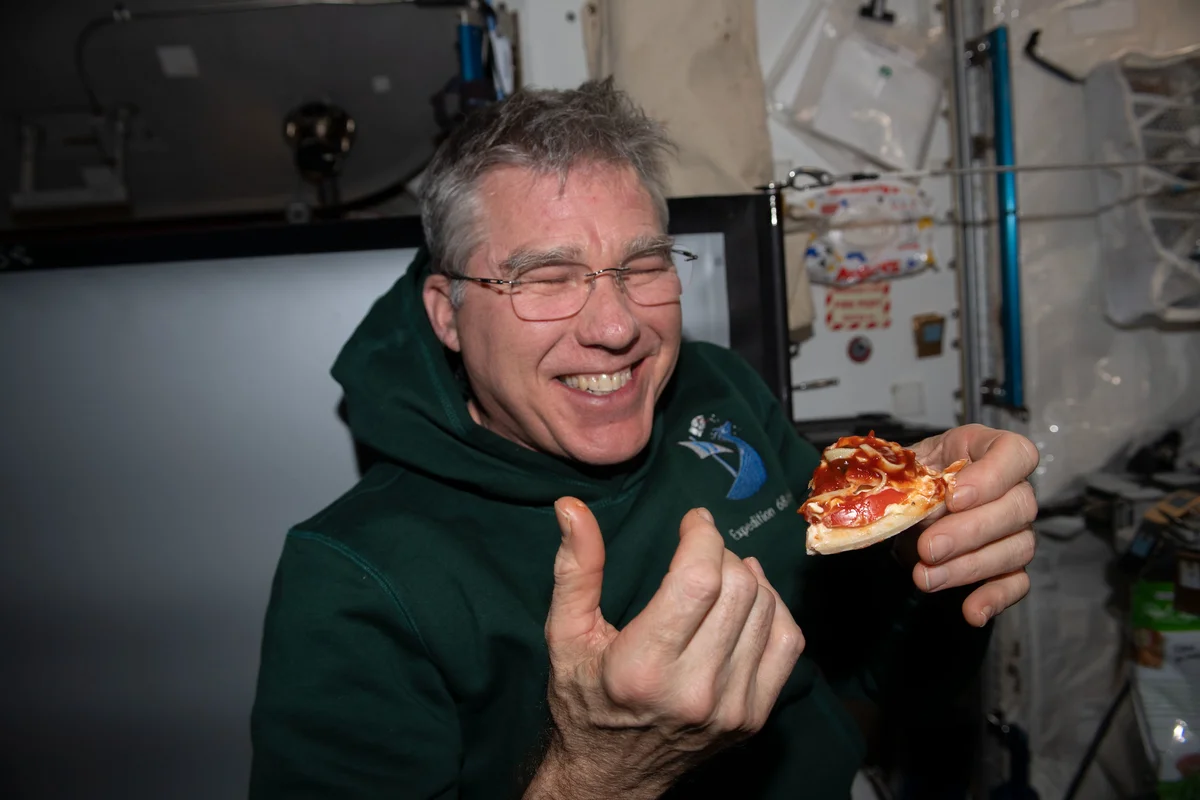
August 9, 20263 min read Add Us On GoogleAdd SciAmIf humans are to spend more time in space, scientists need to understand how life in microgravity affects eating and drinkingBy Sundeep Venkatesan & The Conversation US ASA astronaut and Expedition 69 Flight Engineer Stephen Bowen is pictured in the International Space Station's Unity module during the always popular pizza night. NASA Johnson, CC BY-NC-ND 2.0Imagine trying to swallow a sip of water while your face feels stuffed with congestion, your sense of taste is dulled and your body is floating 250 miles (400 kilometers) above Earth.That scenario is part of everyday life for astronauts aboard the International Space Station (ISS).Spaceflight changes the human body in dramatic ways. Muscles shrink, bones lose density and bodily fluids shift toward the head. Astronauts often return with puffy faces, stuffy noses and a feeling similar to a lingering cold. When you’re congested, you might have more difficulty swallowing—but does microgravity also affect this important body function?On supporting science journalismIf you're enjoying this article, consider supporting our award-winning journalism by subscribing. By purchasing a subscription you are helping to ensure the future of impactful stories about the discoveries and ideas shaping our world today.As a speech-language pathologist and researcher who studies swallowing disorders, I spend much of my time thinking about how to help people eat and drink safely. When everything’s working smoothly, swallowing feels effortless, but it is one of the most complex actions the human body performs.Every swallow requires more than 30 muscles and several nerves to work in perfect sequence. Food and liquid must move from the mouth to the stomach while the airway closes in a fraction of a second to keep material out of the lungs.Most people complete this process hundreds of times a day without noticing. In space, that automatic act may become more complicated.Gravity quietly helps us eatSwallowing does not depend on gravity. People can swallow while lying down, and astronauts clearly eat and drink in orbit. But gravity still provides subtle assistance. On Earth, it helps saliva pool in the mouth and pushes food and liquid down from the mouth to your esophagus after each swallow.Gravity also affects where fluids collect in the body. In microgravity, where objects appear to be weightless, fluids drift upward toward the head, which can cause swelling, nasal congestion and changes in pressure around the mouth and throat.Researchers have documented that weightlessness affects many parts of the digestive system, from the mouth to the intestines. But they are only beginning to explore what these changes mean for chewing, swallowing and nutrition.Why food feels and tastes different in spaceMany astronauts say food in space can seem less satisfying than it does on Earth. Congestion reduces your sense of smell, which normally contributes greatly to flavor, and some foods may lack familiar textures such as crunch. When your nose is blocked, even your favorite foods can seem dull.Astronauts also commonly eat less than expected and may lose weight during missions. Eating less while in space can pose a problem because nutrition is essential for maintaining muscle strength, immune function and mental performance.Research suggests that microgravity and other aspects of spaceflight may alter saliva production and oral health, likely because fluid shifts, dehydration and changes in the body’s stress response can affect the salivary glands. These factors can increase the risk of dental problems and discomfort during long missions.Saliva does much more than keep the mouth moist. It softens food, helps form it into a cohesive mass and allows it to move smoothly through the throat. It also protects the teeth and oral tissues.Anyone who has experienced dry mouth knows that crackers can feel like sand and swallowing can become surprisingly difficult. A dry mouth on Earth is inconvenient. During a long-duration mission to Mars, it could interfere with eating and drinking for months.A round-trip mission to Mars, including travel and time on the planet’s surface, could last two to three years. During that time, astronauts will live far from hospitals, specialists and emergency evacuation options. Every aspect of human health matters, including the ability to eat and drink comfortably enough to maintain nutrition and hydration.Space food is changingEarly astronauts squeezed puréed food from tubes. Today, crews enjoy a wide variety of foods, including tortillas, spicy shrimp cocktails, rehydratable macaroni and cheese, and occasional treats such as brownies, cookies and fresh fruit delivered by cargo spacecraft.Scientists are also developing 3D-printed foods that can be customized to meet nutritional needs and improve variety on long missions. This technology could one day make it possible to tailor food textures if an astronaut has difficulty chewing or swallowing.Researchers are also exploring how technologies such as 3D food printing could build on the texture-modified diets already used in hospitals and rehabilitation centers to help people with swallowing difficulties eat more safely and comfortably.As humans prepare to return to the Moon and journey onward to Mars, even the simple act of swallowing could play a small but important role in whether those missions succeed.This article was originally published on The Conversation. Read the original article.It’s Time to Stand Up for ScienceIf you enjoyed this article, I’d like to ask for your support. Scientific American has served as an advocate for science and industry for 180 years, and right now may be the most critical moment in that two-century history.I’ve been a Scientific American subscriber since I was 12 years old, and it helped shape the way I look at the world. SciAm always educates and delights me, and inspires a sense of awe for our vast, beautiful universe. I hope it does that for you, too.If you subscribe to Scientific American, you help ensure that our coverage is centered on meaningful research and discovery; that we have the resources to report on the decisions that threaten labs across the U.S.; and that we support both budding and working scientists at a time when the value of science itself too often goes unrecognized.In return, you get essential news, captivating podcasts, brilliant infographics, can't-miss newsletters, must-watch videos, challenging games, and the science world's best writing and reporting. You can even gift someone a subscription.There has never been a more important time for us to stand up and show why science matters. I hope you’ll support us in that mission.
How spaceflight changes astronauts' ability to eat and drink
If humans are to spend more time in space, scientists need to understand how life in microgravity affects eating and drinking
1,047 words~5 min read