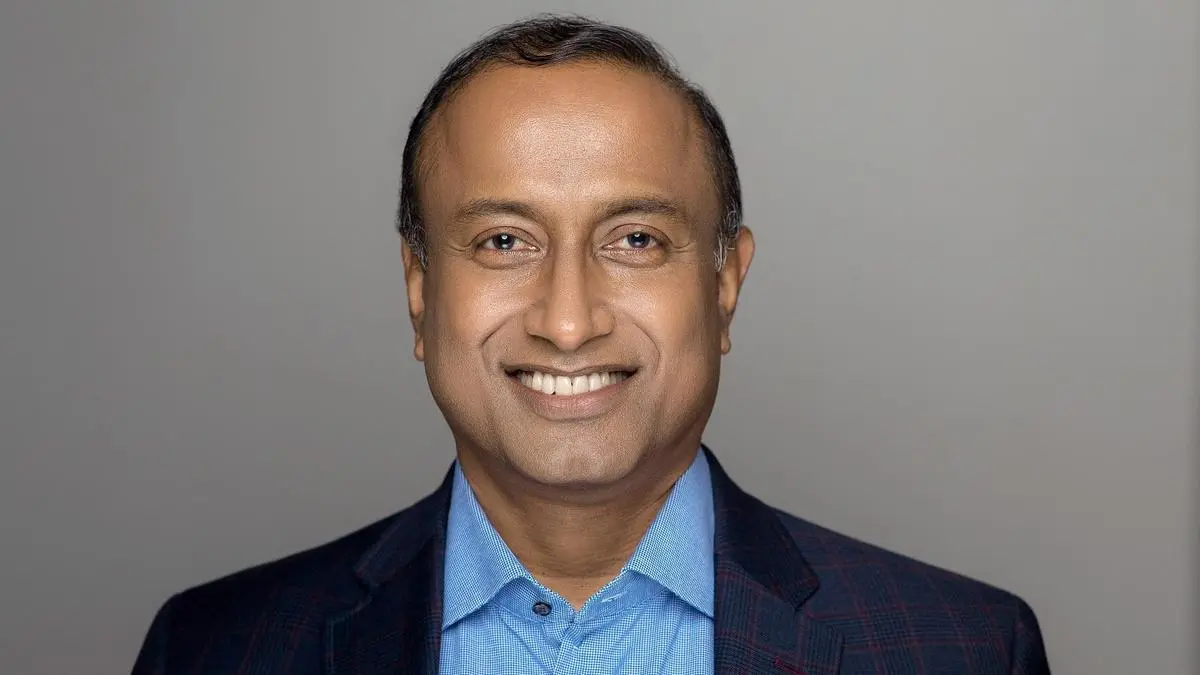
India’s $315-billion IT industry is navigating one of its biggest transitions as AI reshapes business models, hiring patterns and client expectations. While concerns over slowing headcount growth, the future of the traditional FTE model, and the rise of Global Capability Centres (GCCs) continue to dominate the conversation, the sector is also positioning itself for the next phase of AI-led growth.In an interview with businessline, Rajesh Nambiar, President of IT industry body Nasscom, discusses how AI is changing the economics of IT services, why outcome-based delivery is becoming inevitable, the industry’s AI readiness, talent and policy priorities.You said AI has become the operating system for every enterprise. From your industry-wide vantage point today, where do you think India’s nearly $300-billion IT services industry stands in its AI transformation journey?Over the last 1.5 years, this industry has not been the most sought-after from a market perspective. While we grew 6.1 per cent, employee growth has been a little bit slow, at only about 2.3 per cent growth. Historically, revenue growth in the industry has largely moved in tandem with employee growth. This linearity has been broken, especially in the last four quarters, where headcount growth has been less. We find two things to be true. One is a phenomenal uptake in terms of the order books. Revenue growth is not bad; some large companies will register 2-3 per cent growth, which is still significant. The industry will clock around 6-7 per cent growth because of some mid-sized companies. In terms of order books, the future signings are positive and have gone up for every player. The deal pipeline is good.What’s not good is the market’s reaction to the results. Both Indian and global services companies are being punished; most had significant headwinds from a stock market point of view. But if you look underneath the surface, you will find that things are not that bad. There will be a temporary churn in the system: how employment is restructured, changes in job descriptions. However, two years down the line, the industry will return with more growth than earlier.This optimism comes from the rapid growth of technology and its infusion into enterprises. To change how enterprises work, a lot of help is required from the services industry, which understands enterprises best. For the last 3-4 decades, IT services organizations have entrenched themselves in enterprises. They understand the client’s vertical, domain, systems, and context better than anybody. One needs services companies to build meaningful systems and transform their enterprise, which will drive growth.The traditional FTE-based services model appears to be under pressure, while AI-driven productivity gains are increasingly benefiting customers more than service providers. Do you see these trends accelerating, and can India’s IT services industry successfully adapt?For a while now, this industry has been wanting to transition from the headcount used for time and materials (T&M) and into a fixed-price or outcome-based model. Very few could move the needle away from the FTE or T&M-based model. Today, there is no choice. The external environment, along with AI, is forcing us to make that change. The industry can’t rely purely on the number of hours billed.While the industry will survive this shift, not all players may transition. 20-25 per cent of the companies may be left behind, including those whose DNA includes the FTE model. Most mid-size or larger organizations have already begun the transition. Many are announcing AI-based revenue and AI services, which may be only 10 per cent of their revenue currently, but will gradually bulge.Some companies are working deeply with customer organizations. AI is not only about making current processes or software development more productive, but about helping clients reimagine their value chains and how they make money. To do this, companies need to build the required capabilities and wherewithal, which is happening as we speak. They will increasingly be able to offer customers a much more outcome-driven business model instead of the input-driven conversations of the past. This shift is already underway.We are close to the mid part of this journey. The pivot happens not at an industry level but at the company level. Slowly, this will reflect in their numbers. Enterprises worldwide can’t afford not to jump onto the bandwagon and transform their business. This transition won’t stop midway.Drawing on both your policy and industry experience, do you think India’s IT services sector has been too complacent in investing in AI, compute, and foundational capabilities? Barring a few notable bets, has the industry underinvested?I would not say we are complacent. At the commercial end of running a services company, you do what shareholders value. One needs to both balance short-term results and create long-term capability. Many technology companies have an R&D ecosystem. They’ve attempted to pivot into products. But as a nation, India spends roughly 0.65 per cent of its GDP on R&D, while most advanced nations spend upwards of 2.8 per cent. There is a gap in government and industry spending as well. This is true across sectors.Many Indian tech companies have invested in Silicon Valley startups at the forefront of technology. However, large and mid-sized services firms are conservative by nature. Most of these companies have organically grown. This doesn’t mean they couldn’t have spent more on R&D, but when you have a shareholder to answer to, you are hesitant to spend on other things. Patient capital is a new phenomenon in DeepTech, where the returns will take longer. To some extent, the two are comparable. These tech companies are cash-rich. Instead of explaining that some investments have a long gestation, they probably catered more to the investors.Nasscom recently flagged a decline in core engineering and coding skills as AI adoption accelerates. How do you see this affecting India’s tech talent pipeline, and can the workforce successfully transition to meet the growing demand for AI skills?Traditional roles like programmer or project manager are transforming significantly. We don’t believe AI will replace any roles directly. Instead, it will enable you to do the tasks under a role differently. If your job has ten tasks, AI may automate 5-6, meaning you need fewer people to do the rest.However, there is a split. One is the greenfield implementation, where somebody is building a completely new application. AI-based software development has become easy and automated. For instance, Claude can do a phenomenal good job in greenfield systems.But when it comes to brownfield—an existing system with several legacy systems and decade-old databases—there has been little impact so far. Modernizing these systems means cleansing the data and preparing the systems to adopt advanced models. All this requires a significant amount of work from IT services companies.We’ve been working with the government to create an “AI curriculum” as we speak. The idea would be to go through the path of both AICTE and UGC to only teach useful stuff. If a college or university graduate, especially in computer science, doesn’t have the capabilities required—such as leveraging AI systems, managing orchestration, and working with agents—that is what the curriculum will have to evolve to address. We have already finished making a recommendation, so we’re working with the government. GCCs were once seen as complementary to IT services firms but are increasingly viewed as competitors. Will GCCs eventually overtake the traditional IT services industry in scale and employment, or will the two continue to coexist with distinct roles?They are complementary. Almost every services company has created a GCC practice to serve the GCC ecosystem. Initially, they were pushing back, but over the last five years, they have learned that this is also a revenue stream.The GCC practices embedded within service providers are also growing. While the two may look similar, the opportunities they offer are different. Service providers expose employees to multiple industries—banking, healthcare, manufacturing—over a short period, providing broader domain experience that GCCs may not. GCCs, on the other hand, often offer greater responsibility and deeper expertise within a single domain. Both models have their pros and cons, and they will continue to coexist.Over the last couple of quarters, the net addition of employees is probably higher in GCCs. But both have to grow. It will boil down to the individual companies. That’s where the competition would be. If you had three policy asks for the government to better support India’s technology industry, what would they be? From Nasscom’s perspective, which reforms or interventions would have the biggest impact?One of our biggest asks of the government has been policy certainty. If India wants to attract global investors, the ability to project certainty to the outside world is critical. We will continue to advocate for that. Today, India is better placed than many other countries, with greater business certainty, and we need to preserve that. Investor confidence will only grow if we maintain this stability.There’s also a lot of slip between the cup and the lip between the central and state governments. For instance, a state government may come up with something around the labour code because it is a state subject. Suddenly we run around fighting multiple fires, which is an unnecessary aberration. The changes may be applicable for a small industry, while the implications for larger employers like the IT industry may not be taken into account. It’s not an easy ask for the state and central to coordinate, especially when they aren’t from the same parties. This cooperation could help big time.The third ask relates to sectors like GCCs, where the government is addressing several taxation-related issues. The challenge is that there is often a gap between policy decisions at the ministerial level and their implementation on the ground. That gap needs to be minimized. We believe the government’s policy intent is not always reflected in execution. Ease of doing business remains a critical priority.With over half of the industry’s revenue coming from a single geography (USA), how concerned are you about rising geopolitical and policy uncertainty? How can Nasscom help the industry navigate these risks and strengthen global engagement?63% of our revenues depend on one geography, which we believe puts pressure on the industry. The good news is that it has not directly impacted revenues because there is a lot of talk and little implementation. The problem is that because we deal with services, there is no direct tariff. Instead, a tariff may apply to a customer, who may pay a levy on services.The bigger problem would be around skilled talent mobility. There have been some aberrations in terms of some fees. While companies have learned to live with it, it has caused some discomfort, and ease of doing business has been taken away. We hope that once we sign a bilateral trade agreement, we will eventually get out of this. Our government is supportive, and we work closely with the Department of Commerce and the rest of the government in terms of external affairs as well. We also started a Nasscom U.S. CEO forum 1.5 years ago. We have had three meetings so far. This body helps us with positioning ourselves within Capitol Hill. So, we visit different lawmakers, or, for example, meet with senators and congressmen.
Outcome-based IT services no longer optional: Nasscom’s Rajesh Nambiar
Nasscom's Rajesh Nambiar discusses the shift to outcome-based IT services driven by AI's impact on the industry.
TL;DRAI
India's IT services must abandon FTE models for outcome-based delivery; Nasscom warns 20-25% of firms may not survive. CIOs expect value-chain reimagining, not billable hours. India's 0.65% vs 2.8% R&D spend gap limits foundational AI capabilities.
1,845 words~8 min read