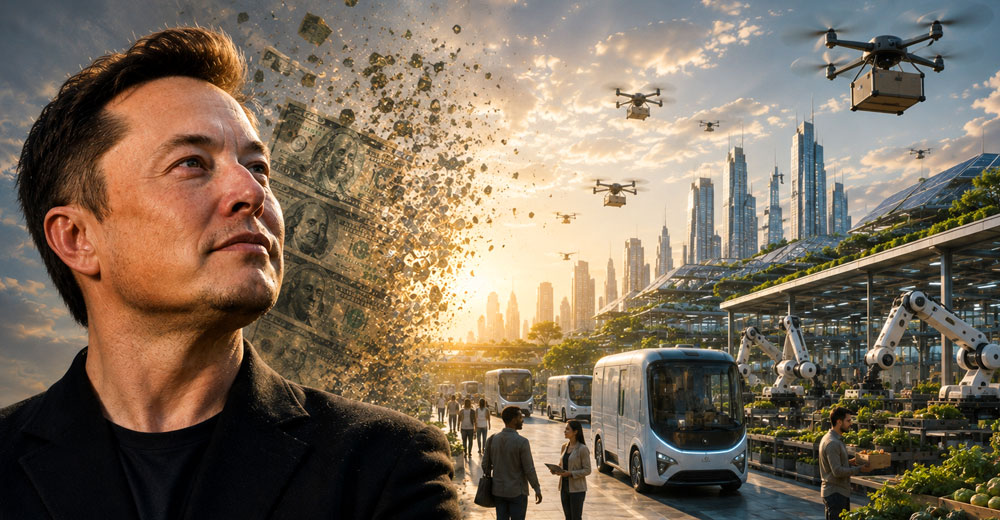
Are human beings doomed to become the equivalent of pet Labradors to the superior intelligence of artificial general intelligence and robotics? That is what Elon Musk considers not just possible but virtually certain – and not in the distant future, but by 2036. In a long recent interview with Economist editor-in-chief Zanni Beddoes, Musk asserted that within 10 years there would be no job – mental or physical – that an AI/robotics system could not do much better than any human. Asked by Beddoes about his “pet Labradors” comment, Musk smiled and turned to the example of gardening. We go to dinner at friends’ and find it quirky to eat small, misshapen potatoes they have grown. Never mind that the ones we could buy would be big, round and juicy – we amuse ourselves with our quaint little human pastimes like gardening. We are a bit like Labradors chasing balls – done for fun, not necessity. While cheerfully accepting that there is a 10-20 per cent chance that this superior intelligence could eventually eliminate its pets, Musk considers it more probable that AI and robotics will create a sort of global economic nirvana of abundance. In the world he imagines, anything humans need will be provided for them. In this nirvana, work is no longer necessary, everyone gets a “universal high income” – essentially a cheque printed by governments in a context where money is no longer a limiting factor for human activity. In a scenario of such abundance, deflation rather than inflation is the likely outcome. Even Beddoes had to reluctantly agree with this part of his hypothesis. I will allow my economist, sociologist and political scientist colleagues a moment to take their blood pressure medication while they prepare their response to this fantastic proposal. Musk may be a technological genius, but he has little understanding of individual or collective human behaviour, as becomes clear when Beddoes discusses his political views. Yet there is a core truth at the heart of his predictions. We human beings can no longer hang our species self-esteem on our intellectual, problem-solving abilities. Nor are we likely to be able to continue making a living in the same ways we always have. Of course, jobs will change and new jobs will emerge: we will, for instance, always need doctors and surgeons, even though their technical skills will be superseded by, and delegated to, AI and robots. So let’s suspend our reasonable doubts and hope that there is some truth in Musk’s assertion that we will enter an age of abundance and that some economic system will emerge to fulfil our basic needs of shelter, food and healthcare. [ How Musk transformed Twitter from communal town square to right-wing conspiracy hubOpens in new window ]The question, then, is what on earth will we do with ourselves? What will we do with all that free time? The great risk is that we become unmotivated and passive – what will drive us if we don’t need to work? Many retirees face this challenge already but what will motivate young men and women in their prime? Depression, anxiety and addiction to gambling, drugs, alcohol, gaming or pornography are all risks for hot-blooded younger people suddenly facing into a life with no demands on them and no purpose. Does human creativity offer an answer? Human beings create and they do so together. They have invented artificial intelligence and robots – and they will go on creating. In the main, people do not create for money, status or power – but for the sheer, liberating joy of expressing human consciousness through conjuring up something that did not exist before. Most artists live on a shoestring – this is true of writers, poets, painters, potters, musicians and composers – and yet they are impelled by a mysterious drive to pursue their art for little significant material reward. True, a few make good and are well-compensated in the material world – your Sally Rooneys, Seamus Heaneys or Paul Mescals, for example – but they are a tiny minority. Visit any of Ireland’s summer festivals and you’ll see the same phenomenon over and over – people creating for the simple joy of it. And then notice how many of them seem ageless.Taking part in creative activities makes your brain younger than your chronological age. In a study of more than 1,000 people across 13 countries, led by my Trinity College Dublin colleague Agustín Ibáñez, we found something striking: engaging in creative pursuits – painting, playing music, dancing – was associated with a significantly younger “brain age”. And this was more than simply a passive link. When people actively took up a new creative activity, their brain age dropped by about four years.What’s more, it’s not just the artists whose brains are rejuvenated – people who engage by being consumers of the art also show better memory and other cognitive abilities. But that’s not why artists do their art or why we come to see and hear their creative outputs. We are far from being pet Labradors chasing balls – we do it because we are driven. So, what is this drive and where does it come from? The famous theatre director Peter Brook said “every actor, director, and stage manager knows well that every audience is part of the performance and every performance is impacted by the audience”. That is as true of the choir I sing in performing in a Dalkey church as it is of the exhibition of glass art on this week in Kilkenny or the hordes who recently attended All Together Now in Waterford. Creative endeavour binds people together in a uniquely human communion that transcends material motivations and touches on the spiritual. Much visual, musical and other art also binds us to nature, which research has shown, has cognitive benefits. Feeling connected to nature also enhances our brains and wellbeing – and also makes us feel that life is meaningful.So, Elon – we are no pet Labradors chasing balls, indulged by your master robots. We have three things your machines will never have – our drive to create, our doing so together and our being part of magnificent nature.
Ian Robertson: If Elon Musk is right and AI makes jobs extinct, what will we do with our free time?
Humans have three things the multibillionaire’s machines will never have
TL;DRAI
Musk predicts AI eliminates all jobs by 2036; Robertson argues creativity will drive post-work meaning and cohesion. Brain research shows creative pursuits reduce brain age by four years; human flourishing stems from art, music and community, not machines.
1,031 words~5 min read