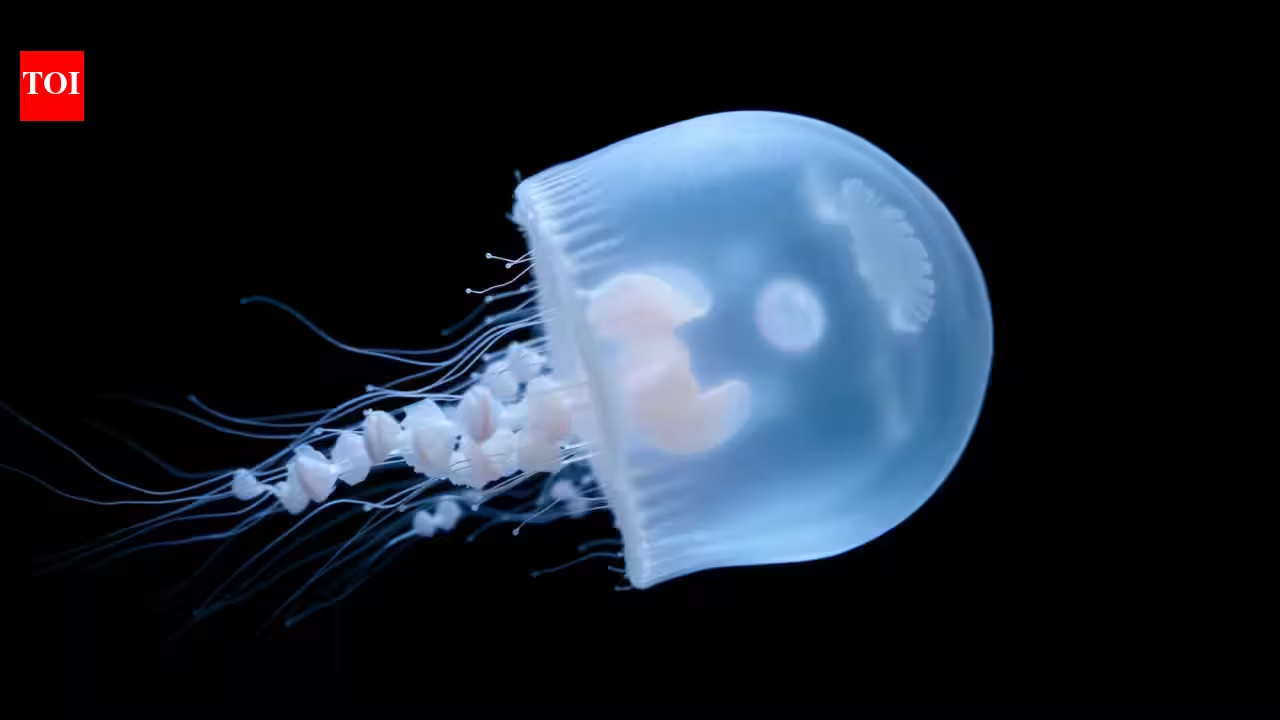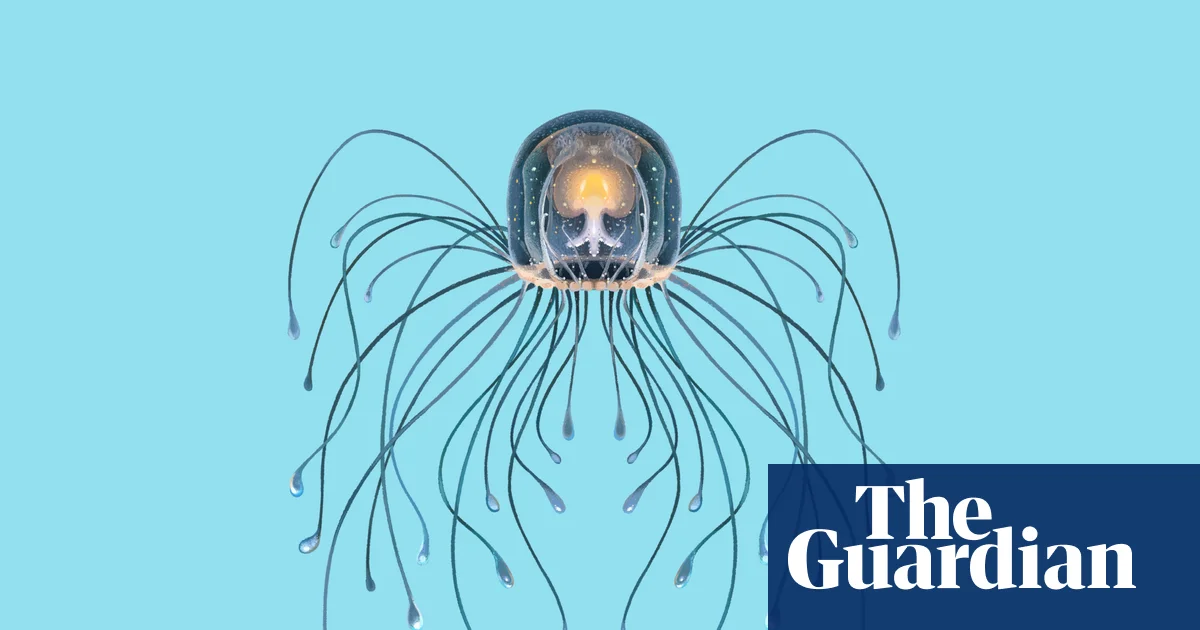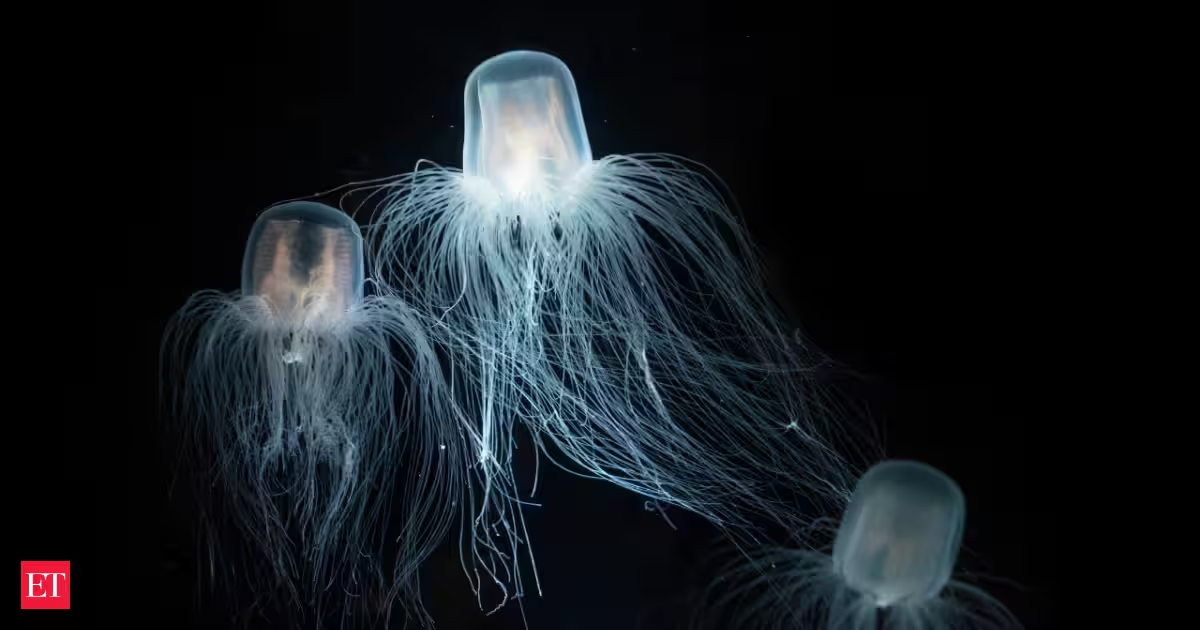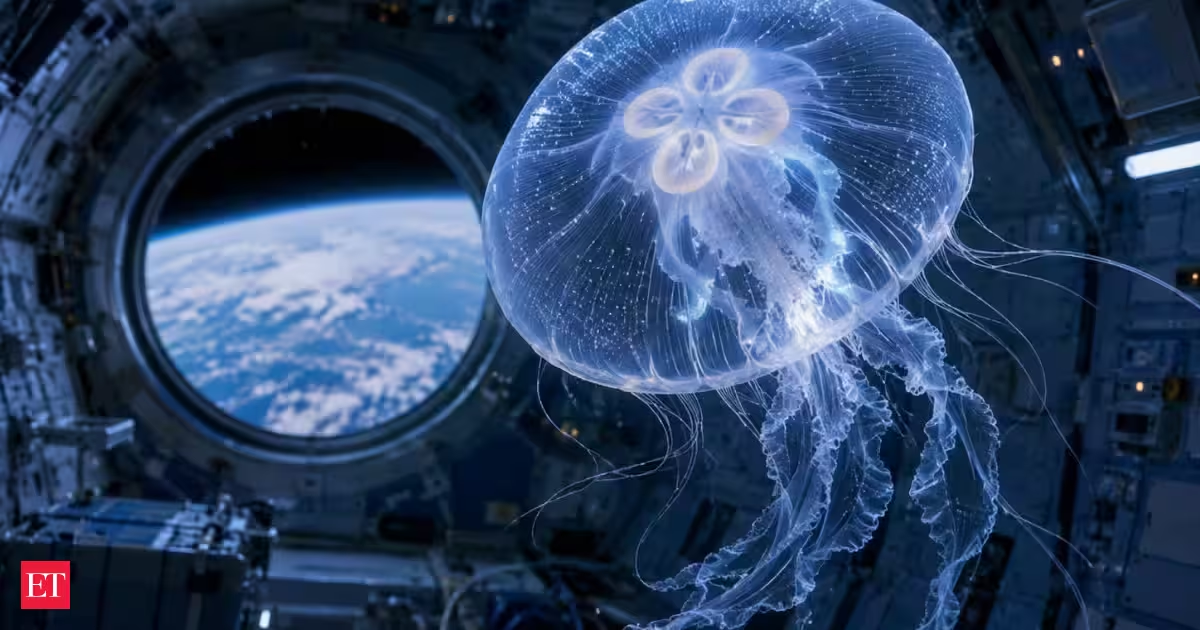
In 1994, NASA raised jellyfish in orbit to study their sense of balance; they developed normally but had trouble swimming under Earth’s gravitySynopsisNASA ventured into the unknown in 1994 by studying baby jellyfish in orbit. The jellyfish managed to develop vital sensory adaptations for balance in the absence of gravity. Yet, their triumphant return to Earth revealed strange swimming behaviors. This fascinating research sheds light on the disorientation hurdles astronauts might face on missions to Mars, revealing the intricacies of adjusting to life beyond our planet.representative image of a moon jellyfish floats inside a spacecraft laboratory, illustrating the unusual conditions faced by organisms in microgravity. Image credits: ChatGPT Ever gone out of your way to go off-the-grid for two weeks: without your computer, no notifications whatsoever, and then suddenly felt really weird going back into your apartment? The slight dizziness, the feeling that your body hasn't quite gotten over the vacation? The scientists at NASA studied this phenomenon about three decades ago, only on an even stranger scale, and their test subjects were not tired graduate students; they were jellyfish.Spacelab LM1, configured as the International Microgravity Laboratory, aboard Space Shuttle Columbia. Image credits: WikipediaThe space shuttle Columbia launched a shipment of baby moon jellyfish (Aurelia ephyrae) into orbit in the summer of 1994, as part of NASA's IML-2 (International Microgravity Laboratory) experiment. NASA's official STS-65 mission reports state that the 14-day space flight employed a German-made slow-turning centrifuge called NIZEMI in order to investigate how living things react to varying gravity from zero-gravity (weightlessness) to 1.5 times Earth's gravity. Jellyfish turned out to be perfect subjects for the mission, thanks to a sensory structure they share, in simplified form, with humans.Why jellyfish, of all creaturesJellyfish lack a centralized brain, but they aren't entirely without a nervous system either; they run on a simple, diffuse "nerve net" spread across their bodies. Within that net sit tiny crystals of calcium sulfate called statoliths, tucked inside sensory structures on their margins, which moved with gravity and told the animal which way was "down." These graviceptors perform essentially the same job as structures found in the human ear do, maintaining body balance.That resemblance to human balance organs was exactly why NASA researcher Dr. Dorothy Spangenberg and her colleagues at Eastern Virginia Medical School chose jellyfish as test subjects: they needed to understand how a sense of balance develops in microgravity, a question critical to astronaut survival on months-long journeys to Mars.IML-2 was the second part of a series of experiments initiated by a 1991 shuttle experiment during which thousands of jellyfish polyps were sent into space. The two experiments together form one of the most intriguing studies conducted by NASA, focusing entirely on the pulsation of baby jellyfish.The good newsThis is the section that should serve as an encouragement to everyone who cheered for the jellyfish. As stated by Spangenberg et al. in the 1994 paper “Graviceptor development in jellyfish ephyrae in space and on Earth,” published in the journal Advances in Space Research, the ephyrae grown in space, during the earlier 1991 SLS-1 shuttle mission, were structurally similar to those that grew in their terrestrial environment.They had all the required graviceptors, complete with the same statocysts, statoliths, and hair cells as jellyfish that had grown in a laboratory tank down on Earth. This shows that zero gravity did not prevent the formation of equipment necessary for sensing "up" and "down.”The bad newsThe problem arrived when the jellyfish got back to Earth. As reported in a companion study from 1994, titled “Development studies of Aurelia (Jellyfish) ephyrae which developed during the SLS-1 mission,” carried out by Spangenberg et al in the journal Advances in Space Research, the ephyrae raised in microgravity during that 1991 SLS-1 flight demonstrated an abnormal swimming behavior characterized by erratic movements, desynchronized arms, and incomplete pulses at a much higher rate than those raised at Earth's gravity.Image of a jellyfish. Image credits: Wikimedia CommonsIt's worth being precise here: this particular swimming-abnormality finding belongs to the 1991 SLS-1 flight, not the 1994 IML-2 mission described earlier. The two flights were three years apart. IML-2's own contribution came from a separate 1996 paper, also by Spangenberg and colleagues in the journal Scanning Microscopy, which examined graviceptors from the 1994 flight under an electron microscope and found a subtler, related clue: the sensory hair cells of space-developed jellyfish had fewer lipid droplets near their base than those of Earth-grown controls, a hint, at the cellular level, of the same kind of incomplete development. They had the hardware, in other words, but the wiring wasn't fully calibrated for the gravity they'd eventually have to swim in.Why this still matters decades later This certainly reads like an odd footnote from the golden era of space shuttle research. However, there is some discomfort when reading it as a preface. If an animal with no brain can develop sensory equipment in space and still be unable to utilize them once it has returned down to Earth, then it's safe to assume that humans, with much more complicated inner ears, will face the same problem, which is something that is already known to flight surgeons as post-flight disorientation. As the plans for a multi-year trip to Mars gain momentum, the information about jellyfish might just serve as a reminder that it takes a lot more than reaching one's destination point. It's been thirty years since people learned how to leave. Now, it seems, they are learning how to return.Read More News onRead More News on
In 1994, NASA raised jellyfish in orbit to study their sense of balance; they developed normally but had trouble swimming under Earth’s gravity
In 1994, NASA conducted a remarkable experiment studying jellyfish in orbit to understand balance. While they thrived in space, returning to Earth posed challenges in swimming due to gravitational adjustments. Learn how this research informs future space travel, particularly for human missions to Mars.
917 words~4 min read