The Problem with Fully Autonomous Remediation
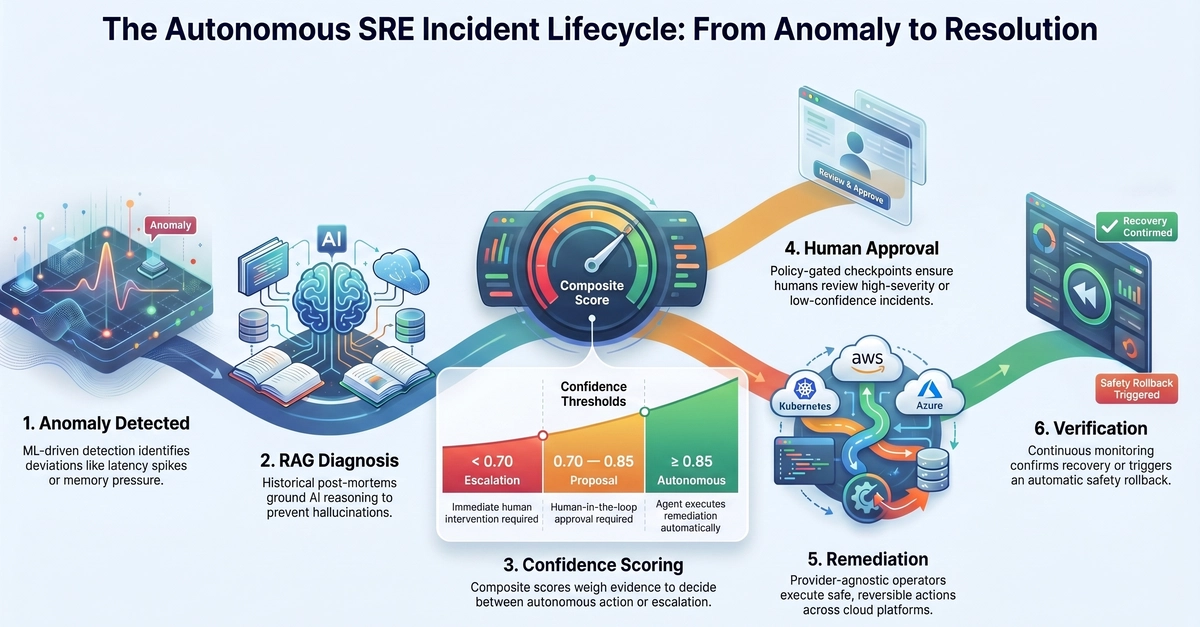
Every platform team eventually asks the same question: can we let something automatically fix production when it breaks? The instinct to say yes is understandable incidents at 3 a.m. are expensive, and a lot of Kubernetes failures follow recognizable patterns. But fully autonomous remediation has a bad failure mode: when the agent is wrong, it's wrong fast, and it's wrong at scale.
AIOps agents for Kubernetes solve this by splitting the problem in two: let the agent do the work of detection, correlation, and proposal the parts humans are slow and inconsistent at and keep a human as the final decision-maker for anything with real consequences. This is the human-in-the-loop (HITL) model, and on Google Cloud it maps cleanly onto existing primitives: GKE for the runtime, Cloud Monitoring/Logging for signal, IAM and Kubernetes RBAC for guardrails, and Vertex AI or a self-hosted model for the reasoning layer.
What the Agent Actually Does
Strip away the buzzwords and an AIOps agent for Kubernetes does four things on a loop: