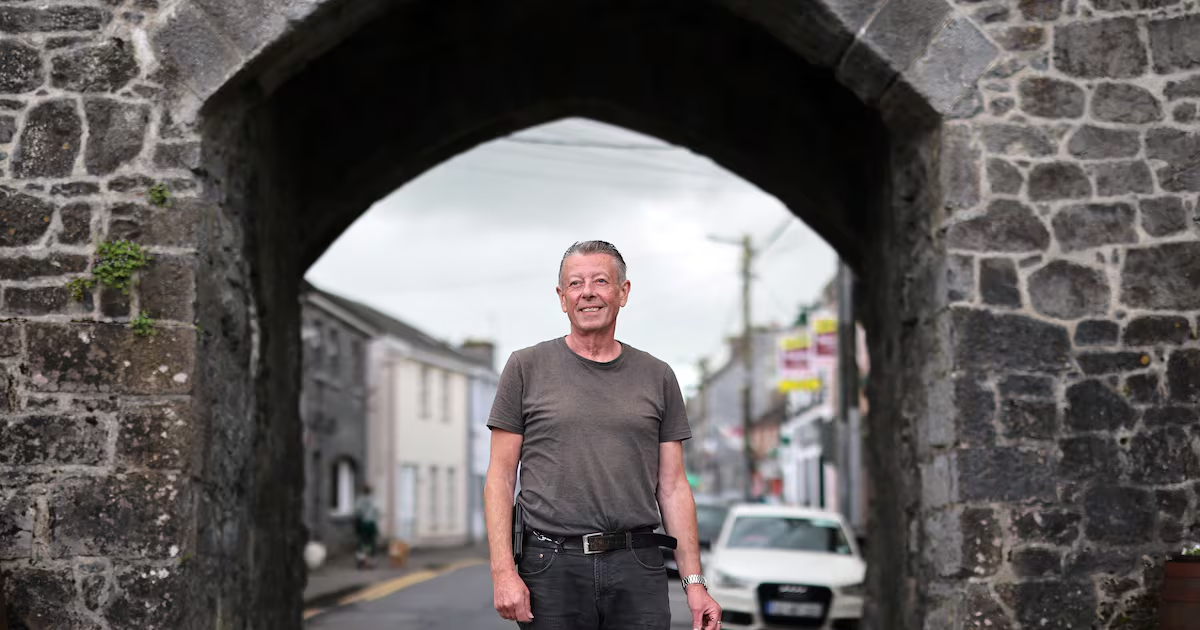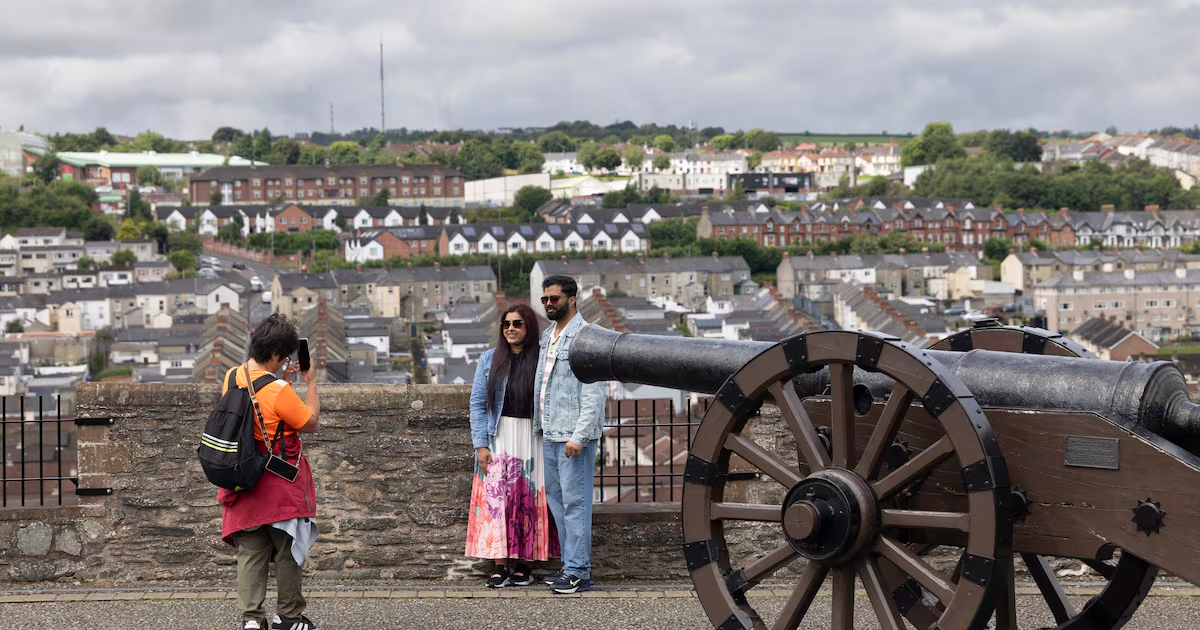
Garvin Kerr loves to be on Derry’s walls first thing in the morning. His favourite spot is the double bastion, where cannons jut out from the fortifications’ southwest corner; Kerr stretches his arm wide to demonstrate a view which seems to take in the entire city, from the Bogside below to the Donegal hills beyond. “When you’re up here in the morning, you’re away on your own,” he says. “It’s the quiet. You can reflect and just take a breath. “I look up to Creggan, where I was born, and I think of my parents, and my wife who lived round the corner from me – we’re 49 years married now – and I think, this is my wee bit up here.“When I look out here now, this is my city,” he says. “I’ve been privileged to be born here, and I love it – love the people, love everything about it. “Just let us tell our story.” A former tour guide and now a city centre warden, Kerr has spent decades telling that story. His job is to walk the circuit of the walls, making sure they are clean and safe and checking for damage, as well as talking to any tourists who stop him. “I would give them a wee bit of the history, and they think this is fantastic. It’s like the taxi knowledge.” He taps the side of his head with his finger. “You have the knowledge in there, and you hold it.” [ The walled town of Wexford: ‘Some people said to us that it must be like living in a prison’Opens in new window ]He demonstrates, laughing at the suggestion the story might be reduced to a “potted” history. “They were built between 1613 and 1618, so took five years, and started with four gates in the shape of a cross with a diamond in the centre,” he begins. This was the plantation of Ulster; what is now Co Derry was granted to companies in the City of London – hence the name they gave their new city, Londonderry – to plant, as was the terminology of the time, with English and Scottish settlers. Those walls, built to protect them, have survived “400 years, four sieges, 50 years of Troubles, never breached, never broken”, says Kerr. Today, Derry’s walls are the only complete set remaining in Ireland; roughly 1.5km in circumference and between 3m and 10m wide, it is the only place where it is possible to walk an entire circuit of the walls. “It’s a thoroughfare through the city, so you have locals using it. If you want to go from the bus depot up to the shopping centre, you walk the walls,” says Derry Walls manager Aisling Gallagher. Derry Walls manager Aisling Gallagher and city centre warden Garvin Kerr. Photograph: Joe Dunne Derry which boasts the only complete set of walls remaining on the island. Photograph: Joe Dunne “We also have these large groups of tourists coming on, and they always say how well they look. They’re astonished they’re the most intact walls in Ireland.”It is something local people are not only proud of, but keen to share, as Mike and Sue Corcoran from Reading have already found out. “Oh, we know, people keep telling us,” says Sue Corcoran.Such is the place of the walls in the city’s heart; they are not simply part of its geography, or built heritage, or its history, but also its identity, in all its complexities. They played a key role in the creation of the Ulster Protestant identity, crystallised by the siege of Derry in 1688-89, when 13 young apprentices shut the city’s gates against the approaching army of the Catholic English king James II. This would lead, the following year, to the Battle of the Boyne; in Derry, the big date in the parading calendar is not the “Twelfth” of July, marked by the Orange Order, but the Apprentice Boys’ march today. Their Memorial Hall stands facing the walls, overlooking the Bogside; high mesh fencing stretching above the parapet of the walls, to protect it from attack, hints at more recent history.Odhran Dunne, chief executive of Visit Derry. Photograph: Joe Dunne The Apprentice Boys of Derry marching in 2021. Photograph: Charles McQuillan/Getty Images “The walls didn’t open to the public until the early to mid-90s,” says Odhran Dunne, chief executive of Visit Derry. “I grew up just overlooking here, and there were artillery posts and army barracks on these walls. During the Troubles, it was really about the British army. It was their site.”From our vantage point on the double bastion, the story of conflict unfolds beneath us. The murals in the Bogside, now a busy tourist attraction in their own right, tell the nationalist story from the civil rights movement to Bloody Sunday and the hunger strikes. “I was struck by this, because I have seen this view on the telly, such a sad view, all through the 80s,” says Nicola Kelly from Kilmore, Co Wexford. “We met some foreign visitors, and I thought they’d have no idea [about the past], they’re just enjoying it, which is lovely.” “It’s absolutely beautiful,” adds her husband Peter. “The wall is gorgeous. We’ve been to York, it’s a lovely city as well, with the wall, but this is every bit as nice. It’s a city to be proud of.”A short walk away, the red, white and blue bunting indicates the Fountain, a tiny enclave nestled beneath the walls and the only remaining Protestant area on the overwhelmingly Catholic west bank of the Foyle. Tourists Peter and Nicola Kelly from Kilmore in Co Wexford. Photograph: Joe Dunne Derry's walls from the Bogside. Photograph: Joe Dunne “The walls are a microcosm of British and Irish history in one place,” says Dunne. “You look down into the Bogside, and you think of our contemporary story and the Troubles story, but then you also look at the British story, which sits overlooking that. “I think that’s the significance for visitors who come here. They can’t believe how close, in reality, all of that is, and how over the years they’ve had to learn to work together and integrate together, sit alongside one another and try and accept one another’s cultures.” “We didn’t know about the walls before we came here,” say Imma Lloansi and Mario Manzano, from Barcelona. They were interested in the Troubles story – “it’s something we have seen since we were small, on the news” – not least because, as Catalans, they believe there are similar issues: “about independence, about a referendum”.So too for Paul Lyant and Liliane Mondini, from Lyons, who wanted to visit Derry because it was “a story we’ve heard about, and seen on the television”. After the walls, they plan to visit the murals and two museums – the Siege Museum, in the Memorial Hall, and the Museum of Free Derry, in the Bogside – “so that we will understand [the history] a bit better”. “I love the walk around the walls,” says Tee Poh Suan, from Malaysia. “It made me think of other walled cities like York or in China. The walls are a must-see.”Tourist Tee Poh Suan from Malaysia. Photograpg: Joe Dunne Tourists Imma Lloansi and Mario Manzano from Barcelona in Spain. Photograph: Joe Dunne “It’s an old city, a fantastic old city, and so much history behind it,” says Mervyn Mills from Larne, visiting with his cousin Pauline Robinson and friend Linda Reid, from Queensland, Australia. “We heard so much about it, we had to come and have a look,” says Robinson. “I didn’t actually think it would be this wide and I didn’t actually know you could walk around it.” Dunne says: “Our walls are unique – they’re one of the finest examples, probably in the whole of western Europe, of walled cities, and many people have travelled to Carcassonne, Dubrovnik, York – but they’re also a little bit unknown.” From a tourism point of view, “it’s just a great asset to have, because you’re always looking to stand out. It’s not that long ago I remember locals would have been asking tourists, why are you coming here for your holidays? That is fully transformed now, because I think the place believes in itself.” Tourism now supports “over 5,000 jobs and generated £94 million [€110 million] to the local economy last year”, he says. Official figures show overnight stays increased by 34 per cent in 2025, significantly above the Northern Ireland average of 9 per cent. The walls are at the heart of this, the focal point of everything from the city’s famous Halloween festival, which celebrates its 40th anniversary next year, to the new generation of fans created by the hit Channel 4 comedy Derry Girls. “The walls are a big feature of that,” says Dunne. “They [the characters] were Irish dancing on the walls.”Behind the scenes, work is always under way to ensure the walls’ future – to protect and conserve them, as befits a historical monument, but also to open them up further. Access to the walls from Stable Lane, closed during the Troubles because of a British army base on the site, was restored only five years ago, while outside Bishop’s Gate – which sits between the Fountain and the nationalist Bishop Street area – a cross-community peacebuilding project outlines how the gate in the “dog leg” – a passageway which “allows the concealed movement from one side of an interface to the other” – recently opened after 40 years. “It’s like the walls themselves,” says Gallagher. “The evolution of it all is the best thing for me.” “They’re the people’s walls, they’re everybody’s walls,” adds Kerr. “We learn to share, and that’s what takes you forward, with the peace process, not only to respect each other’s religions and opinions, but to share them too.” How Ireland’s walled towns came to bePart of the town wall at Robert Brennan Memorial Park, Abbey Street, Wexford. Photograph: (Nick Bradshaw) By Eimear O’ConnellIrish walled towns are towns that have, or had, defensive walls. In Ireland, the earliest examples of these are associated with Viking or Hiberno-Norse settlements. Later, the Anglo-Norman conquest of Ireland brought with it a wave of town-building, starting in the southeast and expanding outwards.The new Anglo-Norman towns were often built at or near existing monastic settlements or on the site of conquered Gaelic strongholds, and the majority of them were walled. This was as a defensive measure, to protect the town’s inhabitants from attack, but also as a means of controlling the trade of goods into and out of the town. Taxes and tariffs were applied at the town gates. The earliest town ‘walls’ in Ireland were a combination of earthen ditches and timber palisade fences. By the 13th and 14th centuries these had mostly been replaced by stone walls, often with towers and wall walks and usually with several gates, giving access to the town from different directions. Today it is largely the stone walls, or remnants of them, that survive. The towns featured in this series are all members of the Irish Walled Towns Network. The network was founded by the Heritage Council in 2005 and is delivered in partnership with local authorities and community groups in 33 member towns across the island. The network supports the conservation of town walls and the regeneration of town centres in its member towns by providing training, funding and a forum for knowledge exchange. Eimear O’Connell is built heritage officer and Irish Walled Towns Network programme manager at the Heritage CouncilNext week, part three: Athenry
Ireland’s walled towns: ‘Our city’s walls are unique, probably the best in western Europe, but also unknown’
In the second of a four-part series on Ireland’s walled towns, we visit Derry which boasts the only complete set of walls remaining on the island
1,928 words~9 min read