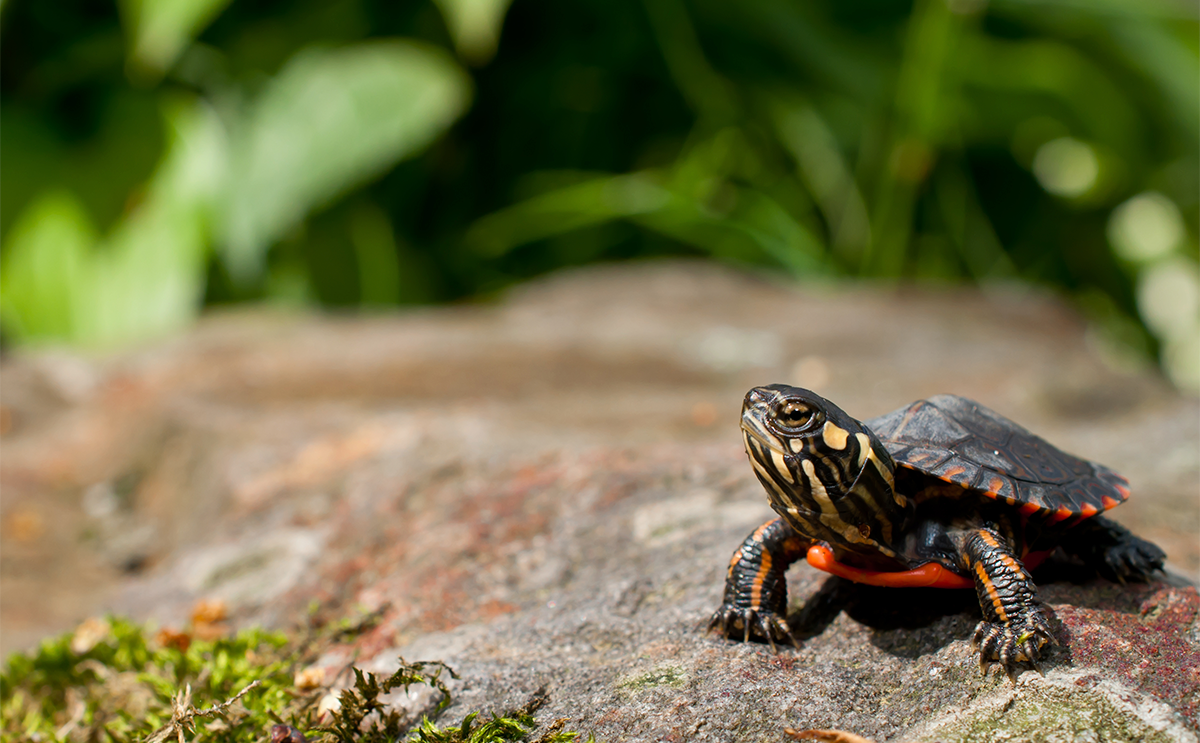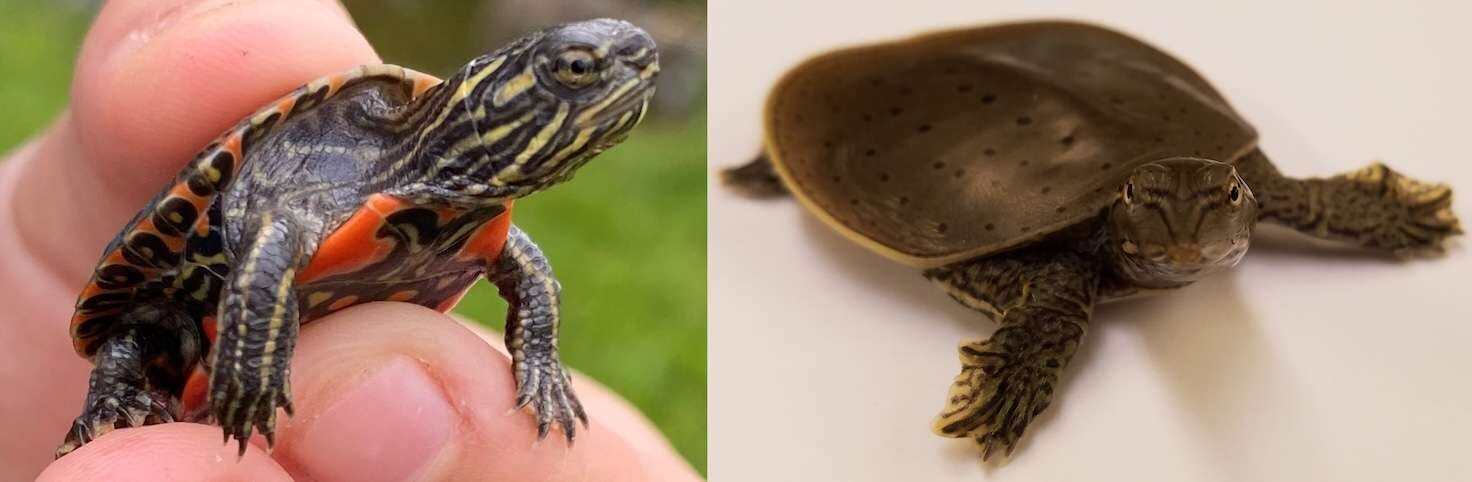
A painted turtle hatchling at the Iowa State University Horticulture Research Station is on the left. The grayish hatchling on the right is a spiny softshell turtle in Nicole Valenzuela's laboratory. Photos by Colin Schuller and Nicole Valenzuela/Iowa State University.
When most baby turtles hatch, their sex depends on the temperature of the sand or soil where their mother laid her eggs. Warm incubation produces females, while cool nests produce males.
Based on a new study led by an Iowa State University evolutionary biologist, a once-ignored cell component—primary cilia, antenna-like protrusions on most types of animal cells—may help turtle embryos detect that sex-deciding warmth. It's the first time that turtle sex determination has been linked to primary cilia, but the cellular sensors are a growing focus of human health research because they are now recognized as important for development and disease. That heightens interest in Nicole Valenzuela's research team. The study is published in the journal PLOS One.
"We have concluded we need to open a whole new research avenue to characterize primary cilia in turtles and see how they're composed, what they are doing, and how they are changing and responding to temperature and other cell signals. It's basic science that's also biomedical science," said Valenzuela, professor of ecology, evolution and organismal biology at Iowa State.