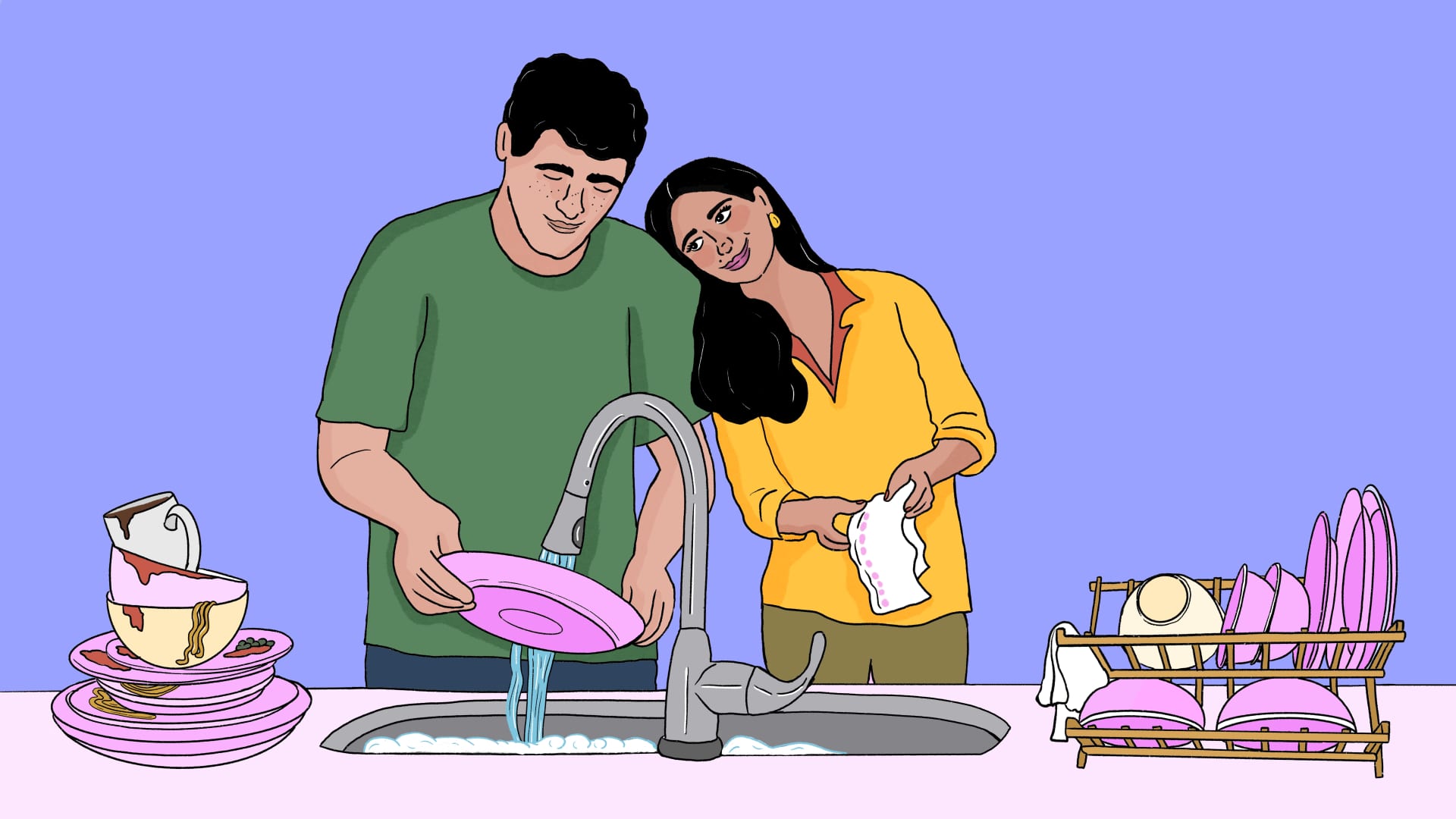
Commitment shows up more reliably in three ordinary behaviors than in anything a partner says out loud.gettyAsking a partner directly whether they’d choose you again produces almost no usable information. The question arrives with an obvious right answer attached, usually in a moment already loaded with feeling, and people are generally motivated to give reassurance when reassurance is being requested. What you learn is that your partner doesn’t want to hurt you — which is sweet, but isn’t what you asked.There’s a better source of data, and it’s already available. Researchers tend to treat commitment not as a stored decision but as something maintained through ongoing behavior: how partners allocate attention, how they interpret each other’s motives, how they describe the relationship to themselves and others. These processes run continuously and largely outside deliberate control, which makes them harder to fake than a verbal answer. Three of them are observable without much effort.Sign 1: They Still Ask You Questions They Don’t Know The Answer ToCuriosity in relationships is usually described as a nice-to-have. But it’s closer to a structural feature.The self-expansion model holds that people are drawn to relationships that enlarge their sense of self — new perspectives, capabilities and experiences absorbed through a partner, a 2025 review published in Social and Personality Psychology Compass found. The model also explains a common trajectory: as partners come to feel fully known to each other, the rate of expansion slows, and the relationship stops supplying something it supplied easily at the start. Research in this tradition consistently associates shared novelty and sustained interest with relationship satisfaction, and the effect appears to run through this mechanism rather than through time spent together.Practically, the marker isn’t intense interest. It’s whether a partner still treats your inner life as incompletely mapped: asking a follow-up question, registering that your position on something has changed, being mildly surprised by an answer. Continued questioning implies a working assumption that there is more to learn. Its absence usually signals the opposite assumption — not hostility, but a sense that the person has been sufficiently understood.Sign 2: They Speak Well Of You When You're Not In The RoomHow partners describe each other to third parties is one of the more diagnostic behaviors in the field, because it isn’t performed for the partner’s benefit.Work associated with the Gottman Institute on long-term couples finds that stable partners tend to narrate shared history charitably — difficult periods are recalled as jointly endured, and each other’s failures are contextualized rather than itemized. Distressed partners describing the same events tend to assign responsibility more sharply.The underlying construct is positive sentiment override: a general tendency to interpret a partner’s ambiguous behavior in benign terms. When it’s operating, lateness reads as a hard day; when it isn’t, the same lateness reads as evidence of indifference. This matters because most relational behavior is ambiguous. A partner’s default interpretation therefore shapes the entire record they accumulate about you, and that record is what any future decision would draw on. Someone speaking well of you privately is, functionally, someone whose accumulated record is favorable.Sign 3: They Choose You In The Unremarkable MomentsGottman’s research on “bids for connection” examines small, low-stakes attempts to get a partner’s attention — a comment about something on the news, a request to look at something, an invitation to go for a walk. What predicted stability wasn’t conflict style but the rate at which partners turned toward these bids rather than away from them.The reason such minor exchanges carry weight is that they’re where responsiveness gets demonstrated repeatedly and cheaply. Perceived partner responsiveness — the sense that someone understands, values and attends to you — is among the better-supported predictors of relationship quality. A 2026 study published in the Journal of Social and Personal Relationships found that it’s specifically what explains why a good day tends to translate into a more satisfying marriage — the daily mechanism, not just the general association. A partner who consistently looks up is repeatedly confirming that your attention is worth reciprocating.Nuance is warranted here. Missing bids is not by itself meaningful; illness, work strain, and depression all reduce responsive capacity without indicating anything about commitment. The relevant unit is the pattern over months.What These 3 Signs ShareEach behavior reflects the same underlying allocation: a partner treating your inner life as worth their limited attention. Curiosity allocates it prospectively, charitable interpretation allocates it retrospectively, and responsiveness allocates it in real time.On the flipside, reduced curiosity, sharper attributions and unanswered bids usually indicate drift rather than a conclusion reached about you — and drift is largely a function of attentional load, which changes. Most of these processes are also bidirectional: partners who receive responsiveness tend to produce more of it, which is why the pattern is often easier to shift than it looks.The more useful reframe is that being chosen again isn’t a verdict waiting to be discovered. It’s a set of ongoing behaviors, some of which you’re in a position to influence.Looking for a sign if your relationship is more than just stable — if it’s actually thriving? Find out with this science-inspired test: Thriving Relationship Test
3 Signs Your Partner Would Choose You Again, By A Psychologist
A psychologist outlines three subtle, everyday signs that reveal whether your partner would still choose you again — signals stronger than any promise.
856 words~4 min read