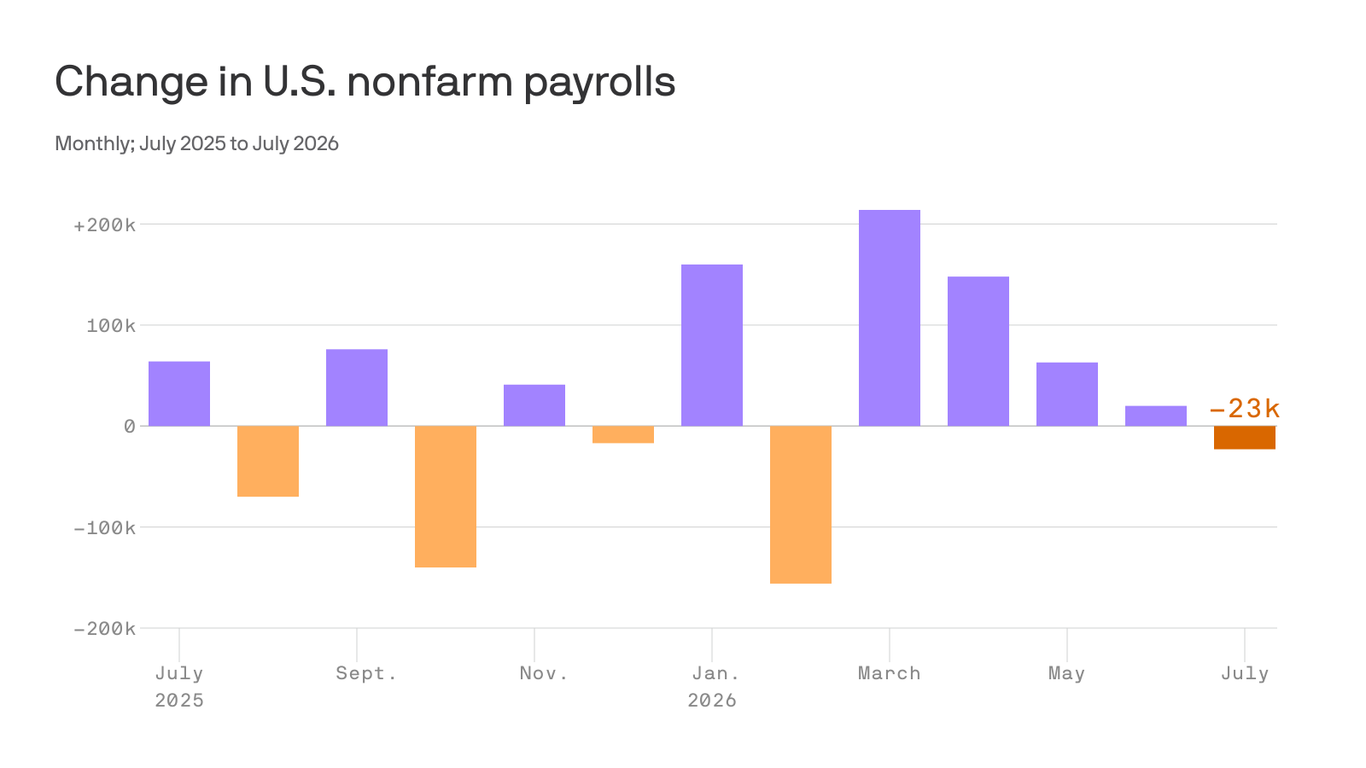
America's employers unexpectedly shed 23,000 jobs in July, while the unemployment rate ticked down to 4.1%, the government said on Friday.Why it matters: The report shows the first job decline since February alongside steep downward revisions to previous months' data — hinting at bigger cracks in the labor market than previously known.Economists anticipated a gain of 87,000 jobs in July.Friction point: The Labor Department said that employment in May and June was a combined 103,000 lower than initially estimated.Zoom in: The key factor of the surprising job loss in July was local education, which is susceptible to distortions from the seasonal adjustment process. The sector shed 50,000 jobs last month.Others pulled back on hiring too. Retail trade — including warehouses and other merchandise retailers — shed 19,000 jobs. Insurance firms and others related financial sector firms shed 14,000 jobs. Health care, which has powered jobs growth in recent years, saw employment increase by 22,000 last month. That was a slightly slower pace of jobs growth than the average monthly gain of 36,000 seen over the past year.What to watch: The July jobs report lands as many Fed officials have said they are more concerned about the outlook for inflation than the outlook for employment.Policymakers are watching for signs of labor market cooling — including evidence that AI is contributing to slower hiring — but many say they do not see evidence of the kind of broad-based deterioration in hiring that would outweigh their concerns about inflation."The economy appears to be performing well with the notable exception of inflation .... With the labor market in balance and growth resilient, my primary concern is inflation," Kansas City Fed president Jeff Schmid said in a speech this week.Yes, but: Financial markets pared back bets of a rate hike in September after the weaker-than-expected jobs report.Before the data release, traders saw a rate hike as slightly more likely than not. Now that bet has flipped and futures markets are assigning a 44% probability to a September hike, according to CME Fedwatch. The bottom line: For months it looked like the American labor market was holding strong in the face of huge geopolitical shocks and uncertainty. The big revisions suggest the labor market might be on weaker footing than previously believed, even if much of July's weakness comes down to a seasonal quirk from the local government.
U.S. economy surprisingly lost 23,000 jobs in July
The report shows the first job decline since February, while the unemployment rate ticked down to 4.1%.
392 words~2 min read