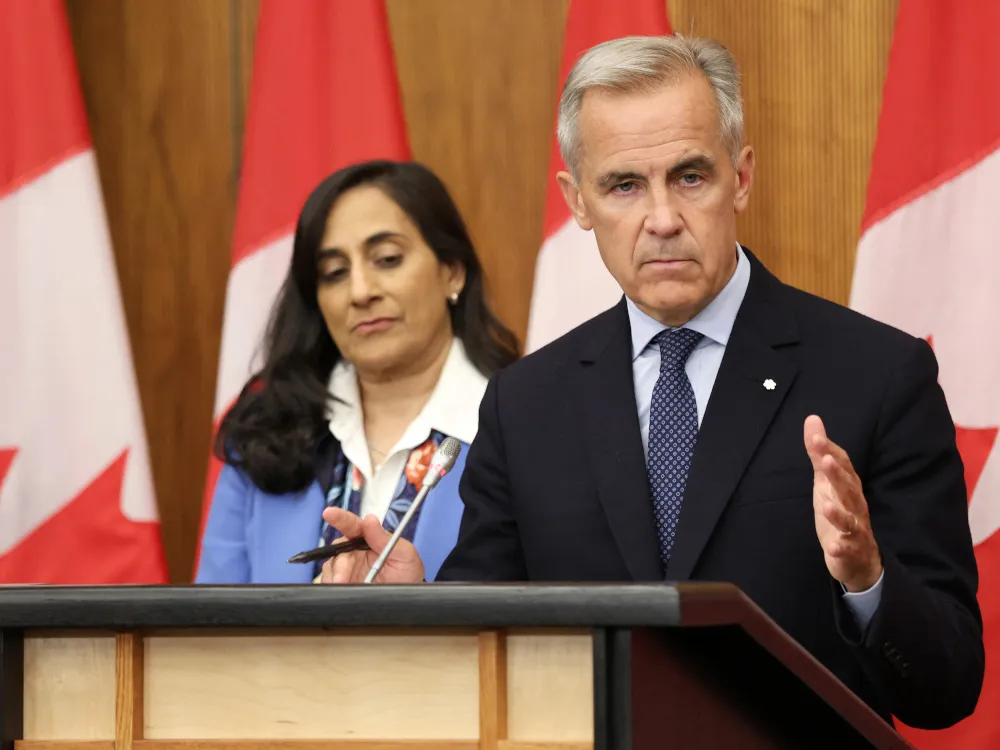
Skip to Content Subscribe Our Offers My Account Manage My Subscriptions FAQ Newsletters Canada Canadian True Crime Canadian Politics Health World Israel & Middle East Financial Post NP Comment Longreads Puzzmo Diversions Comics NP News Quiz New York Times Crossword Horoscopes Life Eating & Drinking Style Sponsored Play for Ontario Travel Travel Canada Travel USA Travel International Cruises Travel Essentials Culture Books Celebrity Movies Music Theatre Television Business Essentials Advice Lives Told Tails Told Shopping Buy Canadian Home Living Outdoor Living Kitchen & Dining Tech Style & Beauty Personal Care Entertainment & Hobbies Gift Guide Travel Guide Amazon Prime Day Deals Savings National Post Store More Sports Hockey Baseball Basketball Football Soccer Golf Tennis Driving Vehicle Research Reviews News Gear Guide Obituaries Place an Obituary Place an In Memoriam Classifieds Place an Ad Celebrations Working Business Ads Archives Healthing Epaper Manage Print Subscription Profile Settings My Subscriptions Saved Articles My Offers Newsletters Customer Service FAQ Newsletters Canada World Financial Post NP Comment Longreads Puzzmo Diversions Life Shopping Epaper Manage Print Subscription HomeNP CommentMatthew Taub: A year later, what happened to Carney's conditions for recognizing Palestine?Conditions that do not have to be met are not conditions. They are political coverLast updated 34 minutes ago You can save this article by registering for free here. Or sign-in if you have an account.Foreign Affairs Minister Anita Anand listens as Prime Minister Mark Carney announces that Canada will recognize a State of Palestine in September, providing the Palestinian Authority makes significant reforms and holds an election in 2026. Photo by Dave Chan / AFPGlobal Affairs Canada was asked to identify the conditions governing one of Canada’s most consequential foreign-policy decisions in decades. Did Ottawa establish benchmarks before recognizing Palestine? Which had been met? Was there a monitoring process, and what consequences would follow if the remaining commitments failed?Enjoy the latest local, national and international news.Exclusive articles by Conrad Black, Barbara Kay and others. Plus, special edition NP Platformed and First Reading newsletters and virtual events.Unlimited online access to National Post.National Post ePaper, an electronic replica of the print edition to view on any device, share and comment on.Daily puzzles including the New York Times Crossword.Support local journalism.Enjoy the latest local, national and international news.Exclusive articles by Conrad Black, Barbara Kay and others. Plus, special edition NP Platformed and First Reading newsletters and virtual events.Unlimited online access to National Post.National Post ePaper, an electronic replica of the print edition to view on any device, share and comment on.Daily puzzles including the New York Times Crossword.Support local journalism.Create an account or sign in to continue with your reading experience.Access articles from across Canada with one account.Share your thoughts and join the conversation in the comments.Enjoy additional articles per month.Get email updates from your favourite authors.Create an account or sign in to continue with your reading experience.Access articles from across Canada with one accountShare your thoughts and join the conversation in the commentsEnjoy additional articles per monthGet email updates from your favourite authorsSign In or Create an AccountorIt could not name one, I know because I emailed them to ask.Instead, the department exposed a contradiction between what Prime Minister Mark Carney told Canadians one year ago and how his government now explains its decision. On July 30, 2025, Carney said recognition was “predicated” on commitments from Palestinian Authority President Mahmoud Abbas to fundamentally reform Palestinian governance, hold general elections in 2026 in which Hamas could play no part and demilitarize the Palestinian state.The National Post newsletter that doesn’t hold back, giving readers the unvarnished truth on media, politics and culture.By signing up, you consent to receive the above newsletter from Postmedia Network Inc.A welcome email is on its way. If you don't see it, please check your junk folder.The next issue of Right? will soon be in your inbox.We encountered an issue signing you up. Please try againThis week, Global Affairs used different language in its response: “Canada’s recognition decision was based on the Palestinian Authority’s commitment to reforms.” This distinction matters.What Global Affairs now appears to be suggesting is that recognition was not based on completed reforms, elections, Hamas’s exclusion or demilitarization. It was based on a commitment to pursue them.That is the difference between a condition and a promise.Global Affairs also said the possibility of achieving two states through negotiation had been “gravely eroded” by Hamas terrorism culminating in the Oct. 7 massacre, Israeli settlement construction, settler violence, proposed annexation measures and the humanitarian crisis in Gaza.“It is in this context that Canada recognized the State of Palestine,” the department said.That explanation raises an unavoidable question: did Canada, in effect, reward the strategy Hamas began on October 7?Hamas murdered approximately 1,200 people, took hundreds hostage and triggered a devastating war. That war further transformed the diplomatic landscape, and Canada then concluded that recognition was necessary to preserve Palestinian statehood.When Canada formally recognized Palestine on Sept. 21, 2025, Carney insisted it was “in no way” a reward for terrorism. But intentions do not erase incentives.According to Global Affairs’ own explanation, Hamas’s terrorism helped destroy the previous diplomatic approach. That destruction created urgency, and Canada responded by granting recognition before Hamas disarmed and before the Palestinian leadership completed its promised reforms.Hamas does not need to govern a future state to claim its violence produced a result. It needs only to point to the sequence: diplomatic stalemate, October 7, war, international pressure and recognition.Canada waited just 53 days between announcing its intention and formally recognizing Palestine. Carney said “progress has already been made,” but did not identify that progress or the threshold it satisfied. Global Affairs has now declined to confirm whether benchmarks, assessments, timelines, monitoring or consequences ever existed.Instead, it listed “steps” toward a social-welfare system, the “development” of educational materials, the “drafting” of an interim constitution, local elections and an “intent” to hold further elections. Every description refers to something minimal, unfinished, local or still in the future. Developing educational materials says nothing about their content. A constitution still being drafted is not constitutional reform. An intention to hold an election is not an election.The April 25 vote was not the general election Carney promised. It selected municipal and village councils responsible for local services, not a president, national legislature or government.It was also geographically limited. Elections throughout Gaza were postponed except in Deir al-Balah, where turnout was approximately 23 per cent, and the West Bank where it was 56 per cent. The Associated Press described the vote in Deir al-Balah as a largely symbolic “pilot” election.Across the West Bank and Deir al-Balah, contested polling occurred in 183 of 420 local authorities. Another 197 councils were decided by acclamation, while 40 lacked enough candidates and were to have members appointed.These elections did not renew Abbas’s mandate, elect a national government or test whether Hamas would be excluded from national political power. They cannot substitute for the general elections Carney described.Global Affairs also cited an intention to hold Palestinian National Council elections on November 1, 2026. Separately, Palestinian Legislative Council elections are scheduled for November 28, 2026. Neither has happened, and Global Affairs did not explain whether one or both would satisfy Carney’s promise of “general elections in 2026.”Scheduled elections are especially unconvincing under a leadership with a history of cancelling them. Abbas scheduled parliamentary and presidential votes in 2021 before postponing both. Presidential elections are now expected in 2027. Abbas was elected in 2005 for a four-year term, but no presidential election has been held since.Nor has Carney’s assurance that Hamas could play no part been tested. Hamas may be formally excluded from the ballot, but it could still exert influence through affiliated candidates, allied factions, intimidation or its continuing armed power. Canada cannot know whether Hamas has genuinely been excluded until candidates are registered, ballots are cast, results are respected, and power is transferred. Yet recognition came first.Then there is demilitarization. Hamas remains armed.Global Affairs told me in their email response that they welcomed “the proposed agreement on the disarmament of Hamas and other armed groups in Gaza that was announced on July 30, which if accepted and implemented by all parties, could mark an important step towards peace and security.”A proposal is not disarmament, and an arrangement announced in 2026 cannot retroactively justify recognition granted in 2025. A report from Reuters last week suggests there are unresolved disagreements over implementation and the handling of different weapons.Carney did not say Hamas should discuss surrendering some heavy weapons. He said Hamas must disarm and the Palestinian state must be demilitarized. Retaining other weapons, fighters, tunnels or an independent command structure would not satisfy that commitment. One year later, Hamas remains armed.The final commitment was that Abbas would “fundamentally reform” Palestinian governance. Global Affairs’ response establishes only that the Palestinian Authority has started or announced several processes. Constitutional work remains unfinished, national elections have not occurred and Abbas remains president more than two decades after his election.If Canada concluded that fundamental reform had occurred, it should identify the standard and demonstrate how it was met. If merely promising or beginning reform was enough, Carney should not have presented fundamental reform as a predicate. Abbas had already made those promises on July 30, so what was Canada assessing during the 53 days before recognition? Global Affairs will not say.Recognition was one of Canada’s principal pieces of diplomatic leverage. It could have been withheld until elections occurred, Hamas was demonstrably excluded, governance reforms reached an identifiable threshold and armed factions surrendered their weapons. Instead, Canada spent that leverage while every major outcome remained unresolved.What happens if the elections are postponed, Hamas retains power, demilitarization fails or reform remains unfinished? Global Affairs identified no consequence. Canada has already recognized the state. It cannot offer recognition again.One year ago, Canadians were told recognition was predicated on elections in which Hamas could play no part, fundamental governance reform and a demilitarized Palestinian state. Today, neither full general nor parliamentary or presidential elections have yet occurred, Hamas’s exclusion has not been tested, Hamas remains armed and fundamental reform has not been demonstrated. Canada’s recognition, meanwhile, is complete.One year later, Ottawa has still not demonstrated that Carney’s predicates were ever genuine conditions. Canada granted recognition first and left elections, reform and demilitarization for later. Conditions that do not have to be met are not conditions. They are political cover.National PostMatthew Taub is the founder and executive director of Unapologetically Jewish, a national organization fighting antisemitism in Canada. Join the Conversation This website uses cookies to personalize your content (including ads), and allows us to analyze our traffic. Read more about cookies here. By continuing to use our site, you agree to our Terms of Use and Privacy Policy.
Matthew Taub: A year later, what happened to Carney's conditions for recognizing Palestine?
Conditions that do not have to be met are not conditions. They are political cover
1,774 words~8 min read