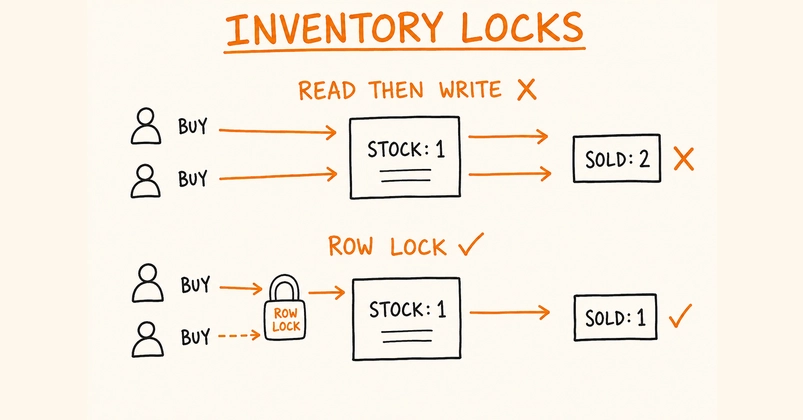
Two customers are looking at the same product. One unit left. Within the same second, both click Pay. If your checkout reads the stock count, decides there's enough, and then writes the decrement, both requests pass the check and both succeed. You've now sold two units of something you had one of.
That's overselling, and it's not a rare edge case — it's the default behaviour of any checkout that treats "check stock" and "reduce stock" as two separate steps. The window is small, but on a product that's nearly sold out, or during a launch when everyone hits the same SKU at once, small windows fire constantly.
I've built the order pipeline for two production e-commerce platforms — pikkuna.fi and pi-pi.ee — where concurrent webhooks and concurrent checkouts hit the same order and product rows. This is the layer I reach for when a store sells finite stock. I covered the bare SELECT ... FOR UPDATE primitive briefly in PostgreSQL Production Patterns; this article is the whole system built on top of it — reservations, multi-line carts, the payment window, and the parts that actually bite you in production.
When You Don't Need Any of This
Start with the honest disclaimer, because it decides everything downstream.
 shopify.engineering