Friday 07 August 2026 5:15 am
| Updated:
Thursday 06 August 2026 11:25 am
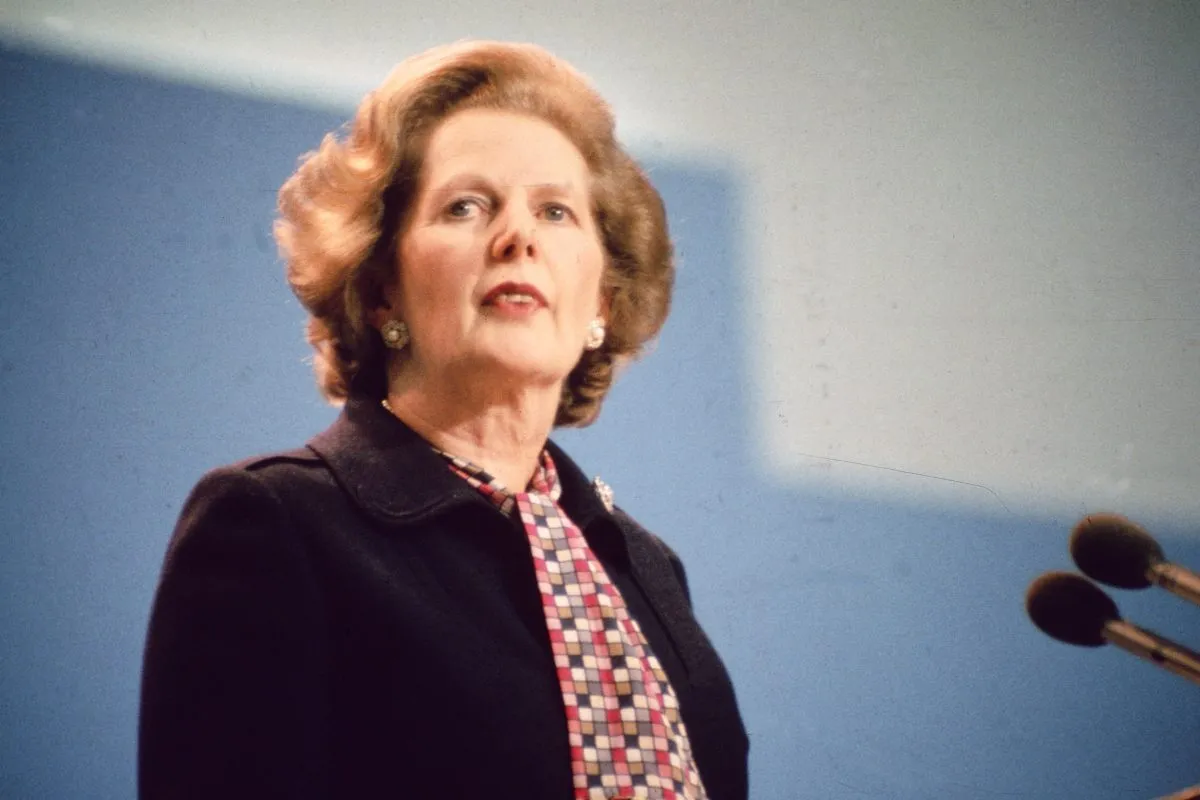
13th October 1984: British Conservative prime minister Margaret Hilda Thatcher, addressing the Tory Party Conference in Brighton, following the bombing of The Grand Hotel, where many delegates were staying. (Photo by Hulton Archive/Getty Images)
Margaret Thatcher remains a bogeyman for Andy Burnham and the British left despite having left Downing Street 35 years ago, but their critiques are wide of the mark, says Emma RevellEveryone has someone or something they blame when things get tough. Astrology girlies use the position of Mercury to absolve themselves of any responsibility for what might be going wrong in their lives. The more traditionally superstitious among us might blame stepping on a crack in the pavement or walking under a ladder for their bad luck. I usually blame hormones or men, sometimes both. But for the British left, their bogeyman is Margaret Thatcher.No matter that she first came to power half a century ago, or left Downing Street over 35 years ago. No matter that the Labour Party itself had over a decade in power in the interim, with Andy Burnham present and in a senior position for some of that time.None of that stopped him reaching immediately for familiar tropes once it was clear he would be the next occupant of Number 10. Britain, he told us, took “a series of wrong turns” in the 1980s. Political power was centralised, economic power privatised, and the country has been paying for it ever since. According to our new Prime Minister, Britain has had 40 years of neoliberalism that “didn’t work for most working people”.It is a powerful argument. It is also, on the evidence, entirely incorrect. The reality is the exact opposite.It’s worth reminding ourselves of what Thatcher inherited when she became Prime Minister. By 1979 Britain was the sick man of Europe in more than rhetoric: humbled by an IMF bailout in 1976, paralysed by the Winter of Discontent, and losing more working days to strike action than any of our neighbours. The post-war settlement Burnham is seeking to bring back to Britain may have been the height of union power but it was not an age of secure industry. It was a slow-motion bankruptcy, propped up by subsidy and paid for by the working population.Deindustrialisation and public ownership are where critics of Thatcher often focus. It’s an area Reform have found futile electoral ground and one where Burnham likely hopes to reclaim some voters, bashing policies from a generation ago and promising a land of milk and honey where the state owns services, runs them impeccably, and provides jobs for regions long ago branded ‘left-behind’.But the decline of heavy industry in the 1970s and 80s was a structural shift that hit every advanced economy – a consequence of technology, global competition and rising wages, not a policy invented in Downing Street. What Thatcher did was stop turning a blind eye to it. She ended the ruinous habit of pouring taxpayers’ money into loss-making, badly run industries that drained resources from everything more productive. That was painful, and you may readily critique her governments and those that followed for not foreseeing the impact on communities where the sole employer folded. But the alternative was not thriving factories or pits. It was a subsidised decline for which future generations would pick up the tab.Transforming BritainThe positive outcomes however, were transformative for Britain. Our manufacturing productivity, the lowest in the G7 when Thatcher took office, became the highest. The economy pivoted towards services and high-value industry, and gave us the remarkable success that is our booming financial services sector – London became a capital of global finance. Many of City AM’s readership will work for or perhaps founded businesses that generate significant chunks of our GDP and compete on the global stage because of reforms undertaken by Thatcher’s governments.Privatisation did not lead to a situation where companies exploit the public for profit. Burnham may have claimed that the water industry is “run predominantly in the private interest rather than the public interest…[its] an industry where the shareholders can never lose and the bill payers never win”. Privatisation led to consistently higher investment in water infrastructure, to the point where at times Britain was spending more money on it than any other European country. This is a feature, not a bug, of privatised industry – without having to compete for Treasury funding, they could secure funding to make the necessary long term investments. Where privatisation of water has faltered, it is because the regulator will not allow bills to rise even slightly to have water companies cover the cost of upgrades.