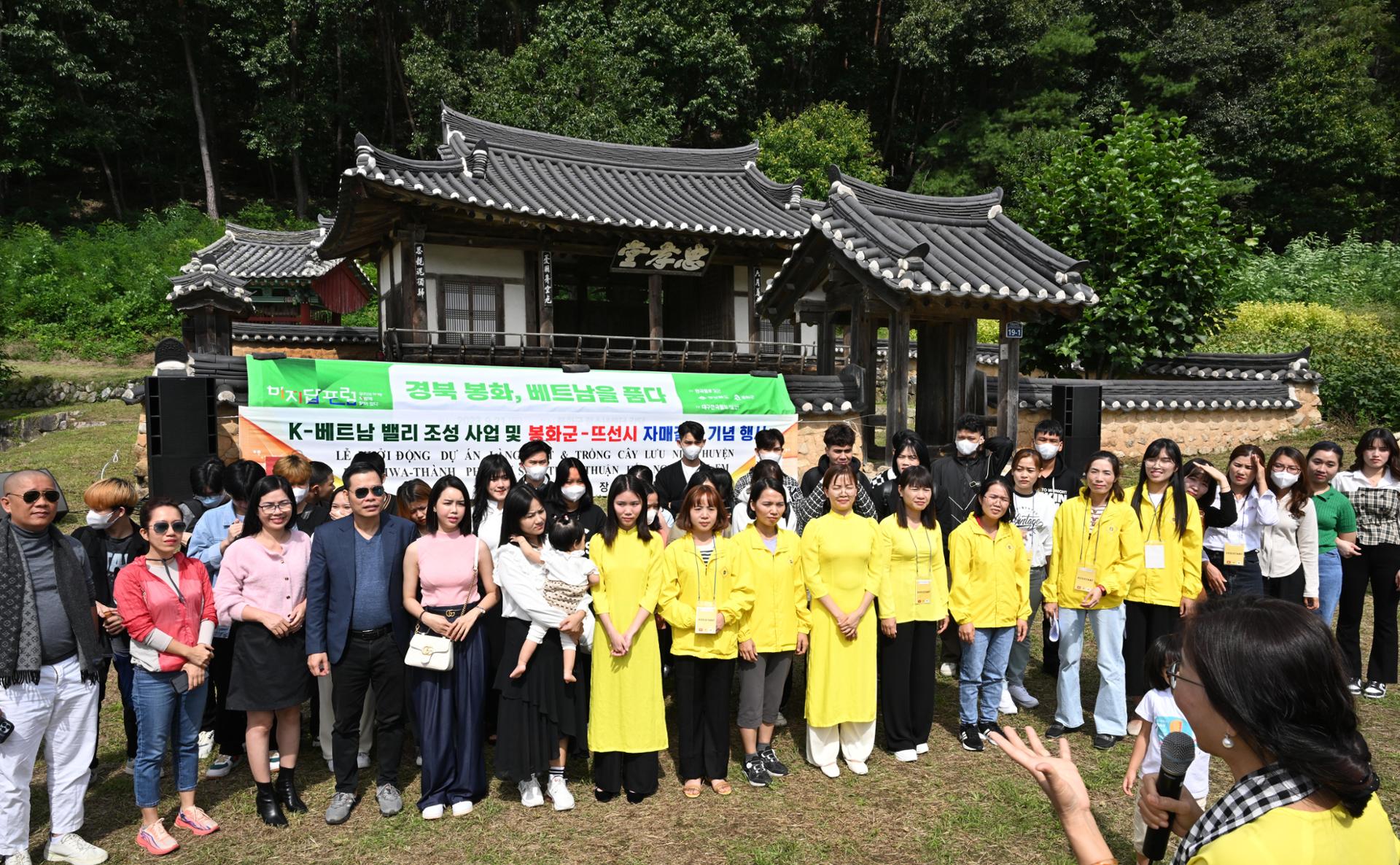
Vietnamese tourists and exchange students from Kyungnam College of Information and Technology pose at Chunghyodang in Bonghwa County, North Gyeongsang Province, Sept. 22, 2023. The historic pavilion is Korea's only heritage site connected to the Hwasan Lee clan, descendants of Vietnam's Ly Dynasty. It honors Lee Jang-bal, a 13th-generation descendant who died at age 19 fighting Japanese invaders during the 1592–98 Imjin War. Korea Times file
Bonghwa County, an isolated mountainous region in North Gyeongsang Province roughly 210 kilometers southeast of Seoul, has officially been named Korea’s newest Special Regional Development Zone in a major bid to deepen ties with Vietnam, government officials said Thursday.
The designation by the Ministry of SMEs and Startups approves the K-Vietnam Valley project, an ambitious $253 million (347.6 billion won) regional development program that leverages an extraordinary 800-year history of cross-border exchange. The initiative builds on the 13th-century arrival of Prince Lu Long Tuong of Vietnam’s Ly Dynasty, whose descendants, the Hwasan Lee clan, still reside in the rural county.
The unusual lineage traces back to 1226, when the prince fled royal purges in Vietnam by sea, eventually washing ashore on the Korean Peninsula during the Goryeo Kingdom. Granted asylum and land by King Gojong, the prince and his followers integrated into local society and helped defend the territory against Mongol invasions, establishing the Hwasan Lee clan. Today, Bonghwa houses Chunghyodang — a historic shrine honoring a 13th-generation descendant who died fighting in the 1592–98 Imjin War, the devastating conflict sparked by Japan's invasion of the Korean Peninsula — making the county the sole physical repository of this shared royal ancestry in Korea.