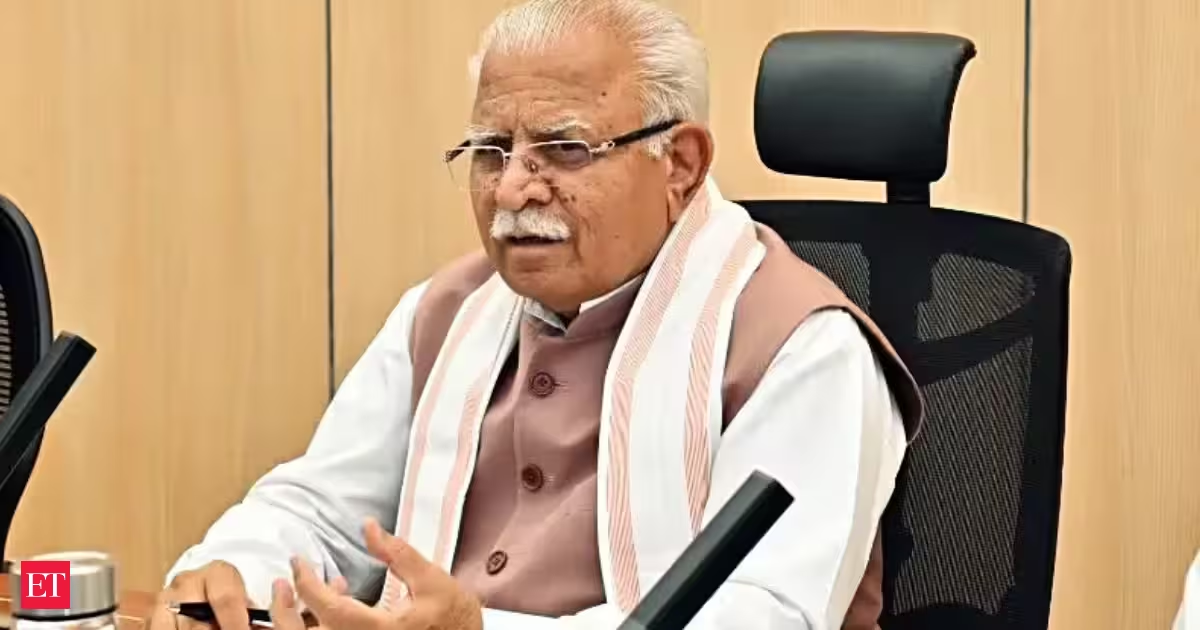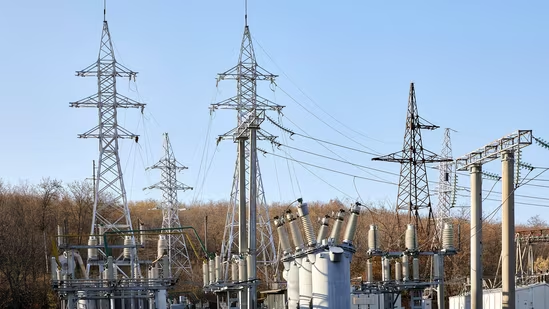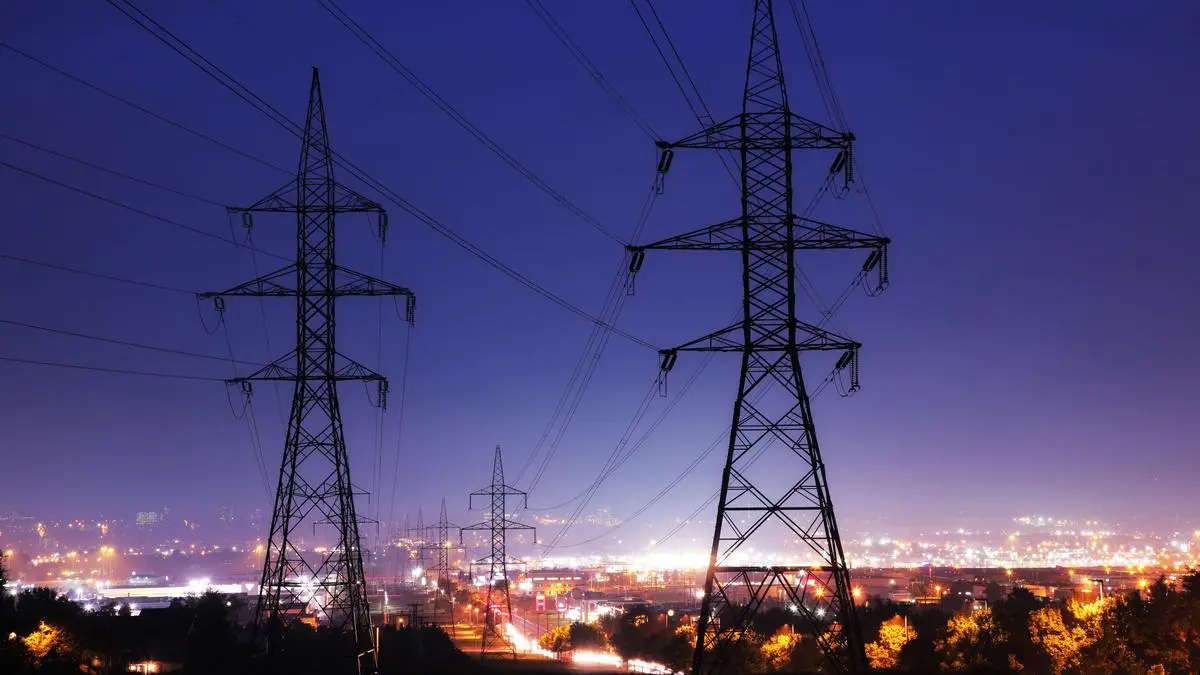
In the the Indian electricity industry, the issue of parallel distribution licensing is creating a buzz. The critical question, however, is whether the existing grid can handle this transition.A government statement on July 24 said that the Consultative Committee of the Ministry of Power met on July 23 under the chairmanship of Union Minister for Power and Housing & Urban Affairs, Manohar Lal, to discuss consumer-centric framework for parallel distribution licensing.While the example of Mumbai is often cited where two players are working simultaneously in a small pocket, but it cannot be equated with parallel licence, according to those closely involved with distribution networks in the country.So what is parallel distribution licensing? It is a regulatory framework allowing multiple companies to supply electricity within the same territory. It breaks the traditional monopoly — but is India’s power sector truly ready for this shift?Knotty issuesCan regulators design a Cross-Subsidy Surcharge (CSS) that fully compensates for lost business revenue while keeping the market competitive? If not, State Discoms will be trapped serving only heavily subsidised homes and farms — leaving them entirely dependent on erratic government subsidy payouts to survive.What happens if a private player fails its Universal Service Obligation or goes bankrupt? Should the State Discom step in as the safety net? These issues require clear answers on who bears the financial risk and how technical and commercial disputes will be resolved.Speaking at the Consultative Committee, the Power Minister had noted that while the Electricity Act, 2003 successfully brought competition to generation, transmission, and trading, it remains limited in the power distribution segment. The committee discussed how the current legal framework allows multiple licensees in one area but forces each to build its own physical infrastructure. This rule causes a wasteful duplication of poles, lines, and substations, driving up capital expenses and deterring new investment.A comprehensive framework was proposed to introduce retail power competition by unbundling supply operations from physical network ownership. The policy dictates that incumbent distribution licensees will maintain structural control over grid infrastructure. Concurrently, parallel licensees may utilise the existing grid upon paying regulated wheeling charges, retaining a statutory option to construct separate infrastructure subject to State Electricity Regulatory Commission’s authorisation.Individual State regulators were to establish detailed, localised implementation guidelines to guarantee market transparency and non-discriminatory grid access.The Minister reassured stakeholders that the new framework explicitly protects existing utilities and their employees. Furthermore, the universal service obligation will apply uniformly to all licensees, legally preventing private players from selectively targeting only highly profitable consumer segments.The proposed framework will enable competition in electricity supply without requiring duplication of the physical distribution network.Under the proposal, incumbent utilities will retain ownership, operation, and maintenance of their existing networks. New distribution licensees can utilise this infrastructure by paying regulated wheeling charges, while keeping the flexibility to build their own physical grid where authorised by the respective State Electricity Regulatory Commission.All this sounds great, but how will wheeling charges shake out? Will the high-value consumers targeted by private players actually save money in the end?Wheeling charges are usage fees paid to an electricity distribution company (Discom) for renting its physical grid infrastructure. Under Section 14 of the Electricity Act, 2003, these charges enable the transport of electricity from an independent power producer or a parallel licensee to an end consumer. Yes, wheeling charges are passed through to the consumer, but the methods depend entirely on the type of consumer you are.Opposing voicesThe All India Power Engineers Federation (AIPEF), representing power engineers and electricity professionals working in Central and State Power Utilities across India, has been vocal in their opposition to parallel distribution licensing. In fact, it has also submitted objections against the proposal of Eleven Power Private Limited for grant of a parallel distribution licence in the revenue districts of Gurugram and Nuh.Private licensees explicitly target high-revenue urban pockets, industries, and commercial premium consumers. These high-paying segments generate the profits that State Discoms use to subsidise poor rural households and farmers. Losing this revenue leaves public utilities with a massive financial deficit.Meanwhile, States such as Telangana and Maharashtra have or are in the process of restructuring their power sectors by creating separate, dedicated electricity distribution companies strictly for agricultural consumers. This structural unbundling isolates heavily subsidised farming connections from the broader commercial and industrial markets. By acting as a fiscal firewall, this model ensures that agricultural losses do not compromise the financial stability of the commercial power grid.Splitting the agricultural sector into a separate utility creates intense financial strain, but the strain shifts dynamically depending on which entity you look at. While the split is designed to clean up the commercial grid, power sector experts, energy analysts, and groups like the AIPEF point out that this restructuring introduces severe, concentrated financial risks.Reforms that improve efficiency and give consumers more choice are certainly a positive step, if the existing PPAs are honoured and the payment obligations of Discoms to power producers remain protected. As the new framework takes shape, it is important that these gains are not diluted and that there is no uncertainty. More importantly, investment is made on building infrastructure first.Published on August 7, 2026
The double-edged sword of parallel power supply
Having more competition in the distribution segment is welcome. But the financial issues of State Discoms need to be addressed
853 words~4 min read