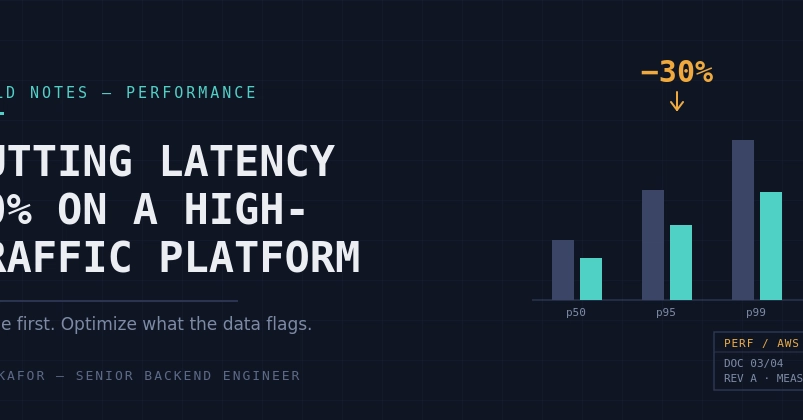
"Make it faster" is one of the least actionable instructions in engineering, right up until you have data telling you exactly where the time is going. Over about two and a half years on a high-traffic e-commerce platform, we reduced platform latency by roughly 30% while maintaining 99.9% uptime during peak trading periods — including the highest-traffic days of the year, when the margin for error is smallest, and the cost of getting it wrong is highest. None of it came from a single dramatic rewrite. It came from a repeatable process, applied consistently.
Start by refusing to guess
The instinct when something feels slow is to optimise the thing you assume is slow — usually whatever you last touched, or whatever looks inefficient on a quick read. That instinct is wrong often enough to be actively dangerous, because "optimising" code that wasn't the bottleneck adds complexity and risk for zero latency benefit, and it burns the time you should have spent on the actual bottleneck.
The fix is boring and non-negotiable: profile first, in an environment that resembles production traffic patterns, before writing a single optimisation. Real bottlenecks are frequently unglamorous — an N+1 query hiding behind an ORM abstraction, a synchronous call to a downstream service that could have been parallelised, a cache that's technically present but missing on the hot path that actually matters.