Analysts expect CAS to enhance transparency, improve execution for institutional investors and ETFs, and gradually reduce arbitrage opportunities.
| Photo Credit:
JoeyCheung
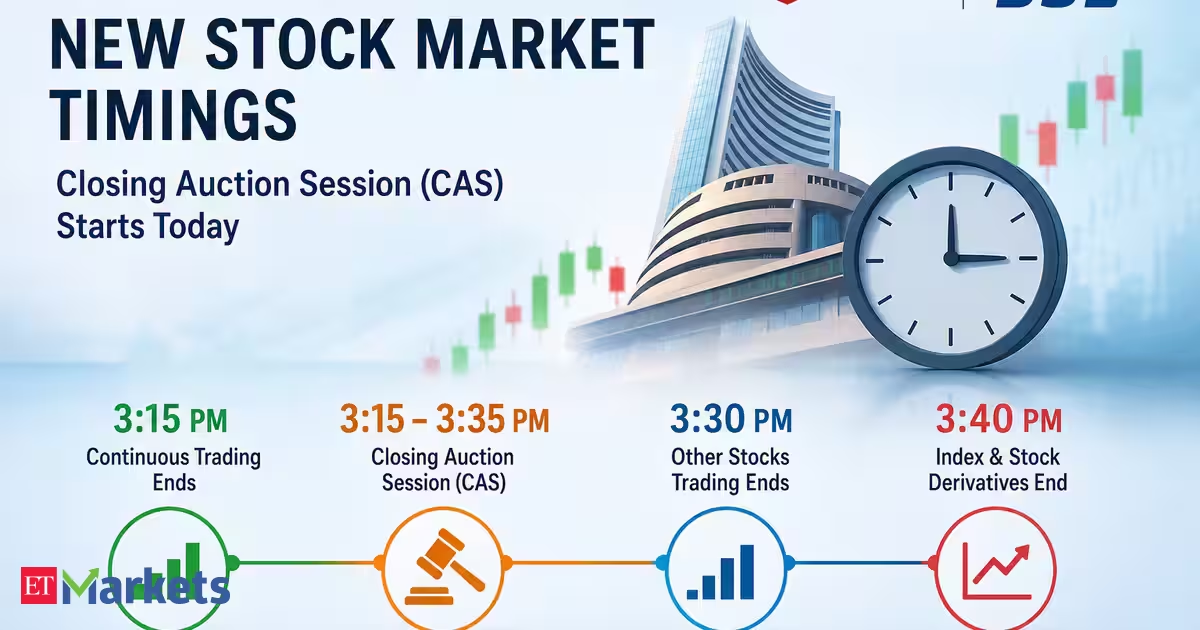
After the initial euphoria, the difference between the Closing Auction Session (CAS)-driven closing and the general market closing of Nifty is slowly narrowing as markets adjust to the new system.The difference between Nifty’s closing price pre- and post-CAS on Thursday was only 8 points. The Nifty closed at 24,628 points at 3.15 pm, while post-CAS it settled at 24,636 points.Similarly, on Wednesday, Nifty closed at 24,570 at 3.15 pm and 24,625 post-CAS, posting a difference of 55 points.On August 4 and August 3, the difference was 155 and 184 points, respectively.How the new closing price mechanism worksExchanges implemented CAS on Monday, and the initial variation in index values and stock closing prices had stoked market concern. Instead of looking at trades over the last 30 minutes, CAS collects all buy and sell orders at the end of the day into a single pool and determines a single price at which the maximum number of shares can be traded. This becomes the closing price. Most global markets, including the New York Stock Exchange and the London Stock Exchange, already use this method to determine the closing price of stocks.The closing price under CAS reflects where buyers and sellers actually agree to trade, making it harder to influence prices with last-minute trades. Since large orders can be executed more efficiently, it reduces tracking error for index funds and ETFs.Experts expect better price discovery and fewer arbitrage opportunitiesShweta Rajani, Head - Mutual fund, Anand Rathi Wealth, said the CAS is expected to make end-of-day prices more transparent and reduce sharp price movements near the market close.Under the earlier system, the final 30 minutes of trading, especially on expiry and index rebalancing days, often saw wider price movements, creating additional opportunities for arbitrage funds to capture spreads between the cash and futures markets.As the new mechanism becomes more established, opportunities arising from end-of-day price movements may become less frequent, although fund managers are expected to adapt by identifying opportunities at other points during the trading day, she said.Gibin John, Senior Investment Strategist, Geojit Investments, said the gains in indices are largely due to wider cash-futures spreads and higher volatility.In fact, CAS is expected to improve price discovery and may slightly reduce arbitrage opportunities over time, he said.Published on August 6, 2026