Market experts said the new auction-based closing mechanism makes the benchmark more sensitive to large order flows than the earlier VWAP-based methodology.
| Photo Credit:
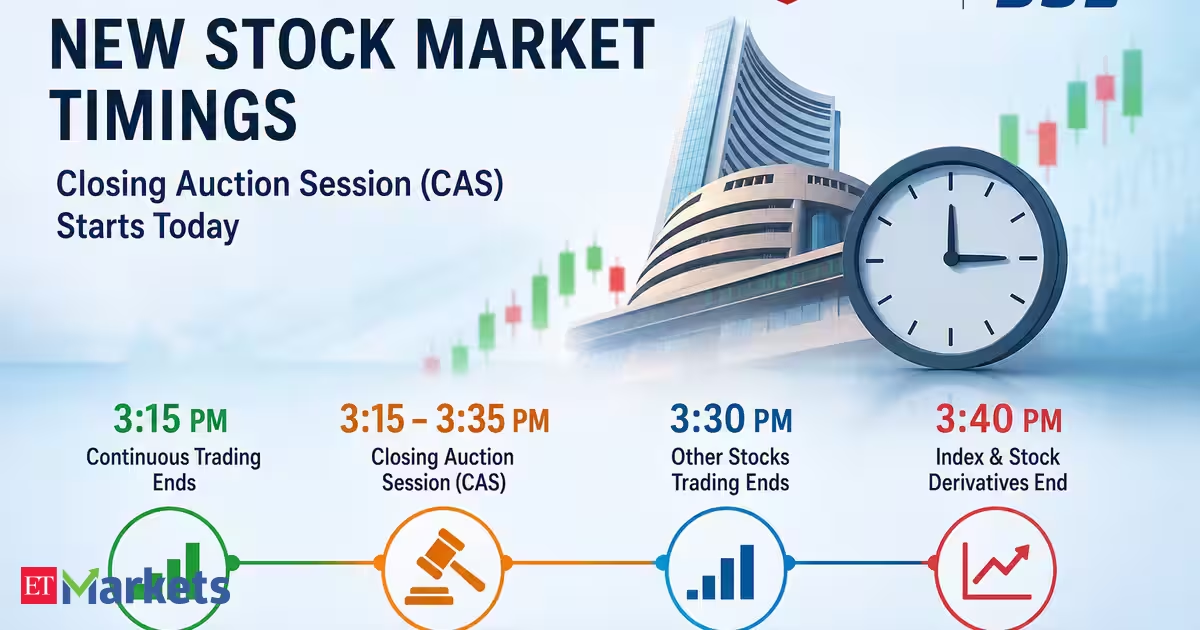
The Nifty 50’s official closing value jumped nearly 200 points on Monday after continuous trading had ended, surprising market participants on the first day of the Closing Auction Session (CAS) for stocks in the futures and options (F&O) segment.The Nifty 50 closed at 24,774.30, up 390.70 points or 1.6 per cent, after jumping nearly 200 points after the closing auction alone. Heavyweights ICICI Bank, HDFC Bank, Reliance Industries, Infosys, Bharti Airtel, and Bajaj Finance were among the top traded stocks on NSE.The BSE Sensex rose 549.62 points, or 0.7 per cent, to close at 78,639.00. NSE saw a CAS turnover of ₹1,276.2 crore while BSE turnover was ₹10.8 crore.The broader market was supported by easing tensions in the Middle East and softer crude oil prices, but the sharp jump in the benchmark’s official closing value occurred during the newly introduced closing auction, which began after 3.15 pm.Under SEBI’s new framework, the official closing prices of F&O stocks are determined through a 20-minute closing auction session, replacing the earlier methodology based on volume-weighted average prices. Since the Nifty’s closing value is calculated from the official closing prices of its constituent stocks, buying heavyweight stocks during the auction led to a sharp rise in the benchmark’s final close.“Today’s closing-phase spike in the index is significantly shaped by the CAS mechanics and revised closing timings, which pull a larger share of day-end execution into a short auction window, making the last few prints more sensitive to big order flows than under the old VWAP-based system,” said Hariselvan Radhakrishnan, Founder and Chief Executive Officer of HST Wealth.“When large institutional orders are concentrated into this auction window, prices can move quickly in the final minutes, especially if there is aggressive buying or short covering across heavyweight Nifty constituents,” he said.Hitesh Tailor, Technical and Derivative Analyst at Choice Broking, said the shift in institutional, passive fund and algorithmic trading activity into the auction, which matched against a thinner order book and pushed index heavyweights sharply higher right at final settlement.Institutional volumes shifted to the auction, while brokers’ auto-square-offs for intraday positions began earlier. “This forced short sellers to cover positions before continuous order matching stopped, adding strong underlying upward pressure near the session close,” Tailor said.Traders also experienced a noticeable disconnect between the screen’s last traded price at 3:15 PM and the final auction-settled closing price, he said.While market participants said the system appeared to have functioned as intended, Monday’s trading raised concerns about how the new closing auction can materially influence the benchmark’s official closing value, particularly on days with concentrated institutional order flows.Published on August 3, 2026