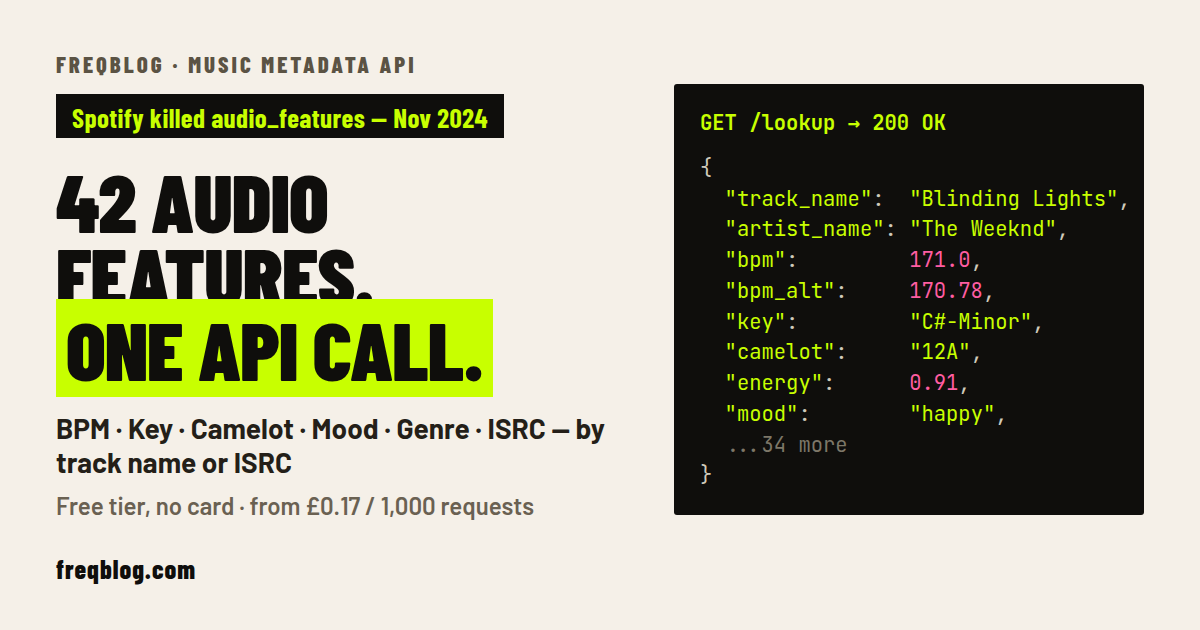
I run a music metadata API as a solo developer. Under it sits a catalog of 90M+ recordings aggregated from six platforms: Spotify, Apple Music, Tidal, Beatport, Discogs, and MusicBrainz. The core job is cross-referencing: take whatever you know about a track (an ISRC, a platform ID, or a messy "artist + title" string from a DJ export) and resolve it to one canonical recording with everything else attached.
When I started, I assumed this was mostly a plumbing problem. Every platform has an API, recordings have a standard identifier, join on it, done. Almost none of that survived contact with real data. This post is the parts I had to learn the hard way: why one song legitimately carries many ISRCs, how fuzzy matching on artist and title actually has to work, why recording-to-composition mapping is many-to-many in both directions, and the failure modes I now check for routinely.
The ISRC almost solves it
The ISRC (International Standard Recording Code) is a 12-character identifier for a specific recording. Daft Punk's "One More Time" is GBDUW0000053: country prefix GB, registrant code DUW, year 00, then a designation number. Every commercially released recording is supposed to have one, and most platforms expose it. So the naive architecture writes itself: one isrc column on the track table, join all six platforms on it, ship.