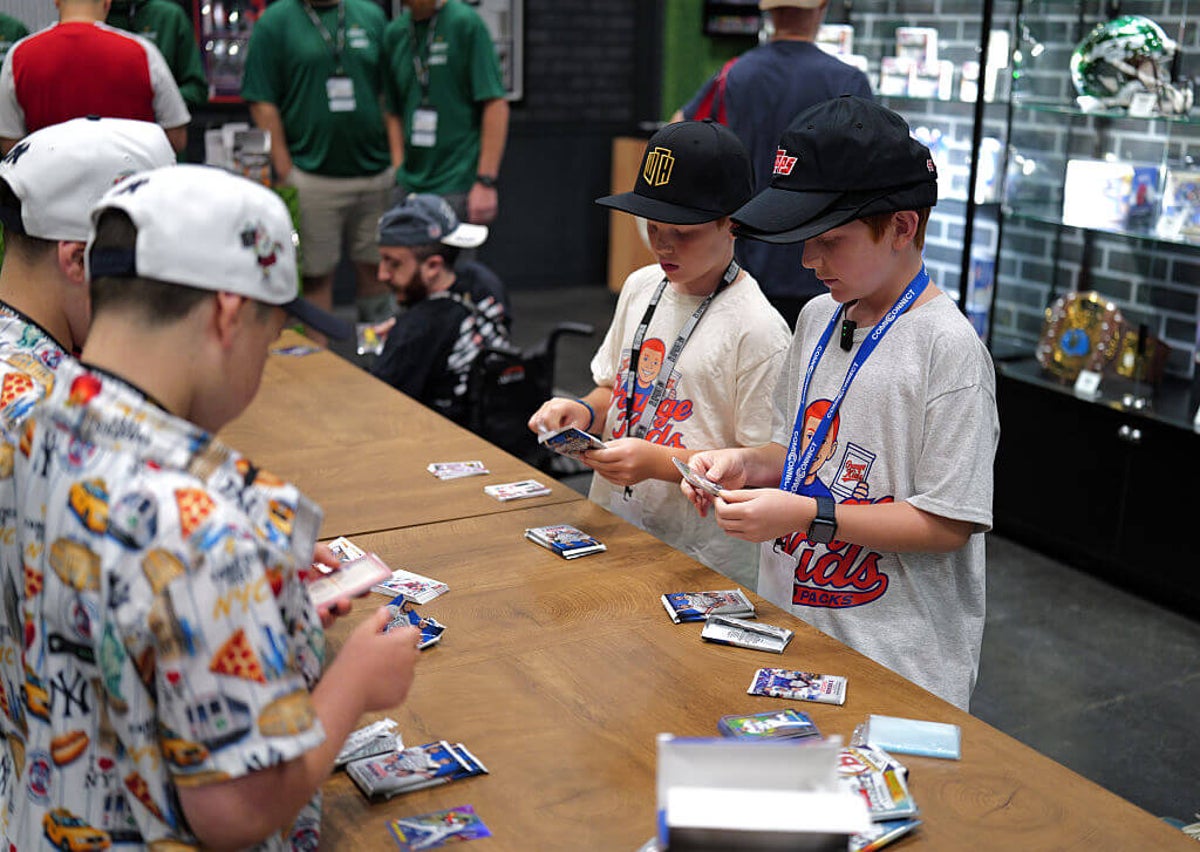
The sports trading card and memorabilia industry just experienced a whirlwind last few weeks with Fanatics Fest and the National Sports Collectors Convention playing out less than two weeks apart.These behemoth events within the booming industry served as perfect stomping grounds to discuss the “state of the hobby” since it’s difficult not to run into experts and industry leaders from different corners of the collectibles world at both events.The Athletic caught up with nearly 20 movers and shakers within the industry for my second annual “state of the hobby” review, more than twice as many as my first roundup last year. That means a wider variety of voices: card manufacturers, auction houses, hobby shops, box breakers, grading services, live shopping platforms and even one of the NFL’s all-time greats.Because of the increased number of voices included, we’re splitting this year’s review into two parts: what’s working and what’s not. This installment will concentrate on what’s been working well for a growing industry that’s busting into more mainstream conversations than ever before.(Participants are listed in alphabetical order)Nick Bell, Fanatics Collect CEO“We’re seeing a lot of new people come in, which is amazing. Walking around the National, I would say my observations from over the last three or four years is: I think the demographic is a little different. It feels younger. It feels more vibrant. I actually see young people again, which is awesome.“I think broadly speaking, the intersection of sports, the hobby and culture really feels like it’s starting to come together and I think that’s really interesting. It feels like athletes are more engaged than ever before. I think we’re seeing that firsthand. We’re seeing a lot of athletes really get into the hobby, start to collect, start to be very involved. Karl-Anthony Towns is a great example of that. Aaron Judge is super involved, Grant Williams is super involved. Not only are they collecting, but they’re talking about it. I think what we’re starting to see is that collecting is pushing out of just the small confines of the hobby and pushing general sports fans and the popular culture movement.”Jared Bleznick, Blez Sports Cards owner“When I first came into the space as a business 10 years ago, sports cards were not the cool thing to do. Now it has become mainstream. Every celebrity and athlete wants to be a part of the space, and it’s grown so much. I think people are finally realizing what I’ve been saying for a decade of how great this business really is. We’re in an industry that never stops. It’s the stock market of sports cards.“I think the major draw of the business, people are seeing some of the sales of some of these big sports cards and how much money they’re actually selling for. The Shohei Ohtani card (that sold for $11 million), you can pull that card out of a $400 box of cards. I can’t think of any industry where you can turn $400 into over $10 million and it’s exciting people. I have so many people contacting me that are in real estate or teachers wanting to get involved in this business to chase the next big card.”Andy Broome, CGC vice president“I think No. 1 most people probably say the (card) values, the influx of the money, people come in. I think actually for me one of the coolest things going right now that the hobby is getting right now is the kids. … Even at other shows (besides Fanatics Fest) recently, there’s a lot more kids. And it’s not just kids showing up. They’re engaged. I noticed that a lot of the companies in the industry are really noticing that and focusing on that. I don’t want this to go the way of the stamp world. Getting kids engaged and loving it, because kids grow up as passionate collectors and that’s what we need.”Finding a Caleb Williams card at The NationalAshish Chhabra, eBay Live vice president“This is my third National. Every year has felt bigger to me, at least over the last couple of years. The thing that gives me a lot of joy and excitement and hope is like, if you look at the eBay arena booth right now, all the little kids with their parents around and you’ve got these young collectors getting introduced to the hobby in a really fun and positive fashion. You see more and more people showing up here, more and more people getting interested in the hobby. That is a really good thing for the health of the hobby overall.”Chris Costa, Card Vault by Tom Brady co-founder“I think you’ve got kind of this trifecta, or even beyond a trifecta of things converging, that are all pushing things in the right direction.“Fanatics, coming in and consolidating a good chunk of the production, has put sports cards production into a new echelon of quality, athlete engagement, celebrity engagement, marketing, promotion. That Fanatics engine and the Fanatics machine has really done a lot as far as getting sports cards into the public eye versus (just) the hobby eye. We as a hobby and as an industry for the last decade, 15, 20 years have always done a good job of promoting amongst ourselves, but I think it really took somebody like a Fanatics to be able to come in here and promote our industry to the world. Cards have truly become mainstream.“A good segue to another part of this where I think social media has really changed the landscape of not just sports cards and the hobby, but sports in general. You have the ability to share cards to the world with the click of a button, which you weren’t able to do a decade ago. Now I can show you a dual (MLB) Logoman Ohtani card on my Instagram page or I can show you the new bat barrel autograph I just picked up. I think that compounded over a number of years has also helped generate the publicity, the awareness, and the excitement of the hobby.”Jordan Gilroy, Lelands Auctions director of acquisitions “What’s important is that there is so much global interest now. It’s not just a little community of people that like collecting things. It’s a big market where people buy, sell, and trade. People leave their full-time jobs in other fields to become card dealers and memorabilia dealers. And now that there is so much involvement from big money like (Michael) Rubin and Fanatics, there are certain parts of this industry that are growing. And yeah, I just said industry. It’s now an industry instead of a hobby. But now card stores are thriving and they used to be obsolete a couple years ago.“Before 2020, it was more of a hobby. Since COVID, it was people having to find ways to make money and now there’s some more people involved. So you have celebrities, you have athletes, buying things to invest and put away for a long time because they have seen the last 10, 15 years of growth. People with a lot of money are coming in to invest and put things away because they have a proven track record. I’m a biased person in this, but I would say it’s more stable than investing in stocks, certain stocks. Obviously, the top ones are terrific, but, if you could buy a jersey of LeBron James 20 years ago and put it away, you made hundreds of thousands of dollars. So, I think people are kind of realizing this is an opportunity with less risk and higher upside.”
What’s working in the sports collectibles world: Industry leaders share what they’re seeing
Sports collectibles records are being shattered on a near daily basis. We asked industry leaders what's driving that success.
2,397 words~11 min read