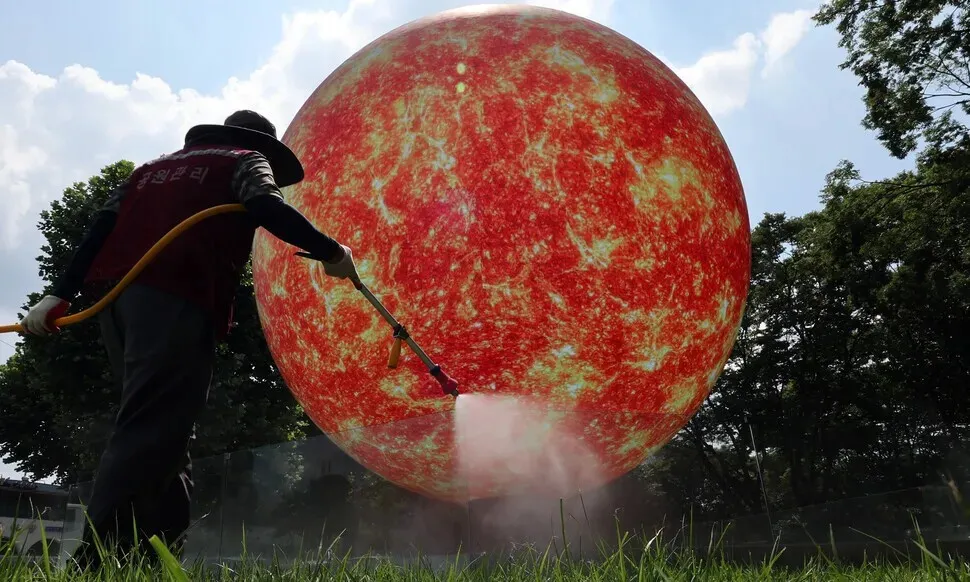
A landscaper works near “The Sphere,” a media art installation representing the sun in the park at Seokchon Lake in Seoul’s Songpa District on Aug. 4, 2026. (Yonhap)
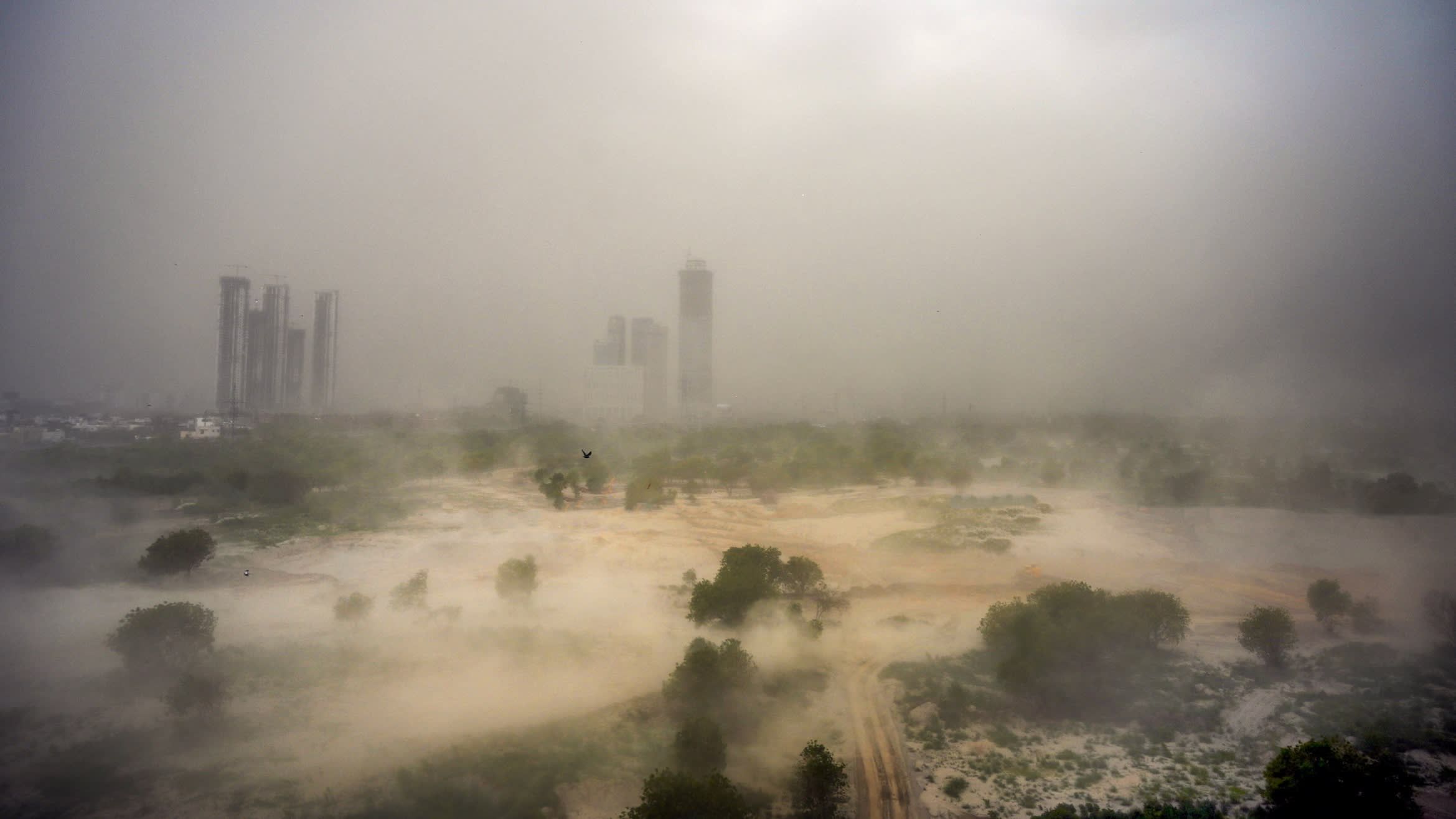
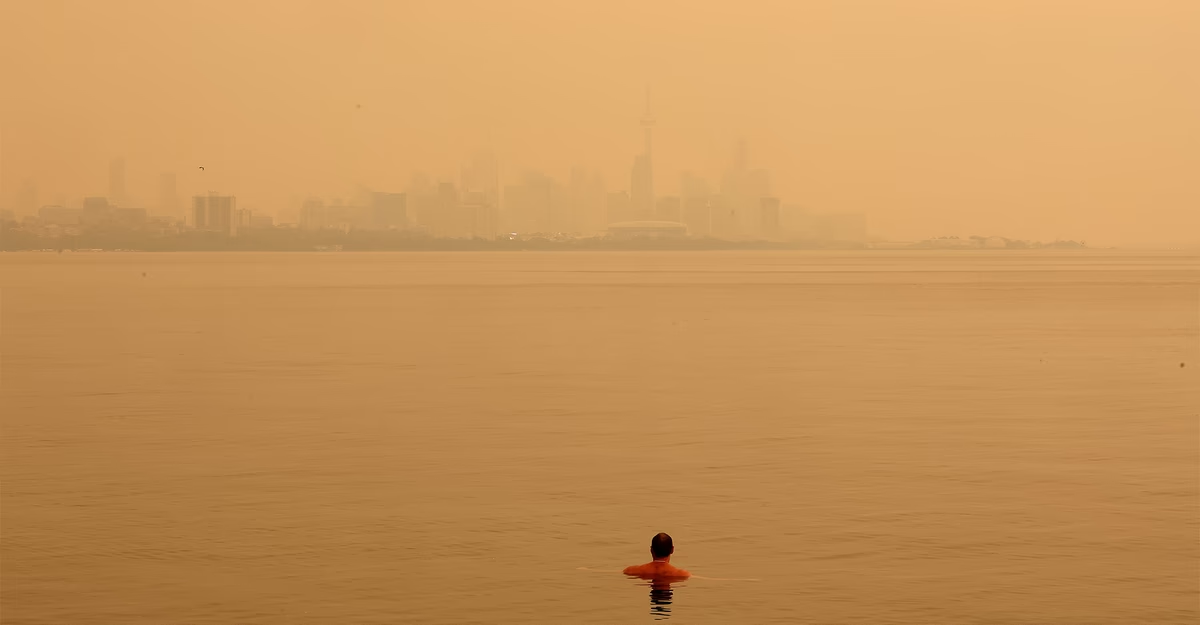
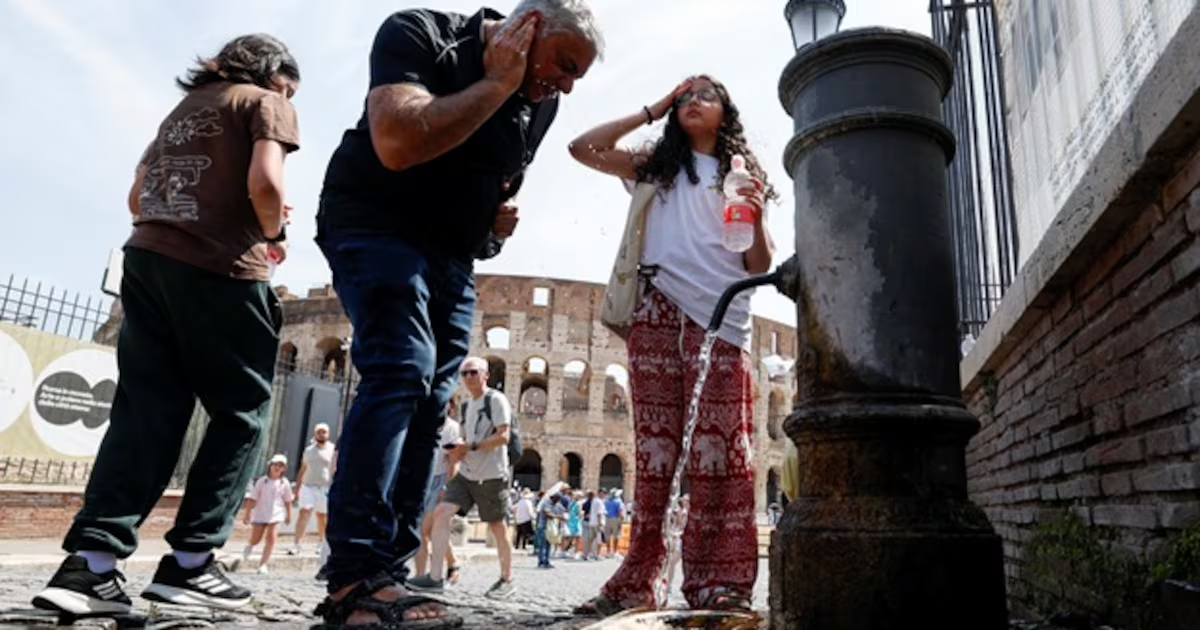
By John Eperjesi, professor of English literature at Kyung Hee UniversityIn the prologue to Bong Joon-ho’s “Snowpiercer” (2014), a radio newscaster euphorically tells listeners that on July 1, 2014, CW-7 will be sprayed into the upper atmosphere to bring the average temperature of the planet to a manageable level. Despite protests from environmental groups and the developing world, 79 countries contribute to the solar geoengineering, or solar radiation management, campaign. This “revolutionary solution to mankind’s warming of the planet” goes awry and triggers a mass extinction event in the form of a new ice age.In “The Day After Tomorrow” (2004), the main character, Jack Hall, is a paleoclimatologist who hypothesizes that the Atlantic Meridional Overturning Circulation (AMOC), the main ocean current system in the Atlantic, has reached a “tipping point” and is at risk of collapsing due to global warming. When the Larsen B ice shelf in the Antarctic breaks up — which really happened in 2002 — the rapid addition of fresh water shuts the current down, and a series of superstorms decimate the planet. While some scientists trashed the representation of climate science in the film when it first came out, the warning about the AMOC approaching a tipping point, about the serious climate impact of weakening ocean currents, now appears quite accurate.Before watching these disaster films, I had never heard about solar geoengineering, of pushing particles into the atmosphere to mimic the cooling effect of a volcano, or about the climate-regulating importance of AMOC. After watching these films, I had a strong sense that, as one of the newscasters in the “Snowpiercer” prologue says, “Global warming can no longer be ignored.” Works of science fiction like “Snowpiercer” and “The Day After Tomorrow” are important in part because they engage in “futures thinking.” In “What Exactly is Futures Thinking?” Susanne Forchheimer explains that for futures thinking “to be valuable it has to be grounded in present-day facts that with synthesis, sensemaking, creativity, and visualization are put into plausible, provocative stories about possible futures that resonate and inspire us to act differently today.” Futures thinking was on display in September 2024, when the United Nations hosted hundreds of global delegates at the Summit of the Future (SotF), with the goal of forging an international pact on how to safeguard the future for today’s youth and for “generations not born.” One of the speakers at the UNESCO BRIDGES panel at SotF was the science fiction writer Kim Stanley Robinson, whose novel “The Ministry for the Future” (2020) was recently translated into Korean. The novel opens in the year 2025 with a catastrophic heat wave in India that kills millions of people. When, after a brief period of mourning, the countries of the Global North continue to heat the planet with excess carbon emissions, the Indian government goes rogue and initiates a solar geoengineering campaign, which is successful. There is an important debate between “Snowpiercer” and “The Ministry for the Future” about solar geoengineering, one that will become increasingly urgent as the planet rapidly heats. The Bong Joon-ho film offers a profound warning about the unintended consequences of messing with the climate system, and scientists who study solar geoengineering generally agree that it is a bad idea. But Robinson’s novel suggests that when tens of millions of people are dying from high wet-bulb temperatures, solar geoengineering could be put on the table. But there are big questions involving governance: Who will be sitting at the table? Where will the table be located? Can we make sure that climate criminals like Trump, sociopathic trillionaires like Musk, or the fossil fuel industry are nowhere near the table?Futures thinking means understanding that the climate emergency is going to get worse before it gets better. But how much worse, and how long before it gets better, depends on what we do right now. What kind of future do we want? Futures thinking can be empowering, delivering a much-needed sense of agency to combat doomerism, paralysis, depression and anxiety. The connection between futures thinking and acting appears in the militant uprisings at the heart of both “Snowpiercer” and “The Ministry for the Future” that demand a different future. In the former, climate refugees dismantle the class apartheid system that structures the train. In the latter, the Children of Kali employ violent direct action to stop the burning of fossil fuels and end the consumption of beef. Both uprisings give birth to new, more just futures.We are living through a massive historical transition, from a hot world built with fossil fuels, to a cool world built on renewable energy, primarily sun and wind. As Bill McKibben’s new book “Here Comes the Sun” makes clear, the transition to solar power is happening faster than anyone expected, and this is exciting. Young people living today could see the warming of the planet slow down, or be reversed, when they are my age. That is a future to fight for. As for me, I expect that the heat waves, floods, wildfires and storms devastating most of the planet right now will get much worse during my remaining time on this planet. Whenever I feel down, I look at a quote from the great journalist and activist Barbara Ehrenreich that I keep on my desktop: “The point isn’t that we will win in our lifetimes, but that we will die trying.”I would like to thank Joni Adamson, whose article “Beyond Cli-Fi: Visionary Fictions, Futures Thinking, and a Cosmovisionary Archive,” inspired this piece. Please direct questions or comments to [english@hani.co.kr]