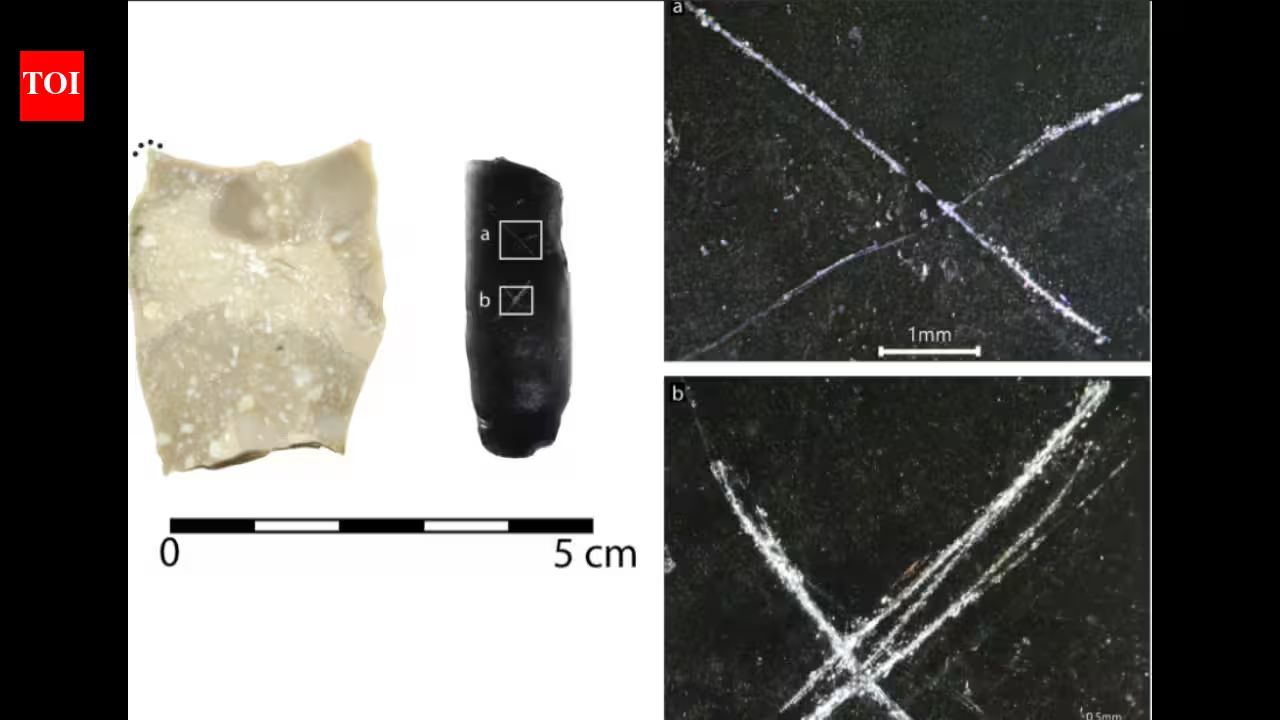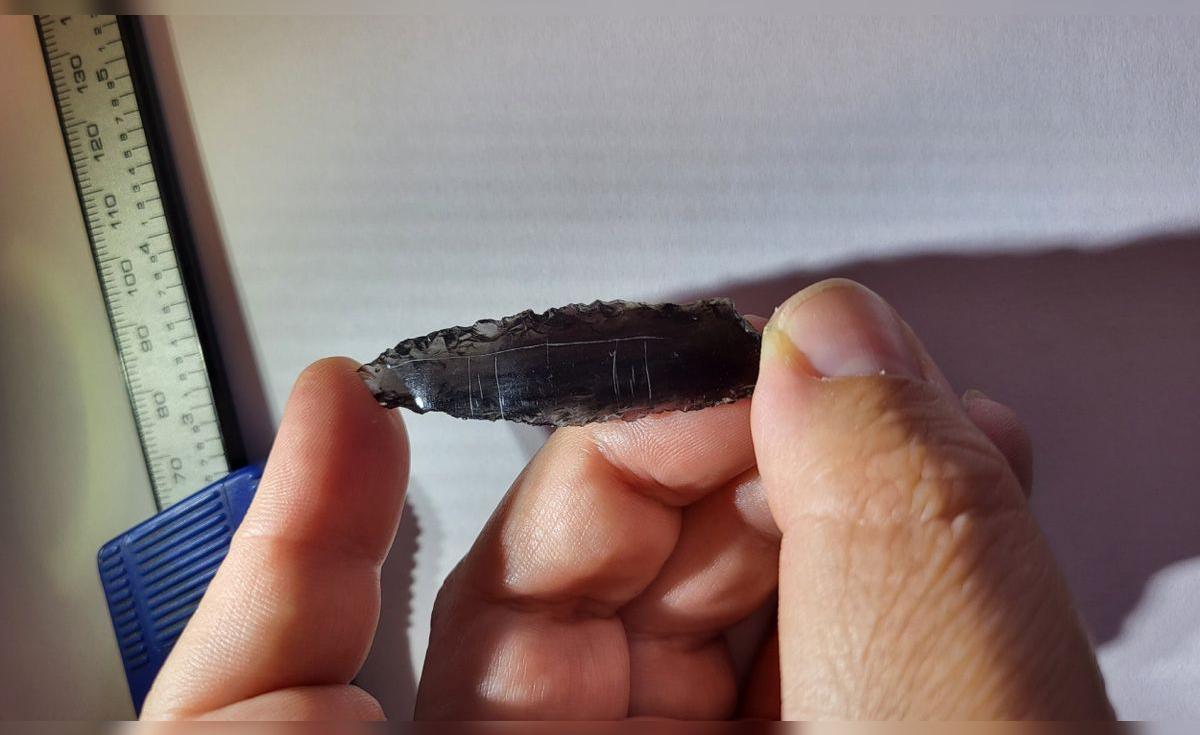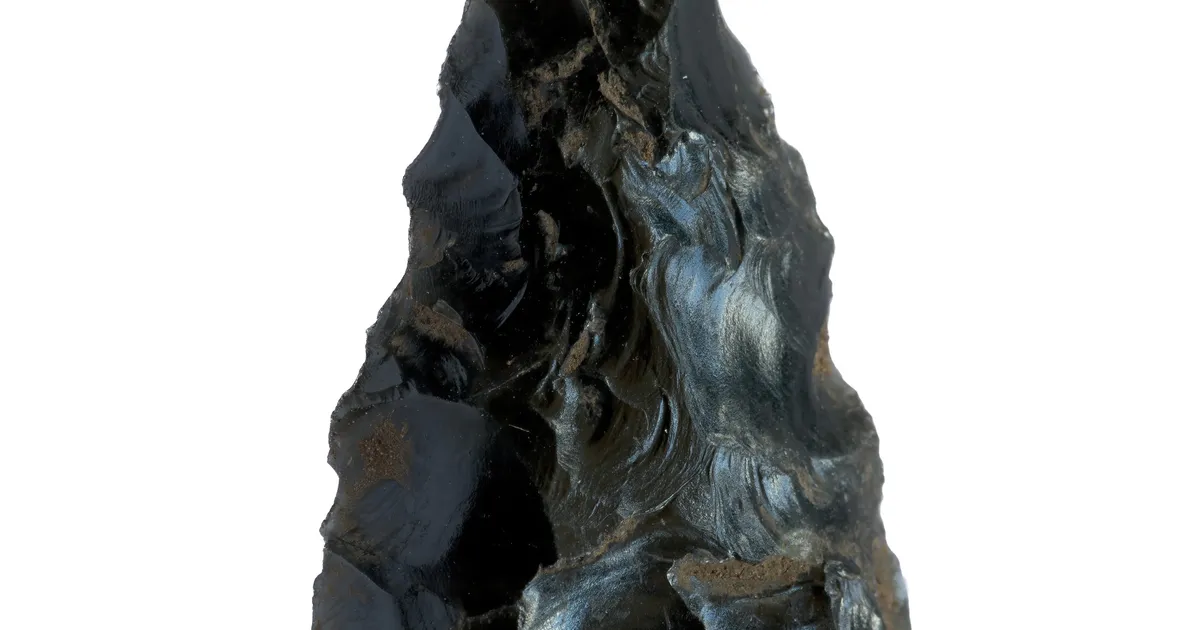
Analysis of incised volcanic glass arrowheads shows effort was expended, even if no coherent graphic language seems to have yet emerged in Neolithic TurkeyAt a site in the Jerusalem hills smack by the highway to Tel Aviv, archaeologists in 2012 discovered a huge settlement from about 9,000 years ago. The Neolithic settlement at Motza was so big that it may have had as many as thousands of residents, and excavations there unearthed, among other things, about 400 objects made of obsidian: beads and blades, and cores (the large stones from which tools are knocked off) too, indicating local manufacture. But none of this volcanic glass was local. Northern Israel has several dormant volcanoes from many millions of years ago, but none of them produced the shiny jet-black volcanic glass found at prehistoric Motza, and also at Ein Zippori. There, in 2014, archaeologists found an obsidian arrowhead from the Neolithic and hundreds of obsidian artifacts from the Chalcolithic, around 6,000 years ago.Analysis proved the glass at Motza and Zippori had been imported from Turkey, specifically from central and eastern Anatolian sources such as Göllü Dağ, Nenezi Dağ, and Nemrut Dağ.Obsidian mirror found in Catalhoyuk, Turkey. Credit: Dick OssemanObsidian mirror found in Catalhoyuk, Turkey. Credit: Dick OssemanWhy were the ancients in Neolithic Israel importing glass from Turkey? It's shiny and pretty and we monkeys have appreciated glitter from time immemorial. Also, while obsidian is more brittle than flint, which is bad for the hunter – being glass, its edges can be sharper, which is terrible for the huntee. Hence it is not surprising that archaeological sites in Turkey are crawling with obsidian. The black glass, sometimes shot through with other colors thanks to natural mineral inclusions, is not only utile but beautiful. Prehistoric obsidian artifacts even include what had to have been mirrors. But engraved obsidian is another story entirely, let alone engraved arrowheads.Marked obsidian arrowheads found at Tepecik-Çiftlik, alongside drawings of their marks.Alice Vinet, Denis Guilbeau, Balcı.We are deeply familiar with stone objects that bear engravings, but not arrowheads, let alone obsidian ones. Now a report in PLOS One from late July focuses on 11 engraved obsidian arrowheads recently found at the prehistoric site of Tepecik-Çiftlik in Cappadocia, found in layers dating to 9,100 to 7,800 years ago. The 11 newly reported objects join 43 incised obsidian arrowheads found at other Neolithic sites in central Anatolia, predominantly from the late 8th and 7th millennia B.C.E.The question is, what significance might the engravings on the black glass arrowheads have, if any.First of all, where are they from? Right there. Unlike the Israeli specimens, whose raw material could not have been local, the arrowheads of Tepecik-Çiftlik were exactly that, having been mined at the local Cappadocian sources of Göllüdağ and Nenezi Dağ, chemical analysis showed. Map showing the sites where engraved obsidian has been found. Credit: Alice Vinet ,Denis GuilbeauMap showing the sites where engraved obsidian has been found. Credit: Alice Vinet ,Denis GuilbeauOkay. What about the markings? They are crude, imprecise and inconsistent, though the team notes possible similarities between them and the graphic language of marks on the obsidian arrowheads found at the other sites in central Turkey. That said, they couldn't detect any correlation between the engravings and the diktats of the raw material, the ways the arrowheads were used, or even the production method. They could say, however, that the incisions were done both before and after final retouching of the arrowhead, ergo, engraving does not seem to have been a fixed stage in production.Add to the mix the fact that engraved obsidian arrowheads have yet to be reported beyond central Anatolia. All of this combines to suggest a local cultural custom in Neolithic central Anatolia, though the team stresses that altogether too few of the items have been found to offer broad conclusions. (Most arrowheads in ancient Turkey were made of stone.)"Analysis of these incised arrowheads, along with the limited archaeological and ethnographic comparisons available, calls for a cautious interpretation," the team writes: "While they have been suggested as personal or collective markers (e.g., hunters' marks), this hypothesis requires further evidence."5th millennium BC obsidian tools from Tilkitepe, Turkey, at Turkey's Museum of Anatolian Civilizations. Obsidian was more fragile than stone, but sharper too, and very pretty. Credit: Kafkasmurat5th millennium BC obsidian tools from Tilkitepe, Turkey, at Turkey's Museum of Anatolian Civilizations. Obsidian was more fragile than stone, but sharper too, and very pretty. Credit: KafkasmuratMark of XTheoretically, like how the illiterate sign their name as "X" - the incisions could have been the mark of the owner/hunter or the maker, or of the community: one village has one mark, another village has another. A paper based on the arrowheads at Can Hasan postulated a parallel to Inuit culture, where hunters marked arrows in order to claim ownership of game. The mark of ownership idea is certainly possible even though the incised obsidian arrowheads found in Cappadocia predated writing by thousands of years. The greatest amount, 31, was found at the site of Can Hasan and date to 9,650 to 8,600 years ago; five found at the Neolithic city at Catalhoyuk date to a range of 9,100 to 8,050 years and so on. The latest ones at Tepecik-Çiftlik are from 9,100 to 7,800 years ago.It is true that by the late Neolithic, "tokens" were emerging, including in Anatolia: bits of clay that could take any geometrical form from sphere to cone to polyhedron, and are believed to have been used to keep track of the newfangled invention of agricultural produce and/or probably domestic animals too, also a kicky innovation. In other words, they are thought to have been counters of some sort. But early tokens were not engraved. More informative complex tokens with lines, notches and/or dots would appear about 5,500 years ago. Cuneiform, early writing as we know it, goes back perhaps 5,000 years. An exhibit of tokens and early cuneiform at the University of Chicago's Oriental Institute Museum. Credit: DaderotAn exhibit of tokens and early cuneiform at the University of Chicago's Oriental Institute Museum. Credit: DaderotThe incised obsidian arrowheads may have been contemporary with plain tokens but predated writing. If an arrowhead was engraved to show it belonged to Utku and not to Mehmet, then the mark was the pre-writing equivalent of X.Problems with the claim-mark thesis, as the new paper points out, include the apparently random distribution of incisions on the arrowheads, combined with the overall scarcity of incised arrowheads across sites. In other words, the phenomenon of scratched-up obsidian arrowheads at Can Hasan lacks discernable coherence. That did not change with the discovery of more arrowheads elsewhere in Cappadocia. Yet taking into account the latest 11 finds – the team suggests that, despite the persisting absence of consistency, the marks may after all represent a shared cultural wrinkle exclusive to central Anatolia, during a certain time in the Neolithic, though not before or after. The team notes that generally speaking, it's easier to make scratches on obsidian than it is on flint. Note that incised flint arrowheads have yet to be found anywhere. In fact the ancient Anatolians clearly used flint to scratch their obsidian. As for significance, the fact is that although the markings seem to fall short of consistent messaging, they took effort. "The execution of the incisions involves a sequence of gestures (more than twenty in some cases) carried out with specific tools... and reflects a deliberate intention to mark the point itself, rather than other parts of the arrow that would have been easier to incise, such as the shaft," the team sums up.So what have we? Proto-Anatolians who scratched on obsidian projectile points, in no obviously consistent way, which argues against interpreting the etching of the arrowheads as possibly ritualistic; there is no evidence of a shared system of signs, just "broad similarities" in motifs, which does not rule out hunter's marks, but doesn't argue for them either. A zigzag does not a shared motif make unless we are sharing all the way to Homo erectus. But since we Homo sapiens are a lazy species, one usually has to have reason to go to effort, and the question remains what that reason was.
Do marks on ancient obsidian arrowheads in Anatolia have meaning?
Analysis of incised volcanic glass arrowheads shows effort was expended, even if no coherent graphic language seems to have yet emerged in Neolithic Turkey
1,363 words~6 min read