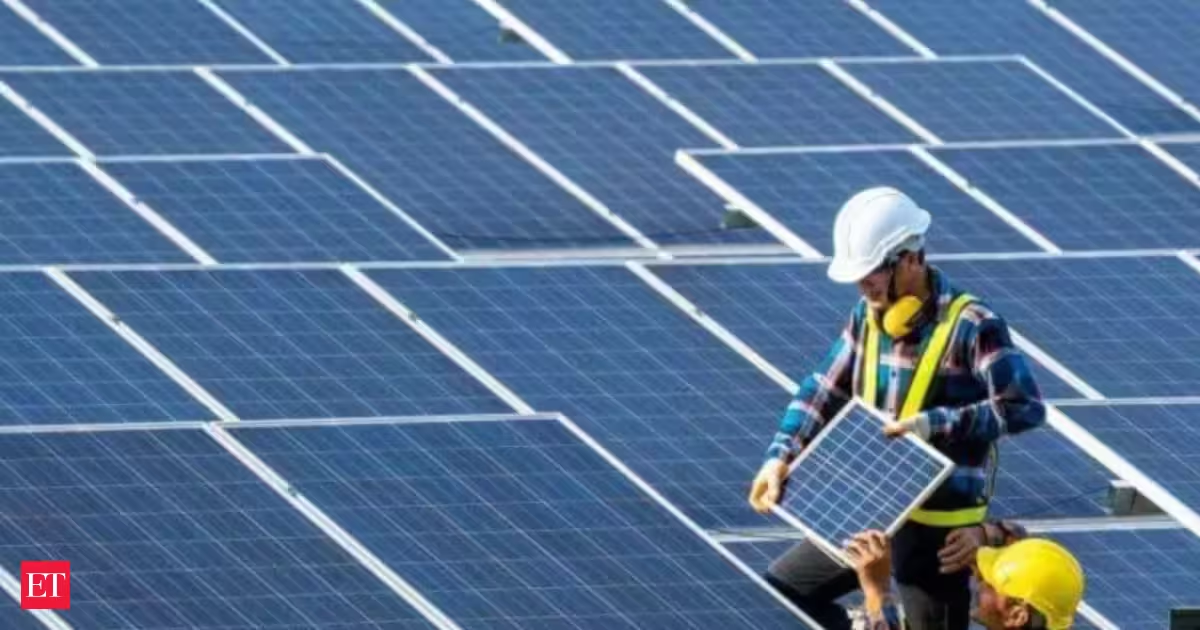
Hanwha, OCI face higher costs, though Qcells’ integrated US supply chain offers buffer Hanwha Qcells’ Solar Hub in Cartersville, Georgia (Hanwha Qcells) Washington’s planned 15 percent tariff and minimum price floor on imported polysilicon could hit Korean solar manufacturers alongside its intended target of China.The proposed measures would extend beyond raw polysilicon to wafers, cells and modules, putting Korean companies that rely on Southeast Asian production directly in the path of the US trade crackdown.The Donald Trump administration was expected to announce the restrictions as early as Thursday, alongside the findings of its yearlong Section 232 national security investigation, Reuters reported Wednesday.More than a tariffSection 232 of the Trade Expansion Act of 1962 allows Washington to restrict imports deemed a threat to national security. The Trump administration has launched 13 such investigations covering products including copper, semiconductors, manufacturing equipment, pharmaceuticals, processed critical minerals and uncrewed aircraft systems.Industry officials said combining a tariff with a minimum import price would be considerably more restrictive than imposing a duty alone.Exporters can partly offset tariffs by lowering prices, as Chinese manufacturers have done in other markets. A price floor, however, prevents imports from entering the US below a set level, directly limiting the ability of state-supported suppliers to undercut competitors.The two measures could therefore bolster US solar manufacturers by reducing the price advantage of Chinese products.Korean firms caught in crossfireWashington’s push comes as China dominates the global polysilicon industry. The country accounted for about 93.5 percent of global output in 2024, according to Germany-based Bernreuter Research.But because the proposed measures would not be limited to China, Korean solar companies could face higher costs as collateral damage.Hanwha Qcells and OCI Holdings rely on Malaysian operations for polysilicon and related products supplied to the US. A blanket 15 percent duty could increase their costs and weaken their competitiveness in the American market.Industry officials said the measures would directly benefit the small number of US polysilicon producers, including Hemlock Semiconductor and Wacker Chemie, whose manufacturing costs are higher than those of Chinese rivals.“If this policy is effectively telling solar companies to use US-made polysilicon, higher raw material costs will inevitably flow through to panel manufacturers,” an industry source said.The added burden would ultimately fall on power developers and consumers, potentially driving up solar project costs and slowing the industry’s expansion, the source added.Hanwha gains a US bufferHanwha Qcells may be better positioned than many rivals to absorb the impact over the longer term because it is building the only fully integrated US solar supply chain spanning ingots, wafers, cells and finished modules.Last month, the company began producing all four products at its new Cartersville plant, known as the Solar Hub, in Georgia.Together with its Dalton, Georgia, module plant, which has operated since 2019, Hanwha’s US facilities will have annual capacity of 3.3 gigawatts for ingots, wafers and cells and 8.6 GW for finished modules.As US restrictions expand from polysilicon to intermediate products, Hanwha could avoid tariffs on imported ingots, wafers and cells once its American production lines reach full capacity.Its US manufacturing base also qualifies for advanced manufacturing production credits under the Inflation Reduction Act, helping offset higher polysilicon costs.The subsidies are projected to reach $675 million this year and could rise to as much as $1.1 billion annually by 2029, according to industry estimates.Seoul has urged Washington to allow Korean companies special consideration if it restricts polysilicon and related imports. The Korean government has also warned that broad trade barriers could disrupt both countries’ supply chains, given Korean companies’ substantial investments in US solar and semiconductor manufacturing.
US polysilicon curbs leave Korean solar firms caught in crossfire
Washington’s planned 15 percent tariff and minimum price floor on imported polysilicon could hit Korean solar manufacturers alongside its intended target of Chi
592 words~3 min read