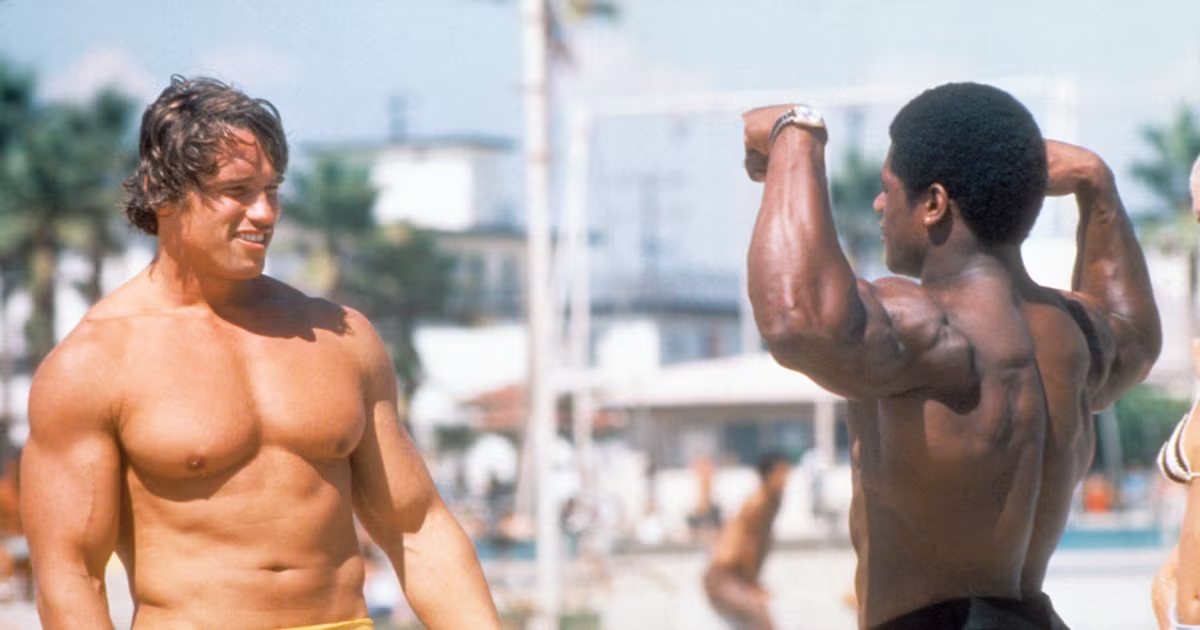
After two years researching and writing about bodybuilding in America, Charles Gaines submitted his manuscript, replete with photographs by his pal George Butler, to Doubleday. “No one in America will buy a book of pictures of these half-unclothed men of dubious sexual pursuits,” said his editor, immediately demanding his advance be refunded. Even after Simon & Schuster subsequently published Pumping Iron – The Art and Sport of Bodybuilding in 1974, the New York Times refused to review it because one critic reckoned a tome about men flexing their pneumatic muscles constituted nothing more than dressed-up gay porn.Within a couple of years, there were over 700,000 copies in print, a documentary of the same name garnered $50 million at the box office, and Gaines had loosed the phenomenon of Arnold Schwarzenegger upon the world. Between the book and the film, he set the Austrian behemoth on the road to becoming a cultural icon and later a governor of California too. The pair remained so close thereafter that Schwarzenegger paid fulsome tribute when his friend died at the age of 84 last month.“There was no adventure too big for Charles Gaines,” he wrote. “He climbed mountains, trekked across ice, fished, and hunted on almost every continent, writing about every adventure in a way that captured people’s hearts and minds. He was interested in everything – and his interest was contagious. Today, I honour the amazing life of one of the people who helped make me who I am.”A by-no-means conclusive list of Gaines’s former occupations included conservationist, bird-dog trainer, novelist, journalist, Emmy award-winning screenwriter, poet, documentary maker, fly-fisherman, rodeo bull rider, skydiver, mountain-climber, college professor and ski instructor. His employment history hints at the breadth of his interests. During a year studying creative writing at the University of Iowa, he often drove straight from hunting wood ducks on the Iowa River to the classroom, where he took a seat at the back with fresh blood stains on his overalls. An epic and peripatetic life began in the maw of a moneyed southern family in Jacksonville, Florida, that later relocated to Alabama. After a couple of academic false starts, he graduated from Birmingham Southern College in 1963, wed Patricia Ellisor, a former Miss Alabama, soon after, and the couple then decamped to Ireland for two years, pursuing artistic dreams in splendid isolation.‘Follow that bliss, catch that fish and kiss those lips while you can,’ wrote Greta Gaines in a tribute, ‘because my father was the live-life-to-the-fullest kinda guy’“The idea, a vague one, was to find a thatched cottage somewhere on the west coast where we could live on potatoes and soda bread beside a turf fire while Patricia did a series of paintings as the thesis for her master’s degree, and I tried to learn how to write, soaked myself in Irish myth and poetry, and read all the books I wanted to read,” wrote Gaines in A Family Place, his memoir. “The roof of the cottage we rented on the shores of Lough Corrib in Connemara wasn’t thatched, and you can never read all the books you want to read…”Stay Hungry, a debut novel set against the backdrop of the burgeoning bodybuilding scene of his Alabamian youth, was shortlisted for the National Book Award and made into a film starring Jeff Bridges and Sally Field. But it was Pumping Iron, which started life as a magazine feature for Sports Illustrated, that caught the ‘70s zeitgeist on page and screen, propelling Schwarzenegger toward action movie stardom and even setting his younger, equally swole rival Lou Ferrigno up for a celebrated stint as television’s shirt-splitting Incredible Hulk. Austrian bodybuilder Arnold Schwarzenegger lifts weights at Muscle Beach, Venice, Los Angeles, California, August 1977. Photograph: Michael Ochs Archives/Getty With 25 books to his name, Gaines was described by the Washington Post as “a literary outdoorsman”. He fly-fished in 25 countries across five continents and wrote two acclaimed books of essays on the subject, a contribution that caused another outlet to label him “the most interesting angler in the world”. Few would quibble with that title. [ Arnold: Schwarzenegger documentary fails to ask the tough questionsOpens in new window ]Upon arriving in 1960s Galway with what he reckoned was “a fat ass”, he was upset to find free weights hard to come by there. If that was not ideal for somebody for whom fitness was another lifetime obsession, and something he wrote several books about, he got his cardio by walking the hilly road to and from Oughterard each day with a scrappy terrier called Rex.Charles Gaines: 'What life is all about is coming up against your limitations and then stretching out against them.' “I believe in hardness, in toughness, in pushing yourself,” he wrote. “What life is all about is coming up against your limitations and then stretching out against them.”That philosophy played its part in the invention of paintball in 1981. It all stemmed from a Scotch-fuelled after dinner argument with Hayes Noel, a New York stockbroker, about whether city folk had the innate survival instincts to cope with wilderness life as well as their rural counterparts. To resolve the issue, the pair of them and Bob Gurnsey, a local ski maven, made up rules and marked out a course on 80 acres of woods near Henniker, New Hampshire. There, along with nine invited guests, all wearing camo, they used maps and compasses to stalk each other one summer’s day. Each brandished a Nelspot 007, a CO²-powered pistol more usually deployed to shoot oil-based paintballs to mark livestock. By turning the weapons on themselves, a billion-dollar recreational industry was born.“Follow that bliss, catch that fish and kiss those lips while you can,” wrote Greta Gaines in a tribute, “because my father was the live-life-to-the-fullest kinda guy.”From field to stream, from Oughterard to Alabama.
Dave Hannigan: Epic life of writer who believed in ‘hardness, in toughness, in pushing yourself’
When studying creative writing, Charles Gaines would drive from hunting ducks to the classroom, where he’d sit with blood stains on his overalls
968 words~4 min read