The case for exempting small-value transactions from MDR is well-founded
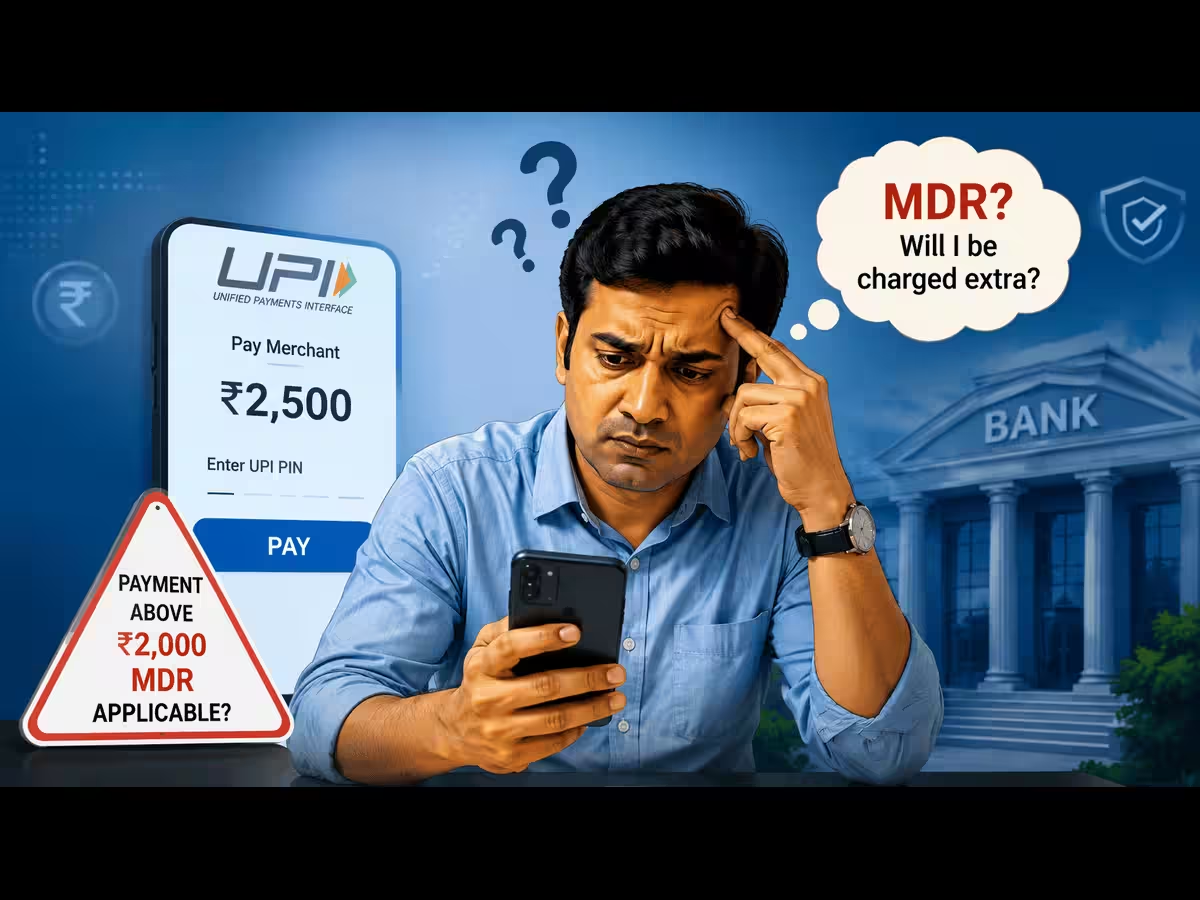
The Finance Ministry recently tabled a bill proposing to amend the Payment and Settlement Systems Act, 2007 empowering the government to levy MDR (Merchant Discount Rate) on “one or more electronic modes” of payment, including UPI.”The debate over subjecting UPI transactions to a service charge — MDR — was initiated in August 2022 by the RBI itself through a “Discussion Paper on Changes in Payment System.” To promote UPI at that time, the Finance Ministry rightfully set aside the RBI paper, while continued advocacy kept the MDR debate alive. Since then, the stakeholders have kept the opinion poll in a permanent campaign mode, with news of sporadic wins and losses popping up now and then depending upon whether there is red or black ink on their balance sheets.The debate took a favourable turn with the payment industry successfully convincing the Parliamentary Standing Committee early this year that the current zero-MDR regime puts pressure on government finances and limits the ecosystem’s ability to invest in long-term infrastructure. On the back of the Standing Committee’s report comes the proposed bill to give flexibility to the government to decide which digital payment modes should remain exempt from charges and which could attract MDR.This has rekindled the interest of third-party application providers and payment processors who have long sought a sustainable revenue model.UPI scaling with supportAs of early 2026, UPI’s scale has reached considerable heights, with monthly volumes exceeding 21.7 billion transactions and value crossing ₹28.33 lakh crore. While the volumes endorse ease of making small payments, they also place a substantial financial burden on banks and payment service providers managing the servers, security systems, and fraud prevention infrastructure that keep the network running.The government has been making budgetary allocations to incentivise digital payments since FY2021-22. Those allocations have followed an uneven path: ₹2,485 crore in FY24, falling to ₹1,146 crore in FY25, with ₹2,200 crore budgeted for FY26 and estimated ₹2,000 crore for FY27. The Department of Financial Services confirmed to the Parliamentary Committee that these incentives cover only around 11 per cent of actual industry costs and represent approximately 14 per cent of the MDR revenue the industry forgoes under the current policy. Industry estimates place actual operational costs closer to ₹20,000 crore annually, leaving a funding gap that the incentive scheme, in its present trajectory, cannot close.Necessary to keep in stepOn the technical side, the MDR landscape is already moving towards a tiered model. While basic UPI remains free, RuPay Credit Card on UPI and PPI wallet transactions now carry an MDR of up to 2 per cent for transactions exceeding ₹2,000. This targeted approach protects small kirana stores and low-ticket daily purchases, which account for over 80 per cent of total transaction volume, while asking larger merchants to contribute to the system’s upkeep.Proponents of the status quo argue that any friction, even a 0.1 per cent fee, could drive small vendors back to cash, reversing years of progress in formalising the economy. Proponents of a fee structure counter that a digital public infrastructure of UPI’s scale requires a durable revenue model to fund future development — including 5G integration and cross border expansion — rather than indefinite reliance on taxpayer-funded subsidies.Direction is clearThe RBI Discussion Paper engaged directly with this tension: whether a payment service should recover costs from its users, or whether the presence of a public good element justifies absorbing those costs as a state obligation. The paper acknowledged that “the government and regulators have an important role in ensuring wider acceptance of payment systems.” It also recognised that full cost absorption by the state is not the only available model. In practice, governments routinely build infrastructure in partnership with the private sector and permit partial cost recovery from users. Roads built under the highway authority model are one example. The toll structure is the mechanism through which commercial users contribute to the cost of infrastructure they could not have efficiently built alone. The more relevant domestic parallel, however, sits within the payments system itself.NEFT and RTGS transactions recover charges from users, structured in bands of transaction value. Those charges have not suppressed adoption. Electronic fund transfer volumes have grown consistently because the opportunity cost of moving money efficiently is higher than the cost of the transfer. The same logic applies to high-value UPI transactions processed by large commercial entities. For a retail chain settling thousands of transactions daily, a nominal MDR is not friction. It is a cost of operating on infrastructure that makes that settlement possible.A large share of UPI’s user base remains in segments where any marginal cost could affect adoption. With India’s financial inclusion index at 67 per cent, the case for exempting small-value transactions from MDR is well-founded. That exemption is not disputed. The question is, whether the same zero-cost logic extend even to large value transactions processed by organised commercial users who derive direct revenue from the network’s reliability and reach. It should not.The appropriate design mirrors what the payments system already does for NEFT and RTGS: band the MDR by transaction value, exempt low-value transactions entirely, and apply a nominal charge to high-value commercial processing. The Parliamentary Committee has pointed in this direction. The RBI’s own 2022 Discussion Paper pointed in this direction. The data on the funding gap confirms the direction.“…establishing a viable revenue mechanism is critical to ensuring the UPI ecosystem achieves financial sustainability without perpetually straining the government exchequer,” stated the Parliamentary Standing Committee on Finance, Report on Demands for Grants, Department of Financial Services. With the proposed Bill, the government intent is clear. Hopefully, the amendment gets enacted quickly translating it into implementation.The writer is former chief general manager, Reserve Bank of India. Views are personalPublished on August 6, 2026