Frontier models are often the fastest way to launch a new AI product. A small team can get something useful in front of users quickly and learn from real-world usage. But as usage grows, the economics change: frontier models can be too slow and expensive to serve every request at scale.
Frontier models are general-purpose, not tailored to your product. More importantly, they do not learn from production on their own. A user correction, rejected output, or recurring failure does not make the next response better. But each failure is hard-won knowledge about your product, and continual learning begins by capturing that knowledge and feeding it back into the system.
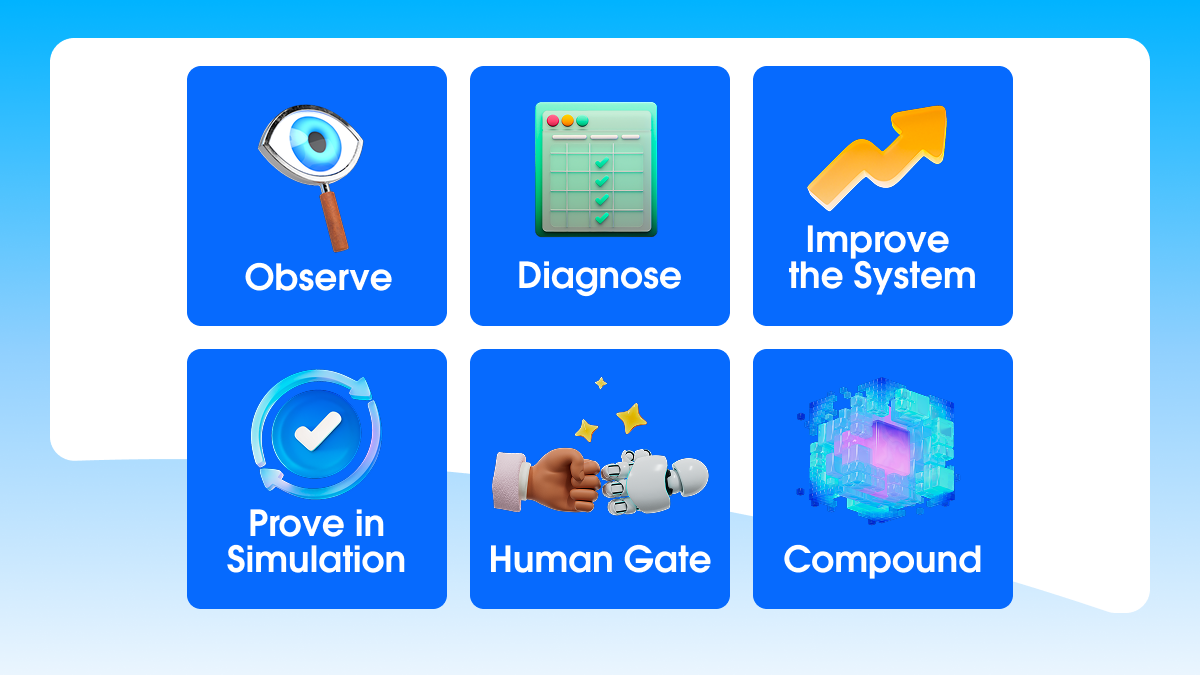
A deployed frontier model is also frozen. It has no mechanism for internalizing what production teaches it. Instead, improvements accumulate in the discrete artifacts around it: prompt edits, retrieval examples, routing rules, and harness code. Production knowledge piles up in words and code while the model’s weights remain untouched. The flywheel is our answer: a continual learning loop that compresses production experience into the continuous space of the model’s weights.
Shopify's GraphQL agent is our clearest example of that loop running in production. That flywheel delivers higher quality than frontier models while reducing latency and cutting costs by 96%.