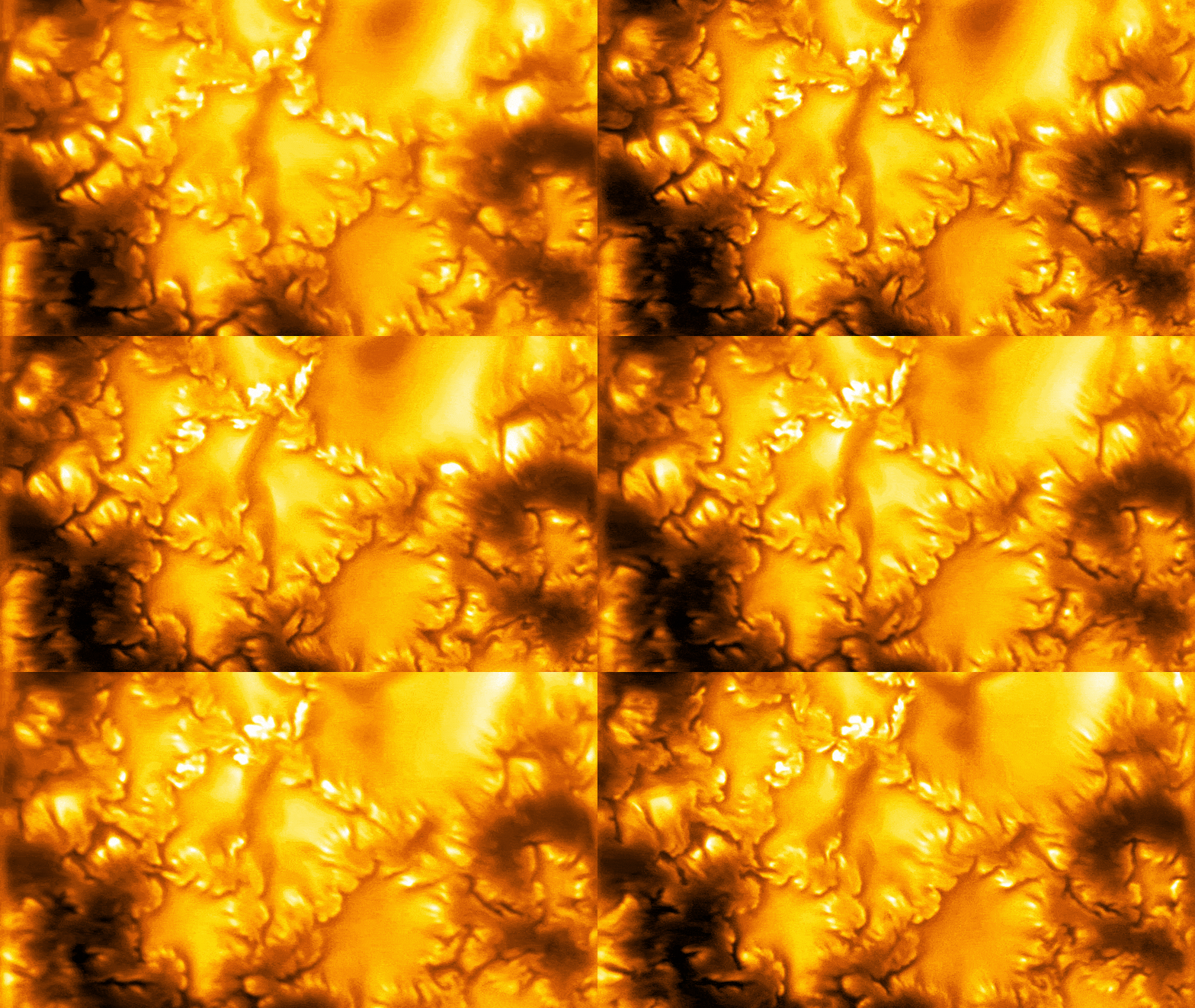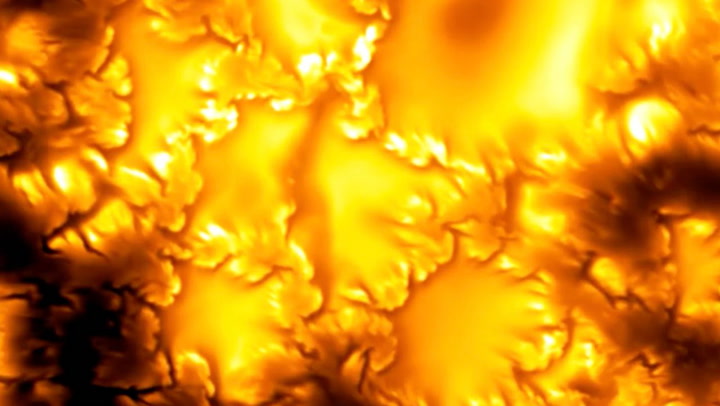
The world’s most powerful solar telescope has captured the highest resolution observations of the sun’s visible surface — and uncovered a hidden process that drives solar activity.
Scientists used the National Science Foundation’s Daniel K. Inouye Solar Telescope, located near the summit of Haleakalā, a volcano on the Hawaiian island of Maui, to zoom into a magnetically active area near a sunspot. Sunspots are considered hotspots of solar activity.
The imagery and time-lapse video reveal an unprecedented look at the sun’s complex and dynamic photosphere, the visible surface of the sun that exists as a thin layer of atmosphere shaped by magnetic fields and currents of fluid plasma.
Combining the detailed imagery with computer simulations helped researchers arrive at a major solar physics breakthrough: identifying the signature of small whirlpools on the sun’s surface that could directly impact life on Earth.
Known as Kelvin-Helmholtz instability, or KHI, the swirling patterns could explain enduring solar mysteries, such as why the sun’s corona, or outer atmosphere, is much hotter than its surface.