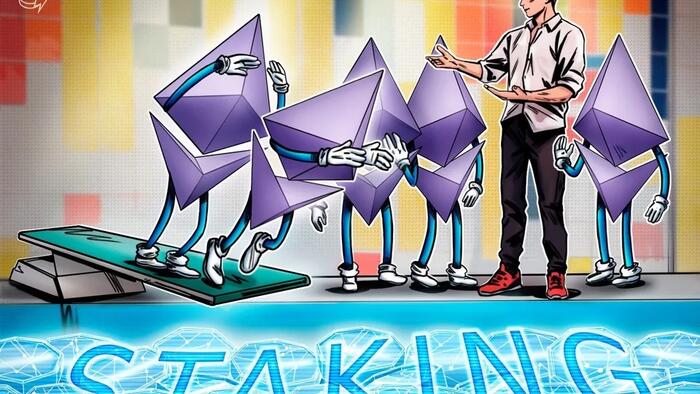
Authored by Felix Ng via CoinTelegraph.com,A group of six Ethereum researchers and developers, including Ethereum Foundation’s Justin Drake, has proposed changing the network’s issuance policy to cut validator rewards more sharply as the proportion of staked ETH rises. The draft, called the Tapered Issuance Burn and currently being assigned the provisional number EIP-8363, would burn an increasing fraction of validators’ consensus rewards as the amount of staked ETH approaches a fixed threshold of 60.25 million ETH (around 50% of the current ETH supply), at which point the deduction hits 100%. The changes would phase in over 18 months. Tapered Issuance Burn Ethereum Improvement Proposal. Source: GithubThe proposal has triggered backlash from developers, stakers and DeFi founders, who warn that the reward cuts could force out solo validators before larger institutions are affected, weaken institutional demand for ETH and disrupt DeFi markets built around staking yield. One of the proposal’s authors, Jérôme de Tychey, said the changes are needed to address the rising share of Ether being staked, which passed 33% in April. The authors argue continued staking growth could concentrate ETH in large custodians and liquid staking providers, while unchecked issuance erodes Ether’s role as a neutral, trustless store of value. “Ever-growing issuance is a dilution tax on every holder: stake, or be diluted. At high ratios, LSTs and other staking derivatives displace raw ETH as the ecosystem’s working money, thus swapping the most neutral, trustless asset for intermediated claims on issuers,” he said.Although EIP-8363 remains an early draft, its publication just two days before a deadline for proposals targeting Ethereum’s Hegotá upgrade has also raised concerns about whether there is enough time to consider the impacts on Ethereum’s tokenomics.EIP-8363 authors’ argument to cut issuance The proposal’s authors argue that under the current curve, staking yield never drops below 1.5% even with all ETH in existence being staked. “The incentive to stake never switches off. Where does it stop? It doesn’t,” said de Tychey. With no changes, a worst-case scenario could see more than 55% of Ethereum supply locked in staking by 2028, he said. “Maximal neutrality & minimal dilution: those are the two fundamentals of a store of value. This EIP not only hardens both, it sets a bar no other blockchain clears.” 🚨 New EIP: Tapered Issuance Burn
Ethereum Researchers Want To Rein In Staking; Critics Warn It Could Backfire
EIP-8363 is a newly published draft proposal that would cut net consensus-layer rewards as the Ethereum staking ratio heads toward 50%...
832 words~4 min read