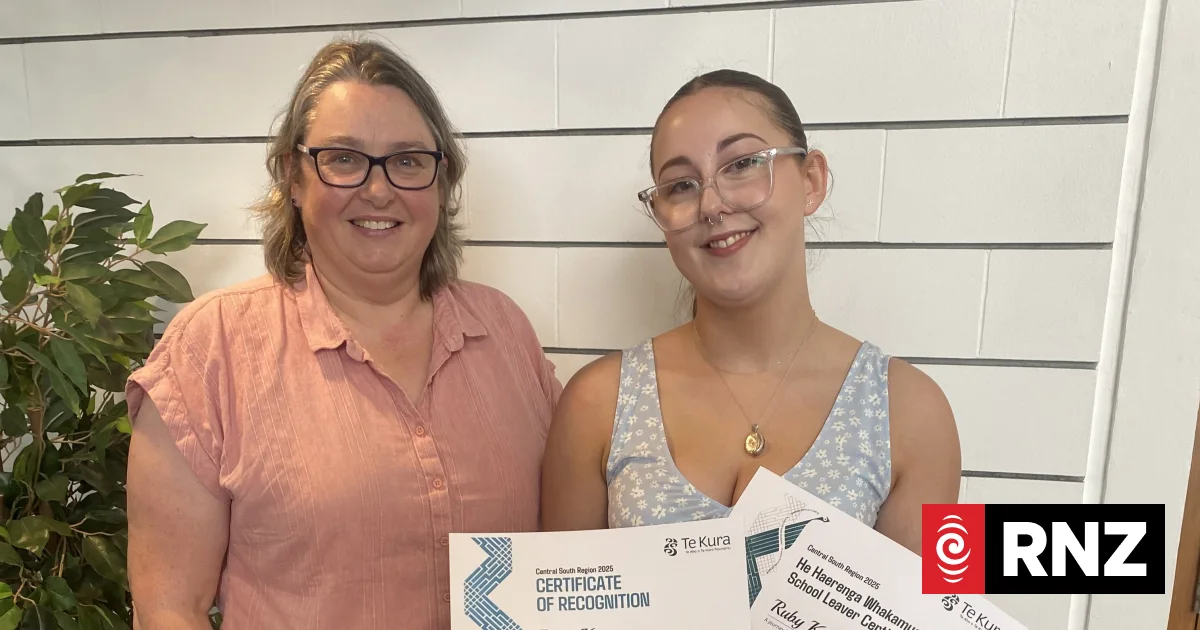
The post-school landscape is bleak for many school leavers because of high youth unemployment, but it's even worse for those who leave without qualificationsWhen you say that nearly 85 percent of New Zealand school kids graduate with some form of qualification, it doesn't sound so bad.But when you give that other 15 percent a number - 10,473 teens in 2025 - that's a lot of young people tossed out into the world who are ill-equipped to deal with it, especially with the unemployment rate for 15- to 19-year-olds now at 25.3 percent."They've lost hope ... their families have often lost hope ... they're floating in a bit of an abyss," says Jen McDonald, the manager of the Whanganui Learning Centre. "They don't know what their direction is in life because they're really not sure that they can succeed at anything."Her not-for-profit organisation is able to take just 15 of these students a year, the aim being to equip them with skills they need to get a job, or pursue their education away from the mainstream.They're often children with trauma, anxiety, bullying issues, or they're neurodivergent and haven't fitted into the school system."What we've found is that if we can give them a space to actually unpack whatever it is that's brought them to our door, quite often they have the answers themselves, but they haven't had an opportunity for somebody to really just sit with them and listen."The biggest thing we're trying to do is build that self-belief and hope, and get them to understand that actually they can succeed."McDonald says the organisation also sees what happens if kids don't get that support, saying they come back through the youth justice system.She says those manual jobs that such kids used to be able to pick up just aren't there anymore, and "apart from that, a lot of these young people just don't have those skills, whether it's resilience or the ability to communicate and engage effectively with people; often those skills are lacking alongside your literacy, your numeracy".McDonald describes it as a poverty of experience."They haven't had the experiences to gain the skills to be able to get ahead, and when they do there's very few jobs there for them anyway."One of the Learning Centre's promising graduates is Ruby King, who turned up as a 16-year-old with no qualifications.King talks to The Detail about how, with help from mentors, she continued her education through Te Kura, the correspondence school, and graduated with NCEA Level 3 and University Entrance. Now nearly 20, she is doing volunteer work at the Alexander Heritage and Research Library in Whanganui, and is curating her own exhibition on the town's dark history, which will run throughout October.The Education Review Office said in June that most teens enrolled in various forms of alternative education leave without any qualifications and too many go on to benefits or crime. But that's not Ruby's experience."I wish I could scream it from a rooftop that alternative schooling is incredible," she says."I have always struggled in school," she says. "It wasn't till I left high school at 16 that I discovered that I had ADHD. That was a big part of, I feel, the reason why I didn't fit into the mainstream schooling system. It just wasn't for me."She says at school she "associated with not the greatest of people, and I think the teachers at school noticed that, and didn't give me the help I probably needed because neither of us realised that was what I wanted".RNZ's education correspondent John Gerritsen says the continuing high level of school leavers with no qualifications has affected schools across the board, but is particularly bad for poorer communities, and Māori and Pasifika children."It's actually quite startling," he tells The Detail.The 15 percent figure has remained steady for the last three years, which coincides with the introduction of tougher numeracy and literacy standards for NCEA."Certainly when you talk to principals about it they do say that there is this group of students who just struggle with these literacy and numeracy tests."Some students, who, principals and teachers say are actually pretty good at reading, writing, and maths, just struggle with an online test."You can apply to do that test on paper; and you can also be deemed to have passed the test by gaining an extra 20 literacy or numeracy credits, but that's on top of what you need for NCEA."What we're hearing from the schools is that some kids, they'll try these tests, and they'll just lose hope - they'll fail, and we know ... the cohort that goes back for a second or third or fourth try have low pass rates."The cost of this is pretty high. If you look at research that's been done into earning rates for people who have no school qualification at all, it's about 20 percent lower than someone who has school qualifications. So there's a life-long cost to this."Gerritsen says the government believes that its overhaul of the system will help address a lot of these problems. It has also been giving schools extra resourcing to deal with the number of kids failing the numeracy and literacy requirements."But as you can see from these figures, it's not clear that it's had any really noticeable effect yet."Check out how to listen to and follow The Detail here.You can also get in touch with us by emailing thedetail@rnz.co.nz
No hope and no prospects for thousands of Kiwi teens
The post-school landscape is bleak for many school leavers because of high youth unemployment, but it's even worse for those who leave without qualifications
898 words~4 min read