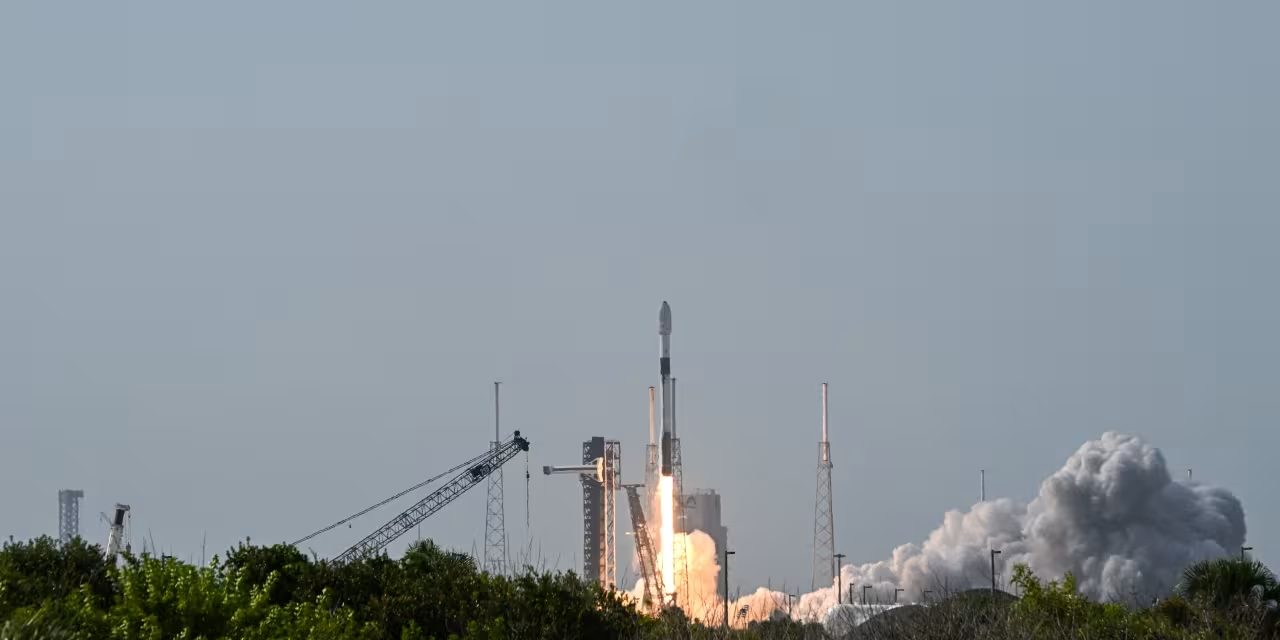
CAPE CANAVERAL, FLORIDA - OCTOBER 13: In this handout provided by NASA, a SpaceX Falcon Heavy rocket with the Psyche spacecraft onboard is launched from Launch Complex 39A, October 13, 2023 at NASA's Kennedy Space Center in Cape Canaveral, Florida. NASA's Psyche spacecraft will travel to a metal-rich asteroid by the same name orbiting the Sun between Mars and Jupiter to study its composition. The spacecraft also carries the agency's Deep Space Optical Communications technology demonstration, which will test laser communications beyond the Moon. (Photo by Aubrey Gemignani/NASA via Getty Images)NASA via Getty ImagesSpaceX shares fell 11% Wednesday after the company revealed a far larger‑than‑expected $18.4 billion surge in second‑quarter capital spending — most of it tied to AI infrastructure — overshadowing a strong revenue beat in its first earnings report as a public company.The reason for the post-earnings drop appears tied to SpaceX — which consists of a profitable satellite internet service provider and money-losing rocket launch and AI units, as I wrote last month — spending far more on AI capital expenditures than investors expected, per CNBC. That might have been acceptable had SpaceX not fallen short on most of the stock market’s four tests for AI cloud services providers — which became clear as investors slammed Meta while rewarding Amazon and Microsoft for their latest results. These tests — the market’s way of assessing whether companies get an adequate return on their AI investments — include the following: Demand and Capacity — Is demand already contracted or capacity constrained?AI Revenue Acceleration — Is AI-related revenue accelerating?Profitability and Cash Flow — Are operating profit and cash generation holding up?Capex-to-Returns Bridge — Does management provide a credible bridge from capex to returns?To be sure, AI-related revenue grew 247%, so the company passed the second test. However, with a $1.3 billion loss and AI capex of $15.8 billion, SpaceX appears to fall short on the third test. The market’s reaction suggests the evidence for affirmative answers to the first and fourth tests was not compelling.Things do not look great for SpaceX investors. Although CEO Elon Musk confidently predicted $100 billion in 2026 revenue, according to Bloomberg, the publication forecasts $38.5 billion in revenue for 2026. One analyst set a price target of $62 — suggesting the stock is worth roughly half its current price as about 119 million shares could be sold by insiders on August 6.MORE FOR YOUSpaceX’s Quarterly ReportSpaceX is a profitable satellite communications business saddled to a reusable rocket launch service and an AI and social networks unit, both of which lose money. SpaceX exceeded second-quarter analyst views on revenue, net loss and loss per share. Revenue rose 92% to $7.81 billion, exceeding consensus estimates by 14%; its net loss fell 46% to $541 million; and the nine-cent loss per share was 14 cents less than the analyst consensus.SpaceX’s Connectivity unit — which operates the Starlink communications business — saw revenue increase 66% to $4.29 billion and reached 12 million users, generating $1.7 billion in operating income. However, price competition from Amazon Leo and others contributed to a drop in average revenue per user — down by a third from $99 a month in 2023 to $66 a month in the first quarter of 2026.The company’s two loss-making units are as follows:Space (launch + Starship) posted 29% higher revenue to $962 million along with a $542 million operating loss.AI saw revenue soar 237% to $2.56 billion and lost $1.3 billion. The market reacted most strongly to SpaceX’s 557% increase in second-quarter capital expenditures. In Q2, capex rose from $2.8 billion to $18.4 billion — with $15.8 billion going to AI infrastructure, 21% more than analysts expected. Moreover, SpaceX provided no formal financial guidance.Why SpaceX Stock Is FallingAI capex sends stock prices up as long as the company’s capacity is sold out, there is a visible backlog, product revenue accelerates and profitability holds up. That dynamic sent Amazon stock up July 31. Investors bought the stock on evidence AWS revenue grew faster than capex. They embraced CEO Andy Jassy’s statement that once revenue growth outpaces incremental capex growth, the resulting cash flow and returns become compelling, CNBC reported.Revenue for AWS rose 37% to $42.2 billion — six percentage points above consensus — while operating income of $16.6 billion yielded 39.4% operating margin, up about 6.5 percentage points.AWS also disclosed a contracted backlog of $496 billion and a $25 billion annual run rate for both the company’s AI and in-house silicon units (Trainium, Graviton).By contrast, investors sell when cash flow deteriorates faster than measurable revenue. SpaceX demonstrated demand growth and insufficient evidence that its AI capex will produce utilization and returns along the lines of Amazon and Microsoft.Meta — which is trying to build an AI cloud service — saw its stock fall as it is in a predicament similar to SpaceX’s.Where Analysts See SpaceX Stock GoingWall Street sees good times ahead for SpaceX investors. With an average price target of $233.14, 31 Wall Street analysts offering 12-month price targets for the company see 86% upside, according to TipRanks.The bull case is that SpaceX is becoming a “vertically integrated infrastructure platform spanning launch, broadband and compute,” according to Raymond James analyst Brian Gesuale. His $800-a-share price target rests on his argument that lower-cost access to orbit, Starlink cash generation and AI infrastructure create a reinforcing flywheel producing more than $837 billion of revenue and $696 billion in earnings before interest, taxes, depreciation and amortization by 2031.The bear case — with a price target of $62 — hinges on the idea that the current valuation is based on unproven achievements. Morningstar’s Nicolas Owens assigns SpaceX a one-star rating, meaning “very high” uncertainty.Owens gives a 7% probability to the Moonshot scenario in which the company achieves all the IPO’s published targets — such as the $28.5 trillion total addressable market estimate.If you believe SpaceX will exceed investor estimates for contracted AI demand, segment margins, capex discipline and a credible path to free cash flow, buy the stock.If you are uncertain, wait to see what happens after Thursday when up to 119 million SpaceX shares held by insiders hit the market.
SpaceX Stock Falls 11% As AI Capex Surges To $18.4 Billion
SpaceX shares fell 11% after reporting a surge in AI capex that overshadowed strong revenue growth and raised new questions about demand, margins and cash flow.
1,019 words~5 min read