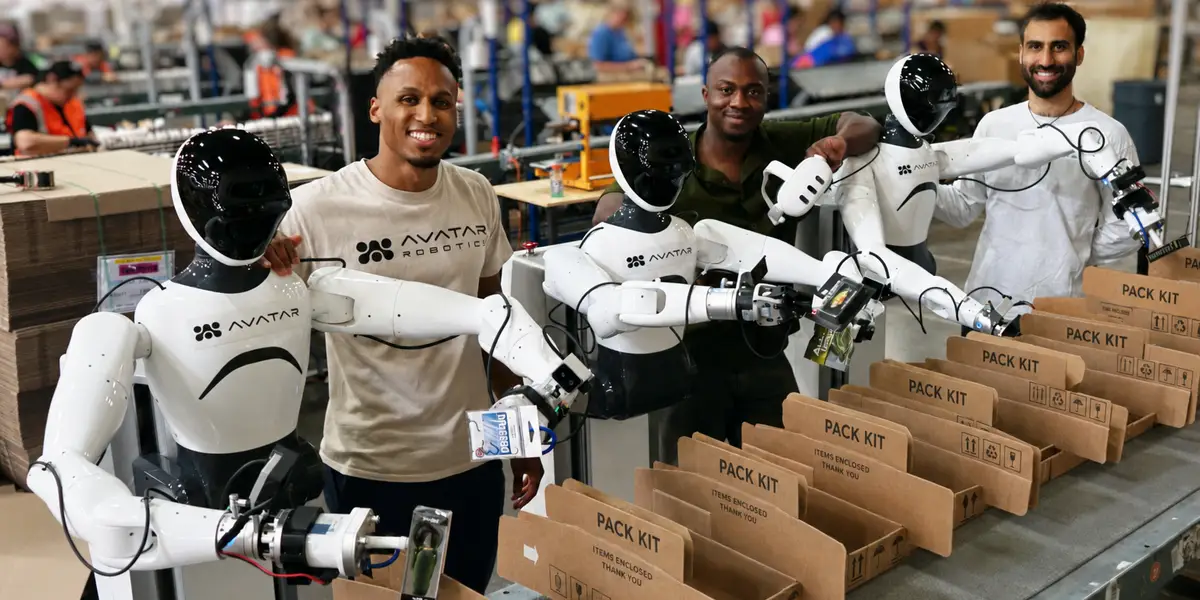
Colin Webb, founder and CEO of Avatar Robotics (middle).
Avatar Robotics
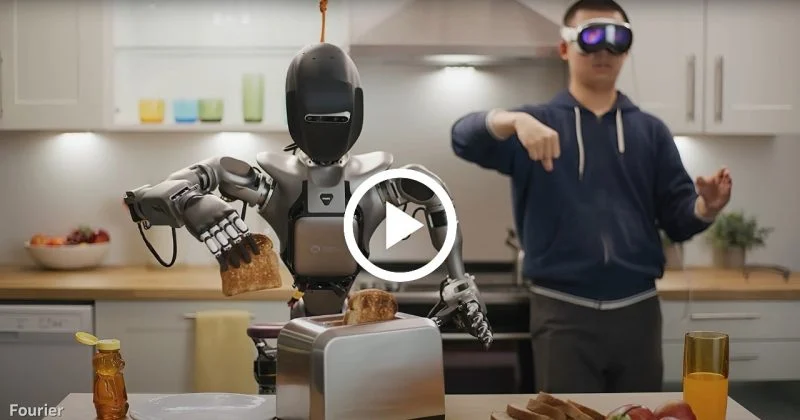
On a cold morning in Dallas shortly before Christmas last year, CEO Colin Webb watched one of his robots work an eight-hour shift alongside warehouse workers. The wheeled machine, equipped with two robotic arms, spent the day packing beauty products into pouches as part of a pilot.A few miles away, a person inside an Airbnb controlled its every move using a Meta Quest headset.The shift tested the unconventional model behind Webb's startup, Avatar Robotics. Rather than waiting for robots to become autonomous, the company puts them to work in warehouses, packing and sorting products under the control of teleoperators, who puppeteer their movements through headsets and handheld controllers.The San Francisco startup announced Wednesday that it has raised a $6.5 million seed round led by AlleyCorp and Defy.vc, Headline, and Henry Ford III, among others. It said its robots have packed nearly 1 million items since its launch in December and operate across several warehouse facilities.Avatar does not sell its robots directly. Instead, it charges customers a recurring fee that Webb said is less than the cost of hiring warehouse workers directly. That's because many of its teleoperators are contractors based in Mexico, Colombia, and the Philippines, earning between $5 and $20 an hour depending on their location. Customers know the machines are remote workers in robotic bodies, Webb said.There's a bigger prize buried in this arrangement. As investors pour billions into "physical AI" — systems built to act in the real world — robotics companies are scrambling for real-world data needed to train the "brains" behind them. Startups, including microagi, Turing, and micro1, already pay people to record themselves performing tasks such as cleaning homes and cooking meals.Avatar's operators generate that data while performing work for paying customers. Every teleoperation session captures what the robot sees and how its human operator responds in real time. Avatar uses that information to adapt open-source robotics models, with the goal of teaching its machines to do more of the work on their own.