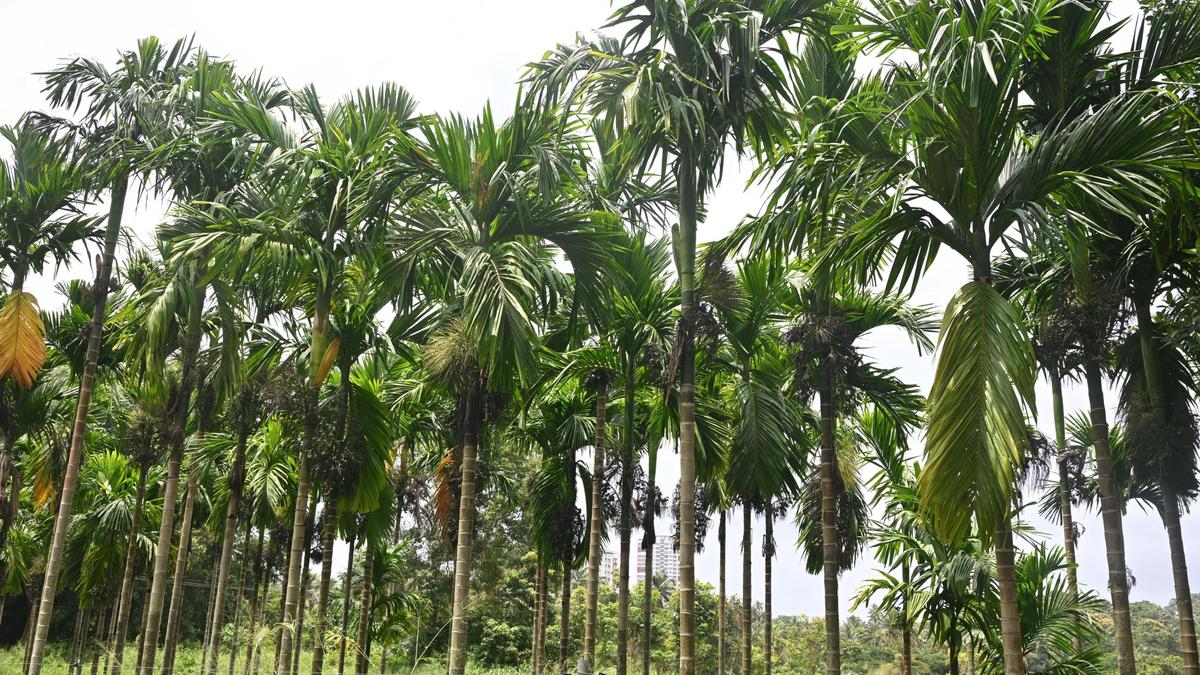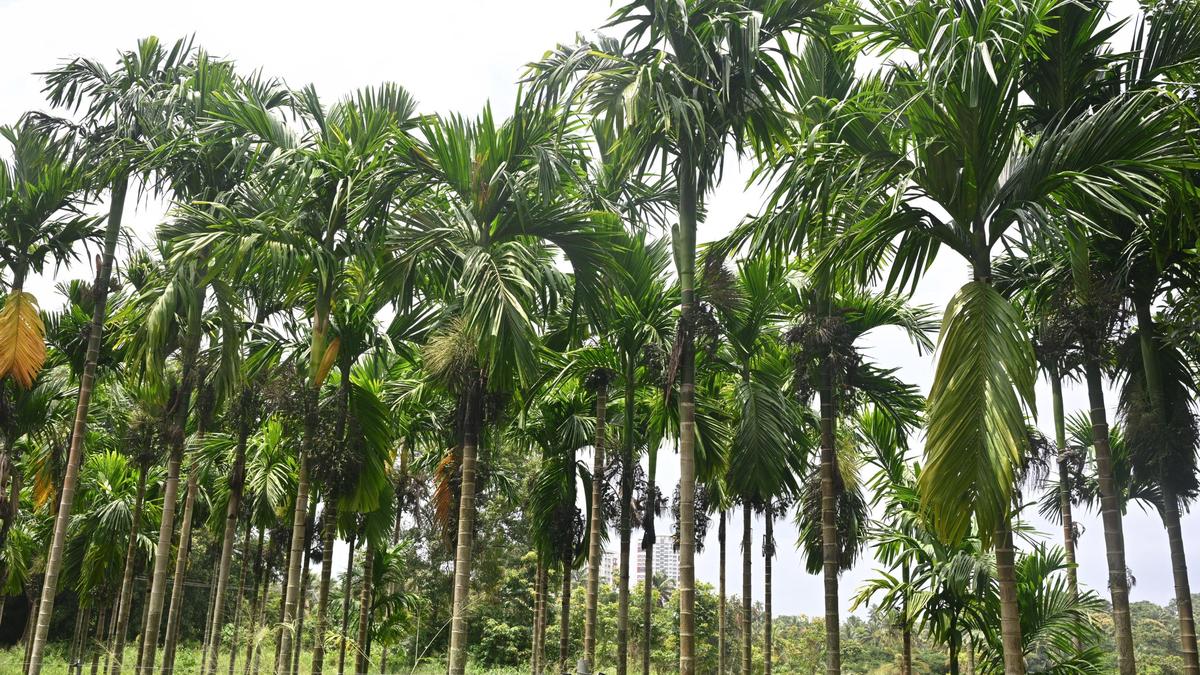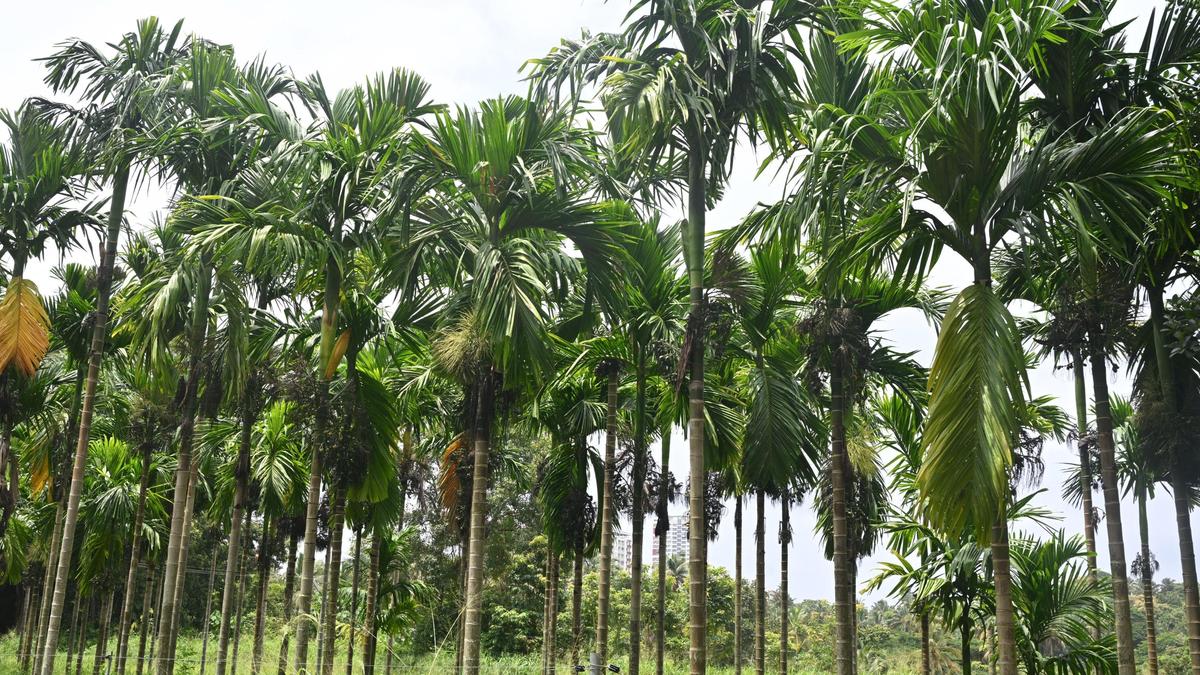
India’s arecanut cultivation area has expanded by around 30 per cent over the past five years, driven by rapid growth in non-traditional States such as Tamil Nadu, Andhra Pradesh, Meghalaya and Nagaland.
| Photo Credit:
India has seen an increase of around 30 per cent in area under arecanut cultivation in the past five years. However, total production and productivity have declined significantly.Total area under arecanut cultivation increased from 8.49 lakh hectares (lh) in 2021-22 to 11.06 lh in 2025-26 (second advance estimates), an addition of 2.56 lh. Non-traditional arecanut-growing states such as Tamil Nadu and Andhra Pradesh in south India, and Meghalaya and Nagaland in north-east India, have seen significant growth in area and production over the last five years.Karnataka, which accounts for 71.56 per cent of the country’s total area (7.98 lakh hectares) and 75.47 per cent of total production (11.32 lakh tonnes), has seen a 32.42 per cent increase in area, and a decline of 16 per cent and 36.60 per cent, respectively, in production and productivity over the last five years.According to the data furnished by the Government in the Lok Sabha, arecanut production declined to 15.29 lakh tonnes (lt) in 2025-26 (second advance estimates) from 16.66 lt in 2021-22, and productivity declined to 1.38 tonne per hectare from 1.96 tonne per hectare.Non-traditional regions drive acreage growthThe percentage growth in area under cultivation was steep in Meghalaya (195.15 per cent) over the last five years, followed by Nagaland (177.14 per cent), Andhra Pradesh (171.17 per cent), and Tamil Nadu (92.25 per cent).Mahesh Puchhappady, President of All-India Arecanut Growers’ Association, told businessline that there were reports of large quantities of seedlings being sent from nurseries in coastal Karnataka to Tamil Nadu in recent years. Unlike traditional areas that depend on monsoon rains and traditional water sources, some people in non-traditional areas are using borewells to irrigate their plantations, he said.Karnataka records lower output amid disease impactInterestingly, the major arecanut-growing state, Karnataka, has seen a decline in production in traditional growing areas and an increase in production in newly added non-traditional areas.Referring to the minister’s recent statement in the Karnataka Legislature, Puchhappady said the crop is now grown in almost every district of Karnataka, barring two. Even districts in dry-belt areas have taken up arecanut cultivation, he said.In a separate answer on Tuesday, Lok Sabha was informed that around 9 lakh arecanut seedlings were available in the departmental farms in Karnataka during 2026-27. A significant portion of these materials was also available in non-traditional arecanut-growing regions.While the traditional arecanut-growing districts in Karnataka, such as Dakshina Kannada, Shivamogga, and Tumakuru, that have more than 1 lh under arecanut cultivation have seen a growth in area under the crop, there has been a significant decline in production in these areas.Dakshina Kannada’s production dropped from 2.74 lt in 2021-22 to 1.41 lt in 2025-26 (second advance estimates), a decline of 1.33 lt. Shivamogga’s production dropped from 2.37 lt to 1.49 lt, a decline of 88,000 tonnes; and Tumakuru’s production to 1.17 lt from 1.60 lt, a decline of 43,000 tonnes.Declines in production are attributed to fruit rot and leaf spot diseases in plantations. Puchhappady said these diseases had affected about 50-60 per cent of plantations in the past few years.Published on August 5, 2026