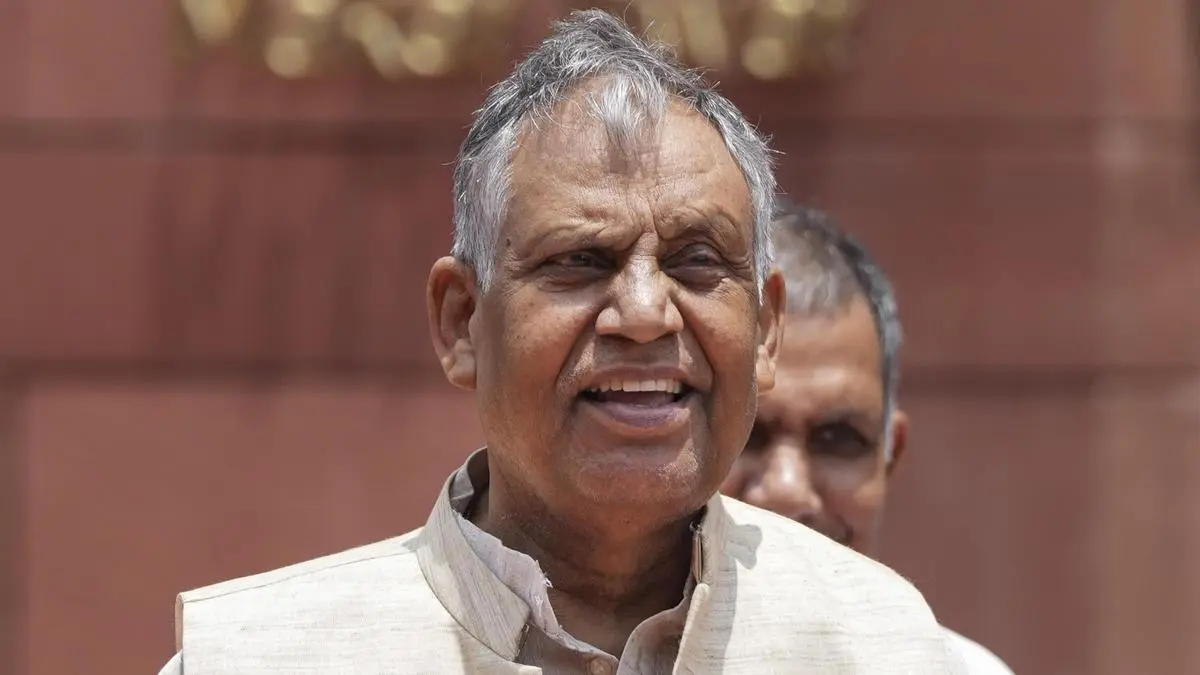
Ramnath Thakur, Union Minister of State for Agriculture and Farmers’ Welfare
| Photo Credit:
The Indian Government has said that the total cultivable land in India has decreased over the past three years. However, the gross cropped area has expanded significantly.Citing the Land Use Statistics 2024-25, Ramnath Thakur, Union Minister of State for Agriculture and Farmers’ Welfare, said in a written reply in Rajya Sabha on Friday that the total cultivable land across the country stood at 179.43 million hectares (mh) in 2024-25 and 179.77 mh in 2023-24. It was at 179.98 mh in 2022–23.Stating that the gross cropped area has expanded significantly, he said it increased from 198.28 mh in 2014-15 to 225.19 mh in 2024-25.The adoption of modern technologies and effective policy interventions have led to a continuous improvement in cropping intensity, which has risen from 142.2 per cent in 2014-15 to 159.7 per cent in 2024-25. He said this reflected a positive shift toward multiple cropping practices, highlighting farmers’ enhanced ability to cultivate the same land more than once annually.Additionally, foodgrain production has increased from 252.02 million tonnes (mt) in 2014-15 to 376.56 mt in 2025-26 (advance estimates), while horticulture production has increased from 280.98 mt in 2014-15 to 377.77 mt in 2025-26 (advance estimates).Makhana production upTo a separate question on makhana production in the country, Thakur said the Horticulture Statistics Unit under the Department of Agriculture and Farmers Welfare started recording data on makhana from 2024-25.In 2024-25, the total production of makhana in India was 63,910 tonnes with an average productivity of 2.03 tonnes per hectare. As per the Second Advance Estimates (2025-26), total production of makhana in India stood at 80,590 tonnes with an average productivity of 2.34 tonnes per hectare. Bihar was the leading producer of makhana in the country in 2025-26, with a production of 60,000 tonnes and average productivity of 2 tonnes per hectare.Makhana exportsPrior to 2025, makhana was classified under general Harmonized System of Nomenclature (HSN) codes. This resulted in the non-availability of product-specific export data. To address this gap, the Directorate General of Foreign Trade (DGFT) introduced a separate HSN code for popped makhana and other makhana products in 2025.India exported 7,264.89 tonnes of makhana products (export value ₹192.96 crore) in 2025-26. Of this, Bihar exported 39.20 tonnes of makhana products (export value ₹4.03 crore).Replying to another separate query, Bhagirath Choudhary, Union Minister of State for Agriculture and Farmers’ Welfare, highlighted the technologies and interventions developed by ICAR-National Research Centre for Makhana, Darbhanga, to improve makhana production in the country.He said the development of high-yielding makhana variety ‘Swarna Vaidehi’ with an average yield potential of 28-30 quintals per hectare, nearly double that of conventional cultivation (14-16 quintals per hectare), accompanied by a complete package of improved practices, marks a significant advancement in aquatic crop production.Complementing this, two thorn-less water chestnut varieties – ‘Swarna Harit’ and ‘Swarna Lohit’ -- have been developed which can be cultivated after makhana harvest, thereby enhancing cropping intensity, optimising land use and boosting farmers’ income, he said.The innovation of makhana-cum-fish farming system has proven effective, particularly in Chaur land, offering 40-50 per cent higher income compared to solo makhana farming, he added.Published on August 7, 2026