Government bonds also continued to benefit. The 10yr Treasury yield fell -6.3bps to 4.61%, and while breakevens led the decline, real yields moved lower too, with the 30yr real yield falling -3.8bps to 2.97%. The Treasury curve is a touch lower again overnight, with 10yr yields down -0.8bps overnight, even as Kansas City Fed President Schmid struck a hawkish tone yesterday evening, saying that “bringing inflation down to the Fed’s 2% objective will require tighter policy”.In Europe, bund yields declined -4.5bps to 3.11%, while gilts rallied a further -5.7bps to 4.90%, extending the strong performance seen since oil began reversing lower at the start of the week. Peripheral debt also performed strongly, with 10yr BTP yields falling -7.1bps to 3.86%, with a -15.8bps decline so far this week marking their best two-day run since May.Importantly however, the bond rally wasn’t fueled by weaker growth. The JOLTS survey for June did show job openings easing to 7.36 million from 7.54 million previously, but most of the survey’s details remained constructive, with hiring picking up, layoffs staying subdued, the quits rate stable at an upwardly revised 2.0% (vs 1.9% expected) and the ratio of vacancies to unemployed workers little changed at 1.04 (vs. 1.03 prev.). In addition to this steady labour market signal, June durable goods orders were revised up to +0.5% mom (+0.3% exp.) with core capital goods orders rising +1.2% (+0.9% exp).That combination of lower oil prices, falling inflation expectations and still-resilient US data proved an ideal backdrop for risk assets. The S&P 500 rose +1.79%, closing at an all-time high for the first time in two months. Tech stocks outperformed, with the Nasdaq up +2.59%, though the Mag-7 (+0.73%) underperformed. The AI complex was even stronger, with the Philadelphia Semiconductor Index surging +6.55%, its strongest daily gain since March and extending its rise since last Wednesday to +16.58%, its biggest 4-day advance since 2020. So the rebound in semiconductors continues to gather pace. After enduring a correction of more than -20% during July, investors appear increasingly willing to re-engage with the AI trade. Helping sentiment were Palantir's (+29.45%) strong outlook, reports of Anthropic agreeing a $10bn computing infrastructure deal to meet demand for its models, and Caterpillar (+5.60%) raising sales guidance whilst pushing back on concerns that data-centre demand is slowing. Together, that helped rebuild investor confidence in the broader AI capex cycle after July's turbulence.Another interesting AI-related development came from the networking space. Reuters reported that the Federal Communications Commission is drafting a ban on imports of new Chinese optical transceivers, critical components that allow information to travel through fibre-optic cables inside data centres. The news boosted US optical-networking names, with Marvell Technology up +12.81% and Coherent gaining +12.35%, as investors anticipated a shift in demand towards domestic suppliers. While a niche story on the surface, it is another reminder of how AI supply chains are part of broader strategic competition between the US and China.A bit of shine came off the tech performance overnight following results from SpaceX and AMD. SpaceX fell by over -7% after-hours after reporting higher AI capex spending, though that decline was smaller than the +9.43% jump in yesterday’s regular session. AMD shares also slid in extended trading as the chipmaker’s Q3 revenue guidance ($13bn vs $12.5bn) came in slightly ahead of consensus but below the more optimistic estimates. This leaves NASDAQ futures (+0.11%) underperforming those on the S&P 500 (+0.32%), but the overall equity mood remains positive overnight.Optimism is also visible in Asian markets this morning. Across the region, the KOSPI (+4.32%) and the Nikkei (+3.32%) are leading gains. Mainland Chinese stocks are moving higher with the Shanghai Composite (+1.34%) outperforming the CSI 300 (+0.99%), while the Hang Seng (+0.11%) is little changed. The China market performance hasn’t been helped by the RatingDog Services PMI for July, which fell from 54.1 to 50.4 (vs 53.7 expected). That’s its lowest level since September 2024, pointing to still soft domestic demand in China. Meanwhile, the S&P/ASX 200 (+0.71%) is on course to eclipse its record high reached back on March 2, helped by a strong June household spending print (+0.8% MoM vs +0.2% expected).Elsewhere, European equity indices continued to push into record territory yesterday. The Stoxx 600 (+0.73%), DAX (+0.77%), CAC (+0.61%) and FTSE MIB (+1.26%) all reached new all-time highs, while the FTSE 100 (+0.20%) is just 0.3% below its own historic peak. So beyond the US, investors are increasingly embracing the combination of lower oil prices and easing inflation concerns.
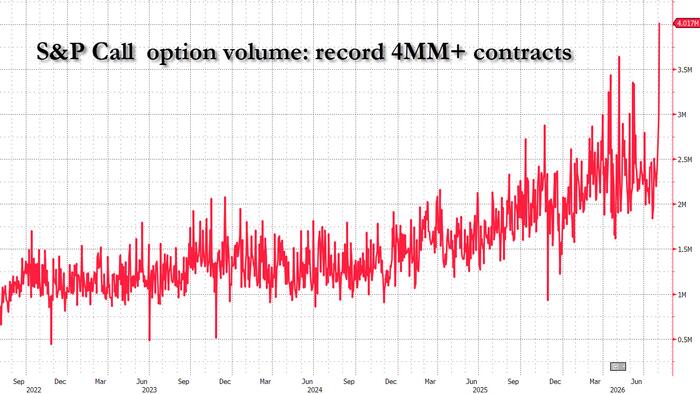
Futures Hit New Record High On Strong Earnings Following Historic Call Buying Frenzy
“Albeit there was some disappointment on the micro level, the numbers are still confirming that the overarching macro trend is intact as they confirm the durability of the compute build-out. Thus, tech as a whole can benefit even if single players suffer.”
TL;DRAI
Semiconductor index +6.55% on Anthropic's $10bn compute deal, Palantir +29.45%, signaling renewed AI capex conviction post-July. FCC ban on Chinese optical transceivers redirects demand to US suppliers (Marvell +12.81%), underscoring AI infrastructure as strategic asset.
1,102 words~5 min read