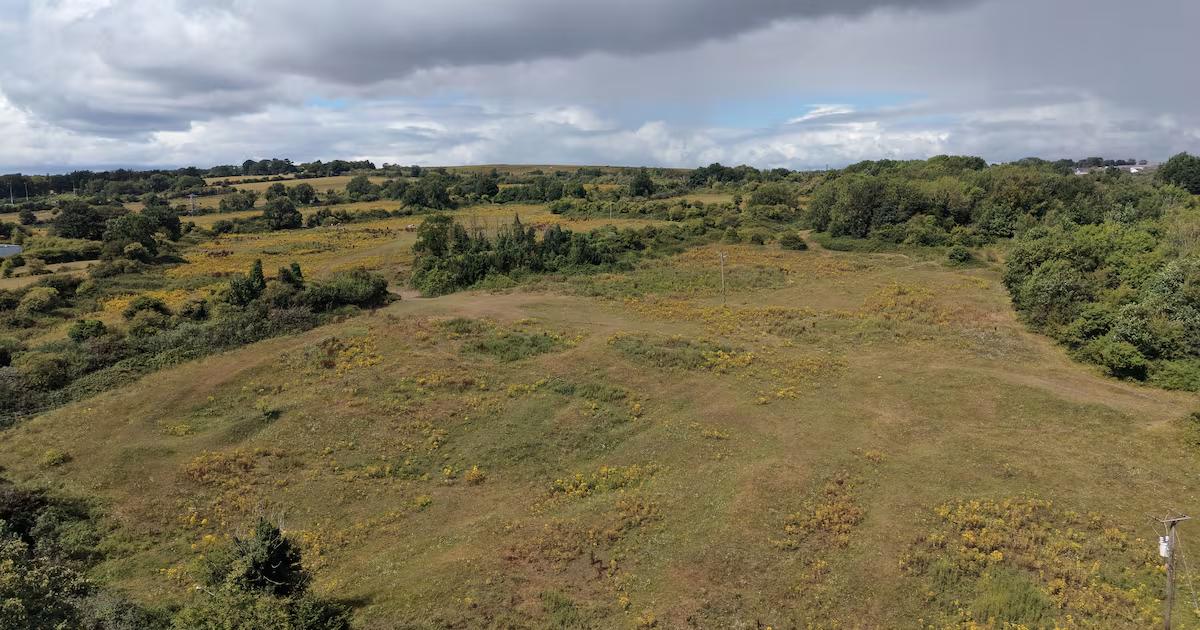
Construction of 18,500 homes at Dunsink in north Dublin, near what was once the capital’s main landfill, can only go ahead if the State’s two largest sewage- and water-supply schemes are built, Uisce Éireann has told Fingal County Council.The council plans to develop what would be the State’s largest town, with a population of more than 46,000, on more than 1,000 acres at the largest tract of undeveloped land inside the M50 .However, Uisce Éireann said the vast housing scheme could only be accommodated once the €6-billion project to pipe water from the river Shannon to Dublin and the €1.3-billion Greater Dublin Drainage Project are completed.The Greater Dublin Drainage Project, intended to process the sewage of 500,000 people, last year secured permission almost 14 years after planning began for the scheme. An application for permission for the water-supply project was submitted to An Coimisiún Pleanála last December.The council has published a draft Dunsink Urban Area Plan to develop the land beside Finglas, Ashtown, Castleknock and Blanchardstown in three phases with 2,500 homes in the first phase, followed by two larger phases of 8,000 each. Most of the homes will be apartments, in blocks up to 15 storeys tall.In a submission on the draft plan, Uisce Éireann said it could accommodate the initial phase of about 2,500 homes near Finglas with “some local upgrades”. However, the development of the overall lands would “require the delivery of both the Water-Supply Project (WSP) and the Greater Dublin Drainage Project (GDD)”, it said.“The WSP has been submitted for planning. However, until approval is received, there is uncertainty regarding the project’s delivery time frame,” it said. “Similarly, although the GDD project has secured planning approval and is currently anticipated to be operational by 2032, this timeline remains subject to change until construction has commenced,” it told the council.“Given the dependency of future housing development on the provision of strategic water services infrastructure, continued engagement and co-ordination between Fingal County Council and Uisce Éireann will be essential to ensure alignment between housing delivery and the timely provision of the necessary infrastructure.”Uisce Éireann “supports the principle of sustainable, infrastructure-led growth within the Dunsink Urban Area Plan lands”, it said. “However, the successful delivery of the scale of development proposed will require substantial and co-ordinated investment in water and wastewater infrastructure.”In its draft plan, the council said the big Uisce Éireann projects “will be important in facilitating long-term water demand associated with development within the Dunsink area”. The draft plan “supports water conservation and demand-management measures in all new development proposals. Planning applications shall demonstrate how water efficiency measures have been incorporated into the design of proposals”, the council said.Hundreds of residents of the existing suburbs have made submissions to the council opposing the plans, in part or in their entirety, with concerns around increased traffic, height and density, the potential loss of a golf facility and the health risks associated with building near the old landfill.The landfill, once Dublin’s largest dump, closed more than 20 years ago. The council said, “given its previous use, this area has limited development potential”. Instead, it has designated the site, which occupies most of the northern section of the land bank, for a regional park, with the housing to be built in phases from east to west, south of the landfill.Large numbers of submissions on the draft plan, made in advance of the deadline last Friday, said the health and environmental impacts of disturbing the dump remained a concern.
Plan for new town at Dunsink ‘requires €7.3bn water investment’ to proceed
Construction of 18,500 homes only feasible if Shannon-to-Dublin water-supply project and Greater Dublin sewage project built
578 words~3 min read