People type 2+2 into Google. They type 9+10. They type 7*8 when they can't remember whether it's 54 or 56. Each of those is a real, high-volume search query — and most of the results are identical calculator widgets. So when I built Wrongulator, a calculator that returns a confidently wrong answer on purpose, I had a question worth asking: what if every expression were its own page, ranking for the exact arithmetic people already search?
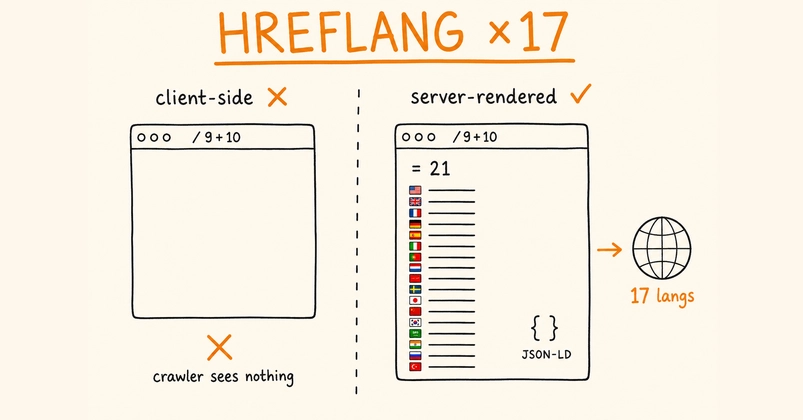
That is programmatic SEO — generating a page per parameter instead of writing pages by hand. And doing it across 17 languages means programmatic SEO with hreflang, where each generated page also declares its 16 translated siblings. The trap is that most programmatic surfaces are thin, duplicative, and get buried by Google. This one isn't, for a specific reason: every page has a real, unique answer baked into the HTML before any JavaScript runs. This post is about how — and the honest costs nobody mentions.
Why a Permalink Per Expression Is Even Possible
A page per expression only works if /2+2 reproduces the same result for everyone, forever, with no database behind it. That property isn't free — it's the result of one design decision I cover in detail in why a viral toy must be wrong the same way every time: the wrong answer is a pure function of the expression, seeded by a stable hash, with no per-user state.