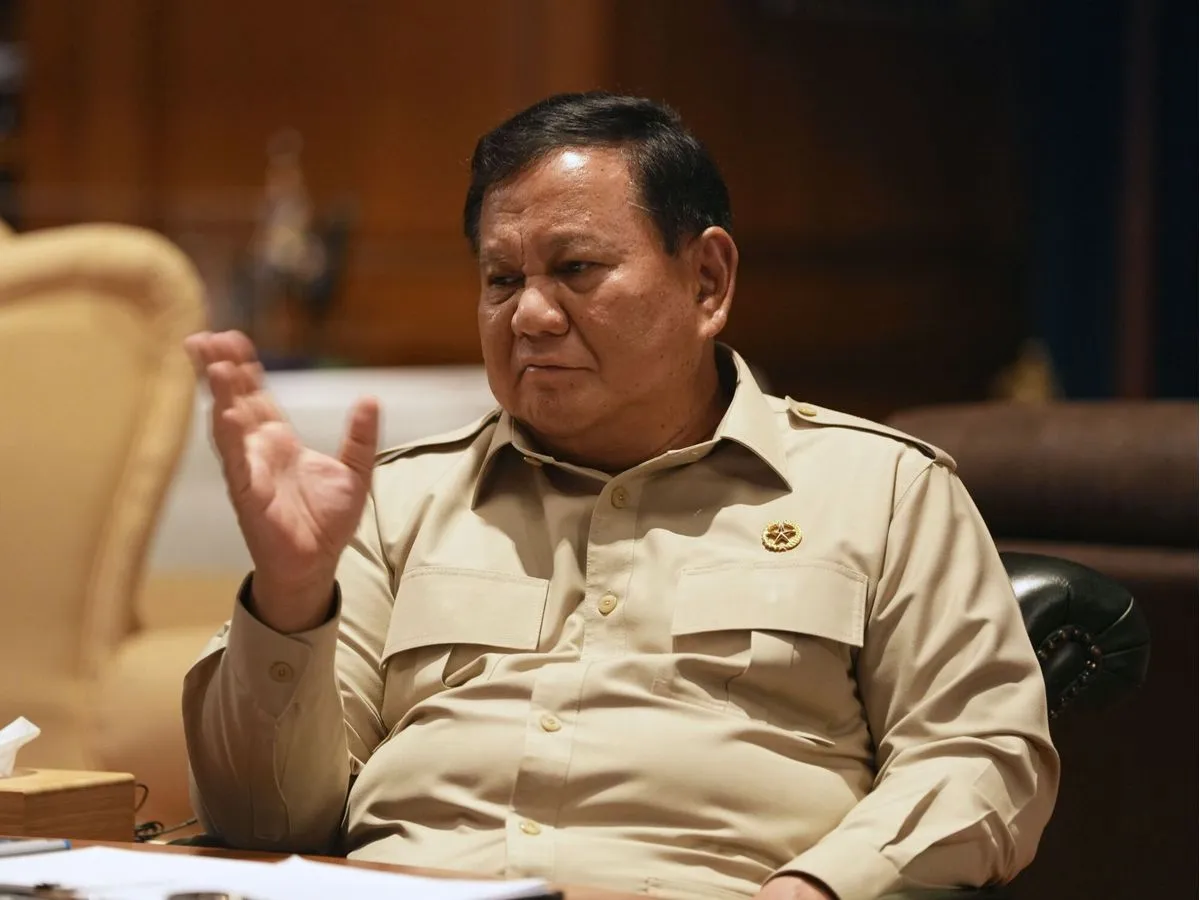
Skip to Content News Archives Economy Energy Oil & Gas Renewables Electric Vehicles Mining Commodities Agriculture Real Estate Mortgages Mortgage Rates Finance Banking Insurance Fintech Cryptocurrency Work Wealth Smart Money Wealth Management Investor Personal Finance Family Finance Retirement Taxes High Net Worth FP Comment Executive Women Puzzmo Newsletters Financial Times Business Essentials More Innovation Information Technology FP500 Podcasts Small Business Lives Told Tails Told Shopping Financial Post Store Obituaries Place a Notice Advertising Advertising With Us Advertising Solutions Postmedia Ad Manager Sponsorship Requests Classifieds Place a Classifieds ad Working Profile Settings My Subscriptions Saved Articles My Offers Newsletters Customer Service FAQ News Economy Energy Mining Real Estate Finance Work Wealth Investor FP Comment Executive Women Puzzmo Newsletters Financial Times Business Essentials HomePMN BusinessPrabowo Eyes Bank Indonesia Chief Aligned With His GoalsGranted independence after the 1997 Asian financial crisis, Indonesia’s central bank remained one of the few institutions to retain autonomy since Prabowo Subianto became president two years ago. Now it looks set to fall more directly under his sway.Author of the article:Last updated 1 day ago You can save this article by registering for free here. Or sign-in if you have an account.Prabowo Subianto Photographer: Dimas Ardian/Bloomberg Photo by Dimas Ardian /Bloomberg(Bloomberg) — Granted independence after the 1997 Asian financial crisis, Indonesia’s central bank remained one of the few institutions to retain autonomy since Prabowo Subianto became president two years ago. Now it looks set to fall more directly under his sway.Subscribe now to read the latest news in your city and across Canada.Exclusive articles from Barbara Shecter, Joe O'Connor, Gabriel Friedman, and others.Daily content from Financial Times, the world's leading global business publication.Unlimited online access to read articles from Financial Post, National Post and 15 news sites across Canada with one account.National Post ePaper, an electronic replica of the print edition to view on any device, share and comment on.Daily puzzles, including the New York Times Crossword.Subscribe now to read the latest news in your city and across Canada.Exclusive articles from Barbara Shecter, Joe O'Connor, Gabriel Friedman and others.Daily content from Financial Times, the world's leading global business publication.Unlimited online access to read articles from Financial Post, National Post and 15 news sites across Canada with one account.National Post ePaper, an electronic replica of the print edition to view on any device, share and comment on.Daily puzzles, including the New York Times Crossword.Create an account or sign in to continue with your reading experience.Access articles from across Canada with one account.Share your thoughts and join the conversation in the comments.Enjoy additional articles per month.Get email updates from your favourite authors.Create an account or sign in to continue with your reading experience.Access articles from across Canada with one accountShare your thoughts and join the conversation in the commentsEnjoy additional articles per monthGet email updates from your favourite authorsSign In or Create an AccountorThe shock resignation of Perry Warjiyo as Bank Indonesia governor last week came after a trusted Prabowo confidant reached out and asked him to step down, according to more than half a dozen people familiar with the situation, who requested anonymity to speak freely for this account. Tensions had been building for some time, with personality and policy differences straining the relationship, the people said.While no final decision has been made, insiders see Senior Deputy Governor Destry Damayanti — now serving in a caretaker role — as someone who checks all the boxes. She’s considered a good communicator and consensus builder who is well respected within the central bank, the people said.Get the latest headlines, breaking news and columns.By signing up you consent to receive the above newsletter from Postmedia Network Inc.A welcome email is on its way. If you don't see it, please check your junk folder.The next issue of Top Stories will soon be in your inbox.We encountered an issue signing you up. Please try againSpeaking in Central Java last Thursday at an event that included Damayanti, Prabowo hinted at the possibility the 62-year-old economist takes the role. “Ibu Destry — she is the acting governor,” he said, using a respectful Indonesian title for women. “What do we think? OK? I’ll leave it to parliament.”Prabowo can either nominate someone to finish the remaining two years of Warjiyo’s term, or appoint someone to a fresh five-year term. Parliament, which is dominated by the president’s allies, must then sign off.“What’s feared is a change in the rules of the game,” said Dipo Satria Ramli, an economist at the Jakarta-based Center of Reform on Economics Indonesia. “If the government fails to instill confidence or demonstrate credibility regarding this new process, I believe it will erode market confidence, and ultimately, the rupiah’s value.”Investors have grown increasingly concerned with Prabowo’s erratic policymaking, which has seen him increase state control over the economy. Since he took power in October 2024, the rupiah has fallen 14% against the dollar, the biggest drop among emerging economies in Asia.In that time, the 74-year-old former military man has upended conventions, from clawing back natural resources to clamping down on tycoons. He’s created a new sovereign wealth fund in Danantara that he’s used to help fund his economic agenda and established an entity to oversee and centralize exports of selected strategic commodities, like coal, palm oil and ferro-alloys.Under his tenure, Bank Indonesia has come under intense pressure to align with his broader goals, which include having an economy that’s growing at at least 8%. Prabowo’s nephew, Thomas Djiwandono, was installed as a deputy governor earlier this year.Bank Indonesia declined to comment, including on questions for Damayanti and Djiwandono. Warjiyo didn’t respond to a request for comment. The Government Communication Agency said the government doesn’t comment on speculation, adding that the “independence of Bank Indonesia is guaranteed by law.”“At the same time, constructive coordination between an independent central bank and the government remains an essential part of sound macroeconomic governance,” it said in a statement. “Investors, businesses and the public can remain confident Indonesia’s economic institutions continue to function effectively, with policy continuity and macroeconomic stability maintained.”Damayanti, a Cornell masters graduate, is also a person the president finds easier to deal with than Warjiyo. Since Prabowo took office there’s been a personality and ideological mismatch between himself and Warjiyo that has strained their relationship, the people familiar said.Prabowo wants aggressive growth, while Warjiyo remained focused on preserving monetary and financial stability; Prabowo wants the central bank to be aligned with his policy objectives, but Warjiyo, although he tried to accommodate the president’s demands, wanted to stick within Bank Indonesia’s legal framework that upholds independence.They didn’t have chemistry, nor did they agree on issues like how to put a floor under the rupiah’s weakness or how to inject liquidity, the people said. In several instances, Prabowo’s nephew Djiwandono had to act as a bridge between the two.Deteriorating sentiment toward Indonesia had fueled sustained capital outflows and kept the rupiah under pressure, prompting Warjiyo to deploy a series of defensive measures that at times put the central bank at odds with the government. It issued high yielding short-term securities that contributed to tighter liquidity in the banking system, scaled back its secondary-market purchases of government bonds, allowing yields to rise, and ultimately delivered aggressive interest-rate increases.The measures were intended to draw foreign capital back into Indonesian assets and stabilize the currency, but they also pushed up the government’s borrowing costs. After raising the benchmark rate three times since May, the central bank paused at its regular meeting last month.The president’s disgruntlement even extended to how the former central bank chief explained issues to him. According to people familiar with their exchanges, Warjiyo often talked about policy issues in highly technical terms that frustrated Prabowo, who prefers simpler, more direct explanations. Warjiyo’s communication style at times left Prabowo with the impression he was being spoken down to, the people said.After hearing the same issues explained by other advisers, the president would sometimes remark the governor should communicate that way instead.As the rupiah continued to plumb new lows, Prabowo’s views that Warjiyo and the central bank weren’t doing enough to stem the slide escalated. At the same time, Warjiyo felt increasingly pressured and unable to accommodate the government’s demands.Eventually, Prabowo had the final say and last Monday morning, it was announced Warjiyo had resigned due to personal reasons. Market watchers weren’t convinced; in fact, Warjiyo was asked to go. “It appears there was political pressure that led Perry to step down and this has been evident since the rupiah weakened at the end of 2025,” said Bhima Yudhistira Adhinegara, executive director at Jakarta-based Center of Economic and Law Studies, adding that Warjiyo had been made a scapegoat for fiscal policy missteps such as the widening budget deficit and poorly planned government projects.Warjiyo was in Singapore for a regional central bank forum when, three days prior, on July 24, a person close to Prabowo requested he step down, the people said. Warjiyo wasn’t surprised and had been anticipating such an ask. He was a little caught off guard only because he thought the call would come from the president himself. The next day, Saturday, July 25, Warjiyo drafted a handwritten resignation letter and had it sent to Prabowo before returning to Jakarta to attend a wedding that evening. There was never any face-to-face meeting between the two during the weekend.Damayanti cut short a work trip to Bali to return to Indonesia’s capital. She and Bank Indonesia’s other deputy governors met on Sunday to discuss the leadership transition before holding a small gathering with Warjiyo, eight years in the job, as a farewell.After news of Warjiyo’s resignation broke on Monday, Bank Indonesia sought to reassure markets that it was business as usual. Still, the central bank’s credibility ultimately rests on its perceived independence, and any suggestion that it is being undermined is likely to unsettle investors.“Investors don’t object to Bank Indonesia and the government talking to each other,” Harry Baskoro, a senior fellow at the Center for Indonesian Policy Studies and a former economist at the central bank, said. “What worries them is when Bank Indonesia’s decisions start looking predictable because they’re politically convenient rather than because they follow a clear and credible policy framework.”Adam Ahmad Samdin, an economist at Oxford Economics, said that even if the new appointee “verbally commits to maintaining Bank Indonesia’s operational autonomy, perceptions of reduced central bank independence alone could be sufficient to weigh on confidence and contribute to renewed weakness in the rupiah.”Until now, Bank Indonesia has remained one of the few major economic institutions that Prabowo has limited influence over. Last September, he notably replaced internationally respected Sri Mulyani Indrawati as finance minister in favor of Purbaya Yudhi Sadewa to bring the finance ministry under his fiscal policy objectives.Purbaya, 62, is another possible candidate for the central bank’s top job. The finance minister has repeatedly argued that Bank Indonesia’s efforts to stabilize the rupiah are making it harder for the government to boost growth. His concerns have centered on the cumulative impact of higher interest rates and tighter liquidity in the financial system that he feels have hindered lending and consumption.The Finance Ministry declined to comment, including on questions for Purbaya.Those disagreements became a recurring source of tension between Purbaya and Warjiyo, the people familiar said. Purbaya also raised these concerns with Prabowo in the week leading up to the resignation, according to the people, a development said to have contributed to Warjiyo’s resignation.People familiar with Purbaya’s thinking say he’s long coveted the central bank chief role, even more so than his current finance minister job. Purbaya, who has been finance minister for close to a year, believes money supply is key to influencing economic activity and inflation. Purbaya is often asked whether he will move to the central bank. Speaking to reporters last week, he dismissed it as “just the same old rumor.” “It pops up here and there but it’s never actually come true,” he said.Whoever takes over will inherit the same bind that constrained Warjiyo. Easing too quickly could revive capital outflows and worsen the rupiah’s weakness, while keeping policy tight would continue to weigh on growth and government financing costs. The next governor may find they have less political room to prioritize stability when those objectives collide.That much was also foreshadowed in a newspaper column that ran a few hours after Warjiyo stepped down. In it, Fithra Faisal Hastiadi, a University of Indonesia economist who serves as a senior expert at the Government Communications Agency, wrote that the central bank’s independence has been interpreted too rigidly.“Like a boat with two rowers of equal strength but rowing at different tempos, energy has been expended but the destination doesn’t seem to be getting any closer,” Hastiadi said. “Perhaps the problem with development isn’t always a lack of instruments. Often, the problem is the inability of these instruments to speak a single language.”—With assistance from Ben Otto.(Updates with government comment in 10th paragraph.) Join the Conversation This website uses cookies to personalize your content (including ads), and allows us to analyze our traffic. Read more about cookies here. By continuing to use our site, you agree to our Terms of Use and Privacy Policy.
Prabowo Eyes Bank Indonesia Chief Aligned With His Goals
Granted independence after the 1997 Asian financial crisis, Indonesia’s central bank remained one of the few institutions to retain autonomy since Prabowo Subianto …
2,188 words~10 min read