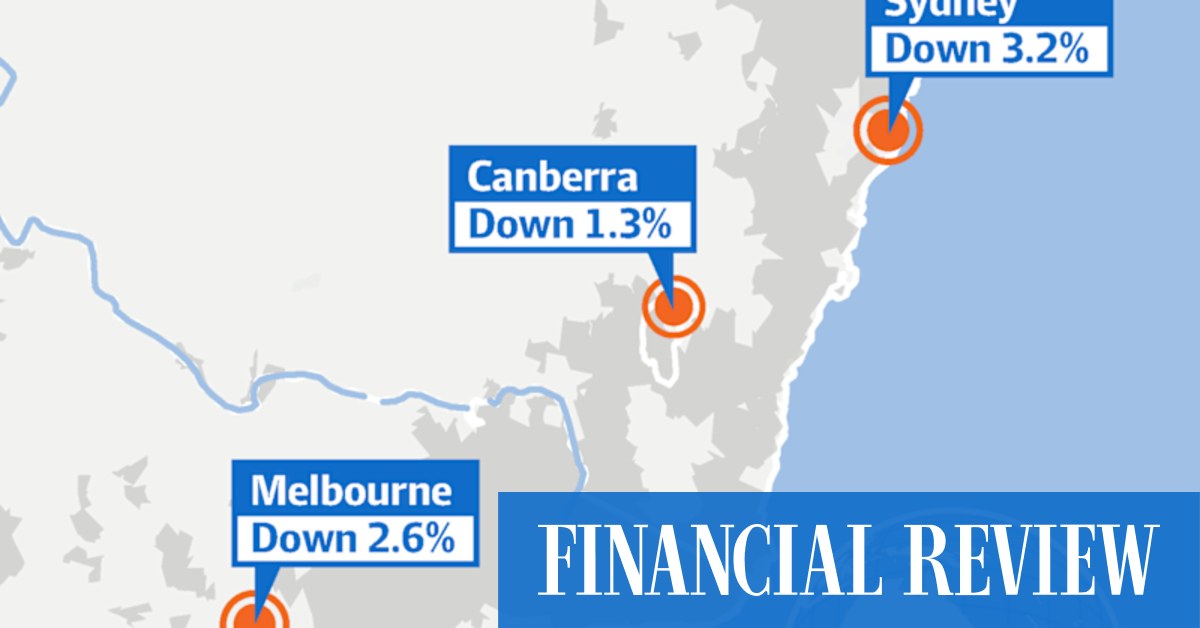
Residential property prices in Australia’s eight capital cities have fallen by an average of 2.5% from their most recent peak in March, according to data published earlier this week by both Cotality and Proptrack. The declines have been somewhat greater in Sydney and Melbourne – 5.6% and 5.7% respectively – where they started earlier, than in other cities. Indeed, prices have not yet begun to fall in Perth, Hobart or Darwin, nor have they (on average) declined outside the capital cities.Those falls are likely to continue, and to become more widespread, for some time yet. The major banks are predicting that capital city prices will be flat to down 5% over the course of 2026, with larger declines of between 3 and 10% in Sydney and Melbourne. Others have forecast that prices could fall by between 5 and 10% this year.It’s important to put these numbers in context. On average, property prices in Australia’s eight capital cities are still up by 47.7% from their lows in the early stages of the pandemic, by 144% from their lows during the global financial crisis of 2008-09, by 365% since the turn of the century, and by 1,007% (yes, more than 1,000%) over the past 40 years. Even a decline of 10% – the most currently being forecast – would leave the vast majority of property owners ahead, and in most cases substantially ahead, of whatever their property initially cost them.The same context needs to be kept in mind when assessing figures tossed around to describe the home values “destroyed” by falling property prices. The 1.6% fall in the average value of all residential properties (including those in regional areas) since the most recent peak will have lowered the total value of Australian residential property by close to $200bn. That sounds like a lot of money – and of course to any individual Australian, it is. But the total value of Australian residential land and buildings, according to the most recent estimates from the Australian Bureau of Statistics, was $12.3tn (yes, trillion) as at 31 March.Sign up for the Breaking News Australia emailEven if prices were to fall by 10% from their peak, the total value of Australian residential real estate would still be more than $11tn. And that is well in excess of the $2.6tn of mortgage debt which is secured against Australian residential property.All of that may be of little comfort to the approximately 45,000 people who have used the government’s 5% deposit scheme to become first home buyers since October last year. Some – although by no means all – of them may now be in a position where their home is, for now at least, worth less than the mortgage they took on in order to buy it (that is, in “negative equity”). That’s an uncomfortable position to be in.But it’s only really a practical problem for those who find themselves having to sell their recently purchased home at a loss – which is likely to only be a small proportion. More likely, through a combination of remaining in their home for up to eight years (the “norm” for first-time buyers) and paying down their mortgage, possibly by more than they’re contractually obliged to (as a large proportion of homebuyers do), they will eventually return to a positive equity position.Those Australians whose only exposure to residential property prices is through their own home – the vast majority of property owners – will, in reality, be little affected by a 5-10% fall in property prices. Yes, their home may realise a smaller amount if and when they sell it than it would have had they sold it late last year (although it will still be worth a lot more than when they originally bought it). But if they are selling in order to “trade up” to a larger home, or one in a more “desirable location”, that home will also likely cost them less than it would have last year. And if they’re “downsizing”, the smaller home that they’re buying will also cost them less.Of course, a much larger decline in property prices (which no one is currently forecasting) could create broader problems for the economy and, potentially, the financial system.A very large – say, 20% or more – decline in residential property prices could result in a bigger proportion of borrowers finding themselves in a negative equity position, which would probably prompt them to curb their discretionary spending – and in some cases, also to cut back on what are ordinarily regarded as “essentials” – in order to pay down their mortgage more quickly. That could in turn materially dampen overall consumer spending, with potential consequences for employment and unemployment.A very large decline in property prices could also prompt concerns about the stability of the Australian financial system, given that mortgages represent more than 40% of the total assets of banks operating in Australia – although historically Australian borrowers have been vastly less likely to default on mortgages than their American counterparts.But, it’s important to once again note, no one is forecasting declines in property prices of anywhere near this magnitude.More modest declines, of the sort which are now being widely anticipated, are for the most part a Good Thing.In particular, they represent the most effective antidote to the problems of deteriorating housing affordability and declining access to home ownership which have been slowly metastasising in Australia for more than four decades.This year the government has been claiming credit for cheaper petrol – via the temporary cut in fuel excise – and for cheaper pharmaceuticals – via its changes to the PBS. If any other expenses listed on the consumer price index were to exhibit meaningful declines over the next year or so, ministers would be falling over themselves trying to claim credit for it.But somehow they seem reluctant to embrace the idea that the solution to the problems caused by “expensive housing” is “cheaper housing” – even though in the most recent budget they implemented reforms which are likely to contribute to housing becoming more affordable – that is to say, cheaper.Perhaps if they were more willing to do that, they’d find it easier to “sell” these changes as a Good Thing for most Australians.
Homes in Australia are now cheaper – why can’t the government sell this good news story? | Saul Eslake
Ministers love to claim credit for things like cheaper petrol and cheaper pharmaceuticals – why not cheaper housing?
1,053 words~5 min read