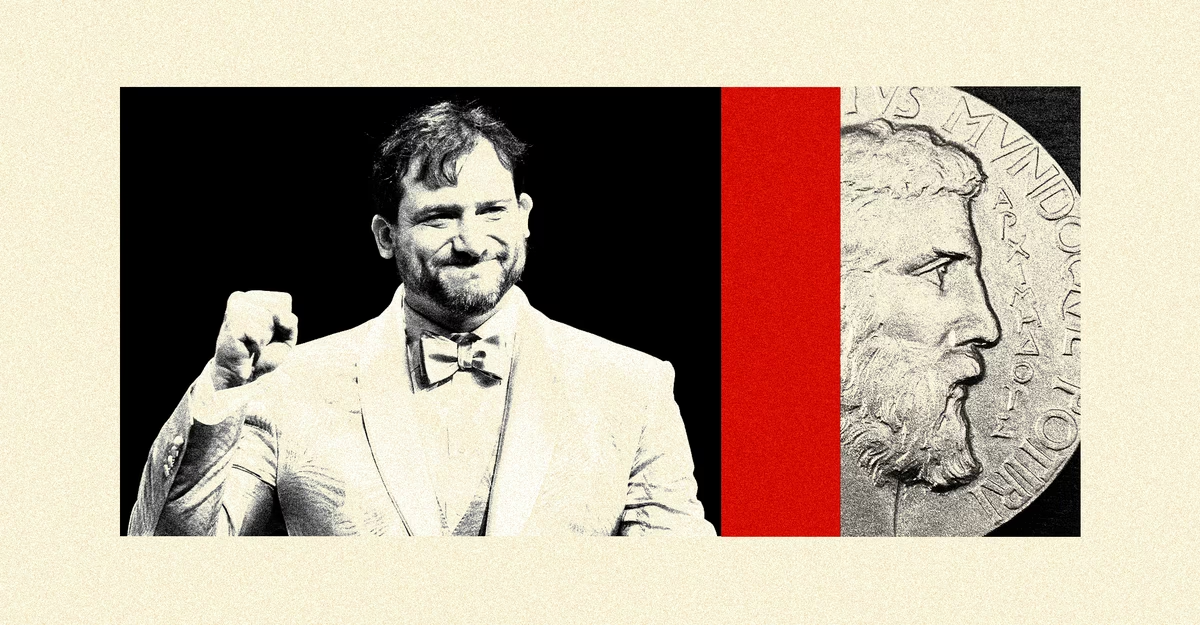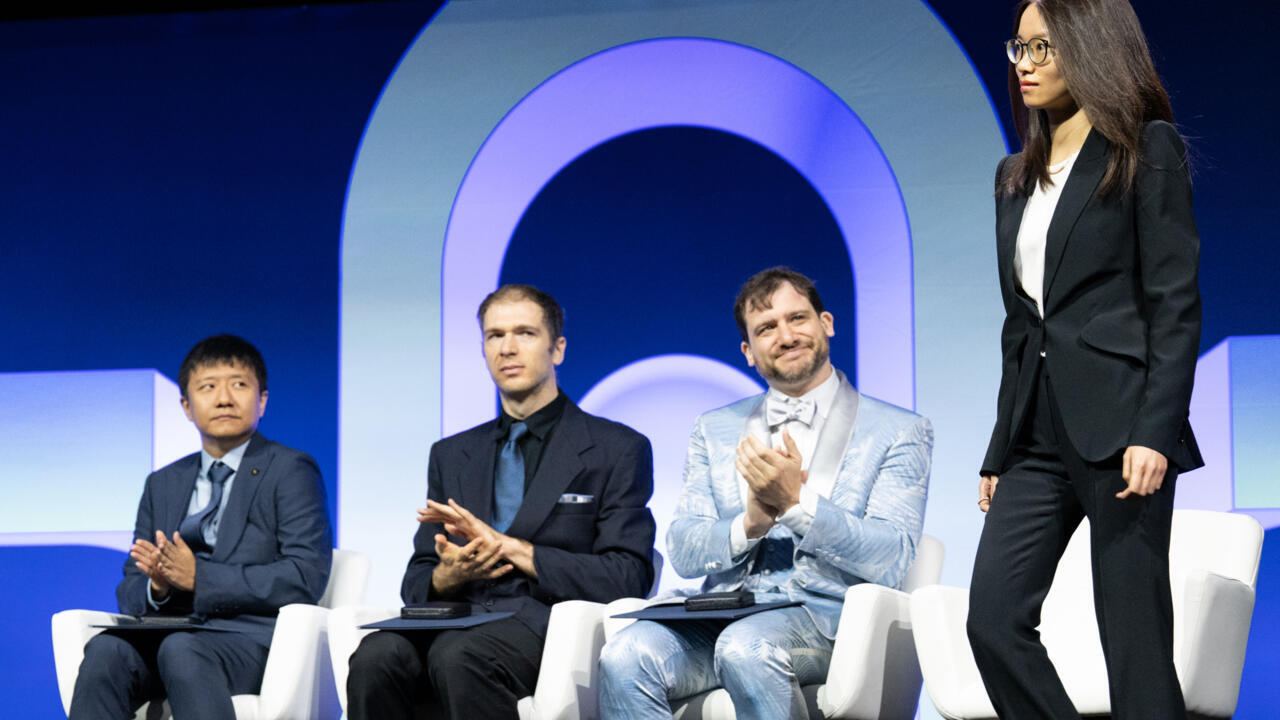
SynopsisApart from praise, the news, published on August 1, also kickstarted a debate on social media over whether the achievement is Fields medal-worthy — and what these honours mean in the artificial intelligence (AI) era. The Fields medal is awarded by the International Mathematical Union (IMU), and is often called the "Nobel Prize of Mathematics". It is awarded every four years to young mathematicians.APChatGPT-maker OpenAI has revealed that its unreleased model family Astra, pegged as its next big release, has solved century-old open problems in mathematics and theoretical computer science.Apart from praise, the news, published on August 1, also kickstarted a debate on social media over whether the achievement is Fields medal-worthy — and what these honours mean in the artificial intelligence (AI) era. The Fields medal is awarded by the International Mathematical Union (IMU), and is often called the "Nobel Prize of Mathematics". It is awarded every four years to young mathematicians.What has Astra solved?The results span group theory, high-dimensional geometry, coding theory and quantum complexity, compiled into a 249-page manuscript.The main result is the construction of the first known non-sofic group, resolving a question that had stood open since mathematician Mikhail Gromov introduced the concept in 1999. Astra has also disproved the Connes Rigidity Conjecture, posed by Fields Medalist Alain Connes in 1980, and cleared three problems from Paul Erdős's catalogue of open questions.ReactionsFields Medalist Tim Gowers said he would have recommended the proof for publication in a top mathematics journal. He has coauthored a companion paper with mathematician Noga Alon to help translate the proof for human readers.“There is no doubt that the solution to the unit-distance problem is a milestone in AI mathematics: if a human had written the paper and submitted it to the Annals of Mathematics and I had been asked for a quick opinion, I would have recommended acceptance without any hesitation," he wrote.The timing has amplified the debate. Jacob Tsimerman, who won the Fields Medal just last week, announced hours later that he is taking leave from the University of Toronto to join OpenAI to work on AI safety.Nicolas Bustamante, a Microsoft executive, questioned the validity of accolades like the Fields medal when hard problems are solved with just a prompt. "What happens to Nobel Prizes when AI designs the experiments and robotic labs run millions of them at scale? Who gets the credit: the person asking the question, the team building the model, the owner of the lab, or the AI itself? Probably not the guy who typed the prompt but who knows," he wrote in a post on X.A user replied to his post saying, "I don’t think these prizes remain. They are kind of senseless." Another said, "It's all going to go away. Post AGI we play by different rules."Some also pointed out that these ten problems were selected by OpenAI, rather than posed by an independent panel, which raises questions about how the results should be benchmarked against traditional achievement in the field. ...moreElevate your knowledge and leadership skills at a cost cheaper than your daily tea.Subscribe Now
OpenAI Astra: OpenAI’s Astra solves 10 longstanding math problems, igniting new debate - The Economic Times
Apart from praise, the news, published on August 1, also kickstarted a debate on social media over whether the achievement is Fields medal-worthy — and what these honours mean in the artificial intelligence (AI) era. The Fields medal is awarded by the International Mathematical Union (IMU), and is often called the "Nobel Prize of Mathematics". It is awarded every four years to young mathematicians.
TL;DRAI
Astra solved 10 open math problems including non-sofic group; Fields Medalist Gowers backed publication-quality proofs. Results trigger debate on AI validation, research credit allocation, and whether traditional honors retain meaning when AI automates theorem-proving.
510 words~2 min read