Story audio is generated using AI
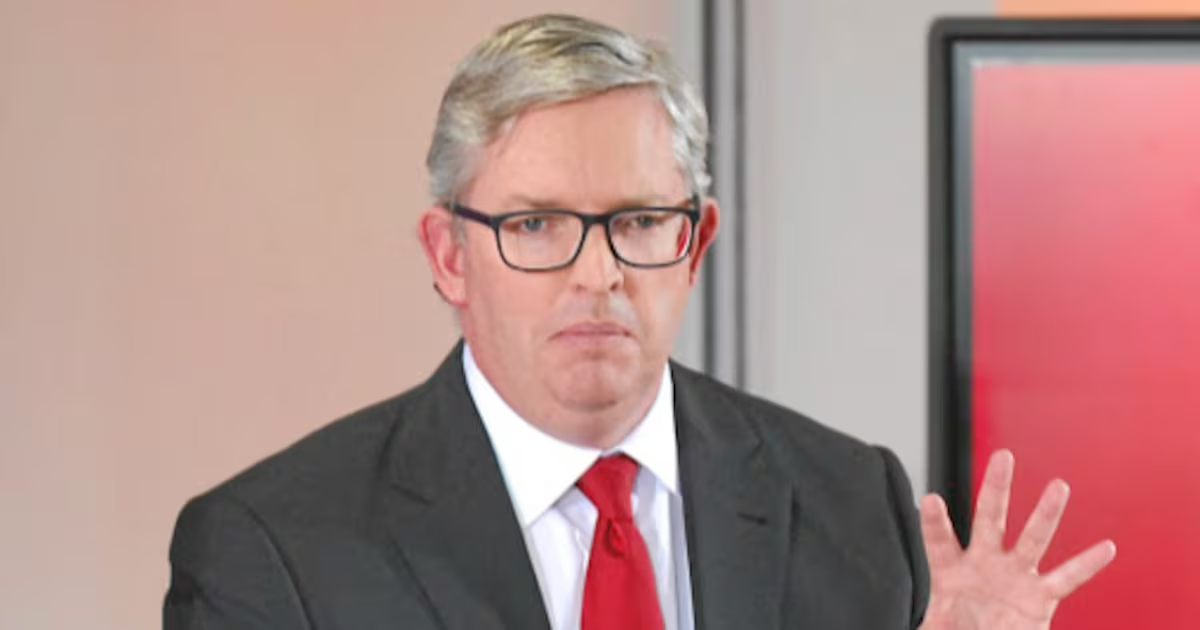
Nedbank CEO Jason Quinn is salivating at the opportunities opening up in the informal economy, with corporate South Africa slugging it out for market share in a sector some have described as over-researched but underserved. “The first step for us was a year ago when we hired Andiswa Bata. She is doing an amazing job and has built a team around her. The opportunity is amazing. Last year in the first half, loans were down 2% in that business, and in the first half this year, loans are up 6%,” Quinn said.“We never really had a township economy strategy at scale. Now we do, with scale and product. What the team is now doing is adding lending, deposit and investment banking capabilities into Ikhokha devices, which will help us leverage and support small businesses across the country.” (Dorothy Kgosi) Nedbank last year lured Bata from FNB to lead its business and commercial unit as the battle for market share in the hotly contested business banking sector intensifies.The bank also completed its R1.65bn acquisition of merchant payments business iKhokha, strengthening its position in the small business market. iKhokha has about 160,000 point-of-sale machines in the country.Standard Bank estimates South Africa’s township economy generates more than R900bn in economic activity each year, while the informal economy accounts for almost one-fifth of total employment. Though banking penetration is relatively high, many business owners continue to rely on personal bank accounts, cash transactions and manual bookkeeping, creating opportunities for businesses offering integrated payments, lending and merchant services.Pepkor last week said it will combine its new acquisition, Shop2Shop, with its informal economy payments platform, Flash, to create a R21.3bn fintech business that processes more than R200bn in transactions annually. The merged business will be listed in Pepkor’s biggest informal economy push to date.Nedbank on Tuesday recorded its biggest one-day gain since late February, up 6.31% to R293.23. This is as the group’s interim results showed it was making steady progress in gaining market share in key areas like credit cards, home loans and personal loans, while it retained a dominant position in vehicle finance.The group’s headline earnings in the six months to end-June rose a modest 0.1% to R8.4bn, though it said this had outperformed the group’s expectations at the start of the year. Headline earnings benefited from improving net interest income growth, strong non-interest revenue growth and disciplined expense management, the group said in a statement. This was offset by a higher impairment charge and no further recognition of associate income from Ecobank Transnational Incorporated (ETI) after the disposal of Nedbank’s investment in 2025. Watch | Nedbank CFO Mike Davis discusses the bank’s performance:When excluding the ETI base effect, headline earnings growth was strong at 12%, reflecting a strong underlying operational performance.HEPS rose 2% to 1,841c and an interim dividend of 1,052c per share was declared. Return on equity of 15% remained above the group’s cost of equity of 14%. Revenue was up 6% to R38.2bn, and the credit-loss ratio was reported at 95 basis points (bps), compared with 81bps a year ago.“Following the bold strategic decisions we made in 2025 to become more client-centred, unlock growth and cross-sell opportunities, diversify earnings, and enhance productivity, benefits have become more evident across our business clusters in the first half of 2026,” said Quinn.He said the acquisition of a controlling interest in Kenya’s NCBA Group is progressing. The offer closed on July 10 and was accepted by shareholders representing 79.9% of NCBA shares in issue, enabling Nedbank to achieve its targeted 66% shareholding. The remaining regulatory approvals are expected towards the end of the third quarter or early fourth quarter of 2026.