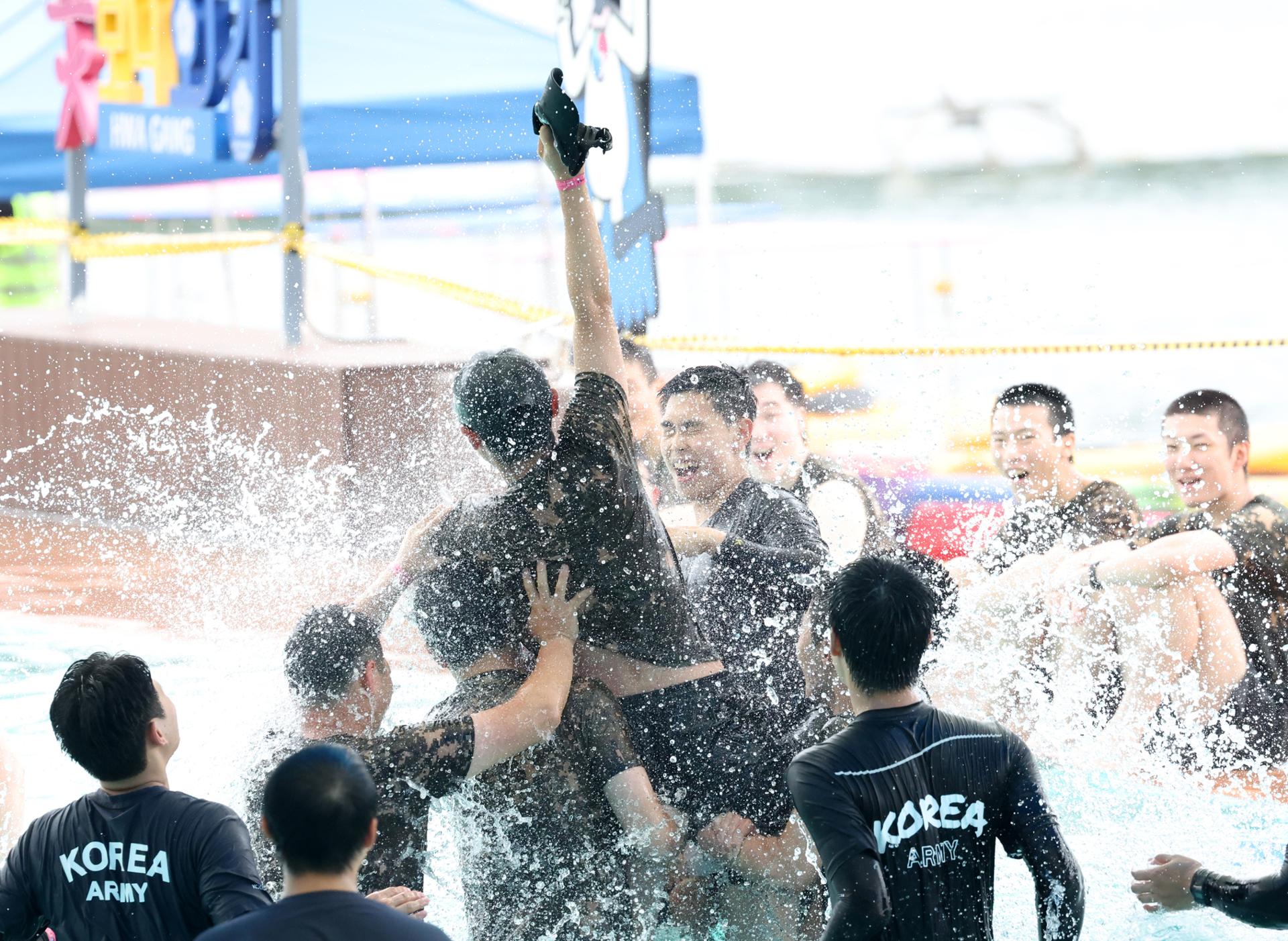
Republic of Korea Army soldiers play in the water during the All-in-One Summer Pick festival in Cheorwon, Gangwon Province, Thursday. YonhapLearning how to march in sync, fold a uniform with precision and salute with crisp authority is a rite of passage for every young military recruit. But for those who grew up overseas or come from multicultural homes, Korea’s armed forces present an extra, unexpectedly tricky drill: decoding a whole new dialect of military jargon.To help these soldiers hit the ground running, the Ministry of National Defense unveiled a surprisingly approachable fix, Wednesday: a user-friendly military glossary designed specifically to cut through the language barrier.Titled the "Easy-to-Understand Barracks Life Glossary," the guide breaks down 562 essential military terms — ranging from daily basics like "jeomho" (evening roll call) and "gyeongnye" (salute) to tactical training lingo like "yeongjeom-sagyeok" (zeroing a rifle) — into plain, accessible Korean. Crucially, each entry is translated into five languages: English, Chinese, Vietnamese, Spanish and Japanese. To keep things intuitive — and far from a dry rulebook — 231 of the terms feature playful webtoon-style illustrations.The initiative stems from a broader policy effort launched last year to support a rapidly expanding demographic of nontraditional recruits, as Korea navigates a shrinking draft pool driven by a historically low birthrate. According to projections by the state-funded Korea Institute for Defense Analyses, the number of conscripts from multicultural backgrounds — currently estimated between 4,400 and 5,000 — is expected to surpass 10,000 by 2030, accounting for roughly five percent of all active conscripts. They are joined each year by hundreds of overseas Korean permanent residents and dual nationals who voluntarily enlist to fulfill their mandatory service. Under the Military Service Act, this mandatory commitment lasts between 18 months (Army and Marine Corps) and 21 months (Air Force) — a substantial period to navigate while adjusting to a rigid command structure and unfamiliar lingo.Rather than compiling the guide from a quiet administrative office, officials took a field-first approach to ensure the handbook reflected real daily life in the barracks, according to the ministry.Between December 2025 and January 2026, a research team from Hanyang University visited major army facilities, including the Army Training Center and the 17th Infantry Division. Researchers observed recruits from wake-up calls to lights-out, recording conversations and interviewing soldiers on the ground.A monitoring panel made up of three educational advisors and 10 active-duty soldiers with long-term overseas experience — two for each language — vetted the lexicon from word selection to final translation. The International Association for Korean Language Education also provided academic oversight. Out of an initial pool of over 2,000 gathered words, the panel narrowed the list down to the most essential 562 terms."Having lived in China for 14 years, I found many military terms totally foreign when I first joined," said Specialist Seo Young-jun of the Army’s 6th Infantry Division, who served on the review panel. "It felt great to help build something that will make life easier for the soldiers coming after me. It should definitely help new recruits settle in faster once they reach their units."The handbook is organized chronologically into two main parts — "Boot Camp" and "Unit Life" — alongside an appendix covering rank structures, leave procedures and common barracks announcements.Starting Wednesday, the digital version is accessible on the Military Manpower Administration website for preenlistment reading, with physical pocketbooks being handed out to all new recruits starting basic training this month."We hope this glossary helps smooth over the awkwardness or isolation that recruits facing language hurdles might feel," said Park Shin-young, director of the Barracks Culture Innovation Division. "We’re committed to offering tailored support so that no soldier feels left behind simply because of a language gap."This article was published with the assistance of generative AI and edited by The Korea Times.
Lost in translation no more: Korea's military unveils multilingual guide for recruits - The Korea Times
Learning how to march in sync, fold a uniform with precision and salute with crisp authority is a rite of passage for every young military recruit....
630 words~3 min read