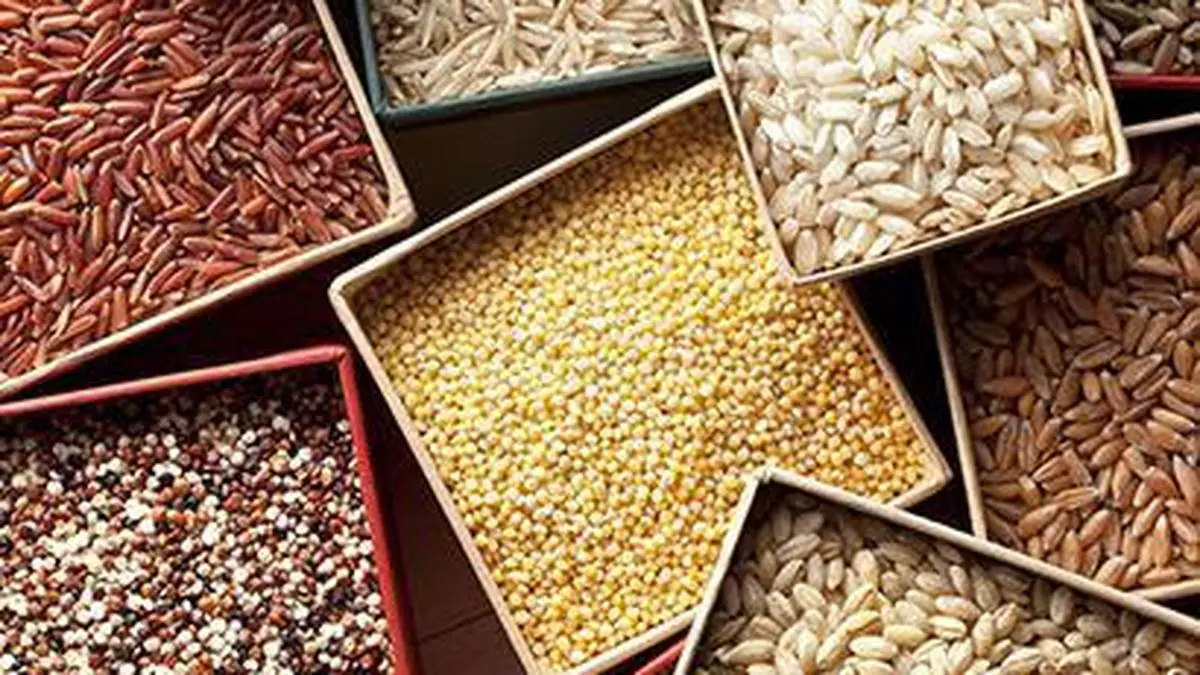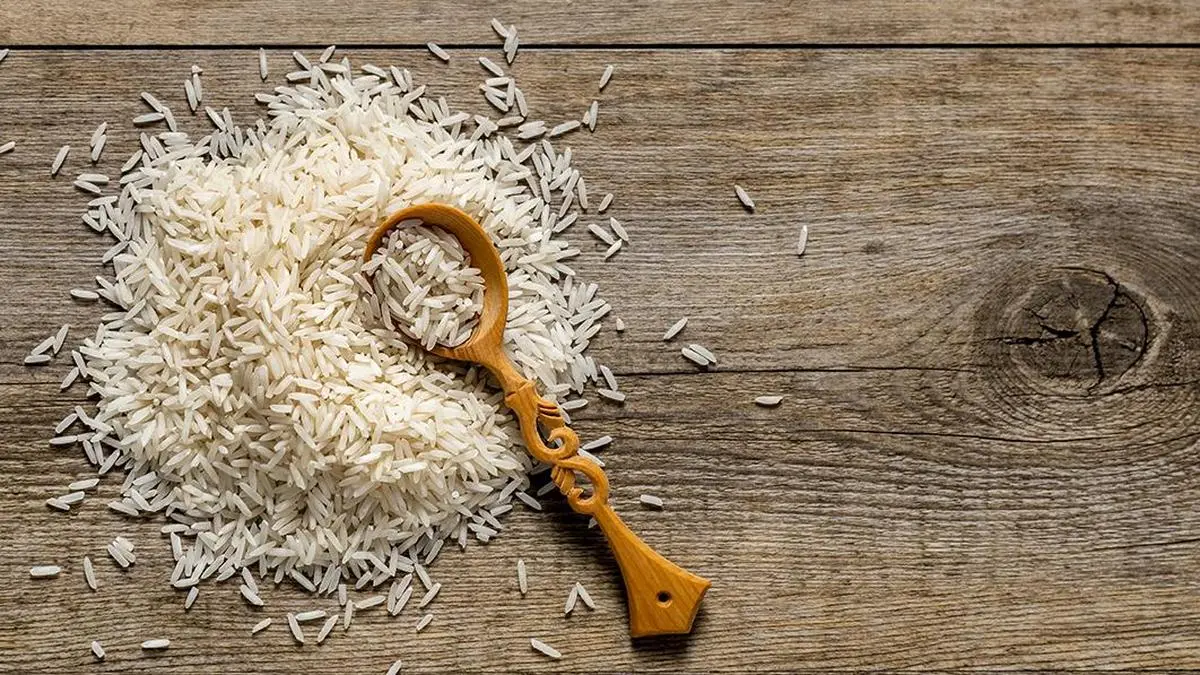
Top view of Basmati Rice pile with wooden spoon on the antique wooden background.
| Photo Credit:
EleSi
More than a year after its announcement, one of India’s two gene-edited rice varieties is set to be planted in the upcoming rabi season for seed multiplication. The Indian Council of Agricultural Research (ICAR) is expected to sign a Memorandum of Understanding (MoU) this month with US-based Corteva, which holds the license for the CRISPR-Cas9 gene-editing technology.Highly placed sources said that ICAR has received 2 of the 3 approvals, including one from the Ministry of External Affairs, required to sign the MoU with Corteva and once the third one is received the agreement will be signed. After the MoU is signed, it will pave way for the commercial release of “Pusa DST Rice 1", developed by ICAR’s New Delhi-based Indian Agricultural Research Institute (IARI).“First the MoU will be signed with Corteva and next will be with US-based MIT/Broad institute which has the patent over ‘CRISPR-CaS12a’ tool,” said a top official. The ‘CRISPR-CaS12a’ tool was used to develop DRR Dhan 100 (KAMALA), developed by Hyderabad-based Indian Institute of Rice Research.Set for seed multiplicationOn May 4, 2025, Union Agriculture Minister Shivraj Singh Chouhan announced the breakthrough of ICAR’s scientists in which for the first time two rice varieties have been developed using gene editing technology.Sources said that IARI has already kept about 2 tonnes of Pusa DST Rice 1, which is sufficient for starting the seed multiplication in upcoming rabi season with transplanting around November. Pusa DST Rice 1 is derived from MTU1010, which is suitable for rabi season in southern states. Since MTU1010 is sensitive to several abiotic stresses including drought and salinity, scientists have edited SDNI mutant of Drought and Salt Tolerance (DST) gene and was tested in the multilocation field trials during 2023 and 2024.Pusa DST Rice 1 exhibits an average yield of 2493, 3508, 3731 kg/ha (under three different conditions) against MTU 1010’s 1912 kg/ha under coastal salinity stress, 3199 kg/ha under Inland Salinity stress and 3254kg/ha under Alkalinity condition. ICAR recommends Pusa DST Rice 1 can be grown in Andhra Pradesh, Telangana, Karnataka, Tamil Nadu, Kerala, Chhattisgarh, Odisha, Madhya Pradesh, Maharashtra, Jharkhand, Bihar, Uttar Pradesh and West Bengal.AI-designed enzymesBefore the MoU could be signed with ICAR, Corteva has signed the long-term humanitarian licensing agreement with ICRISAT. Announcing the partnership, the International Crops Research Institute for the Semi-Arid Tropics (ICRISAT) on August 3 said that it has secured long-term access to CRISPR-Cas9 in order to deploy gene editing, one of the world’s most transformative new technologies, across smallholder Asian and African farms.Scientists said that there is no issue using the patented tool while doing research, but due to the Intellectual Property Rights of the technology, any commercialisation of new varieties from that research is prohibited, unless the patent holder or its licensee agrees.On the other hand, even as ICAR struggles to sign MoU so that already developed varieties through gene editing reach farmers’ field, its own team of scientists led by Kutubuddin Ali Molla has showed that AI-designed enzymes can accurately edit plant DNA, enabling gene knockout, base editing and prime editing in crops. While a US company had earlier developed a similar AI-designed system for human cells, this is the first successful demonstration in plants.Molecular scalpelGenome editing technology (CRISPR-Cas) works like a molecular scalpel, allowing scientists to precisely cut and rewrite sections of a plant’s DNA to develop traits such as higher yield, climate resilience or disease resistance without introducing foreign genes. Until now, these tools relied on proteins borrowed from bacteria and other microbes found in nature.The final products of two variants of genome editing technology, namely, Site Directed Nuclease 1 (SDN 1) and Site Directed Nuclease 2 (SDN 2), are treated by India as free from regulation. In SDN1 and SDN 2 type of genome editing, a native gene is mutated in its native location to create its alternative form called allele with a desirable altered expression and function. The mutants created by SDN1 and SDN 2 approaches are free of exogenous introduced DNA. These mutants are alike and indistinguishable from spontaneous or induced mutants. Hence, exempted from biosafety regulation of Rules 7-11 of Rules 1989 under Environment (Protection) Act 1986.Published on August 4, 2026