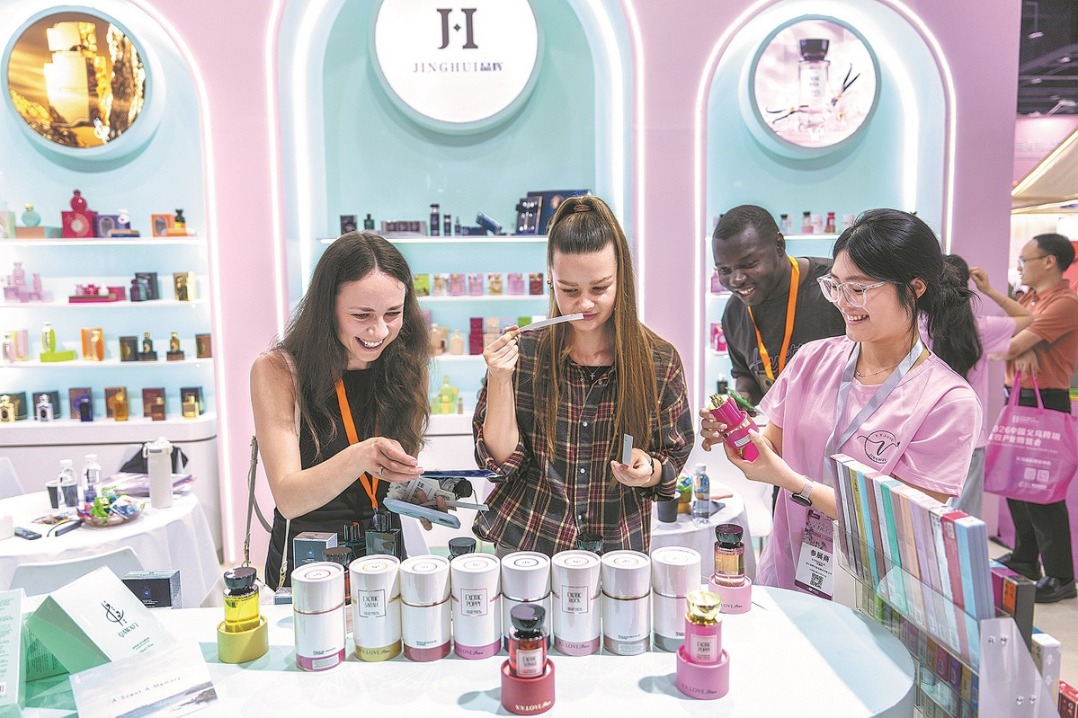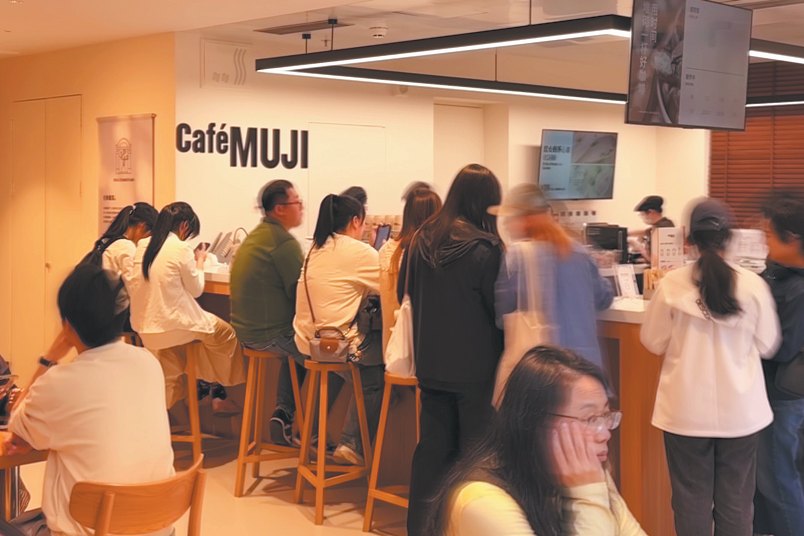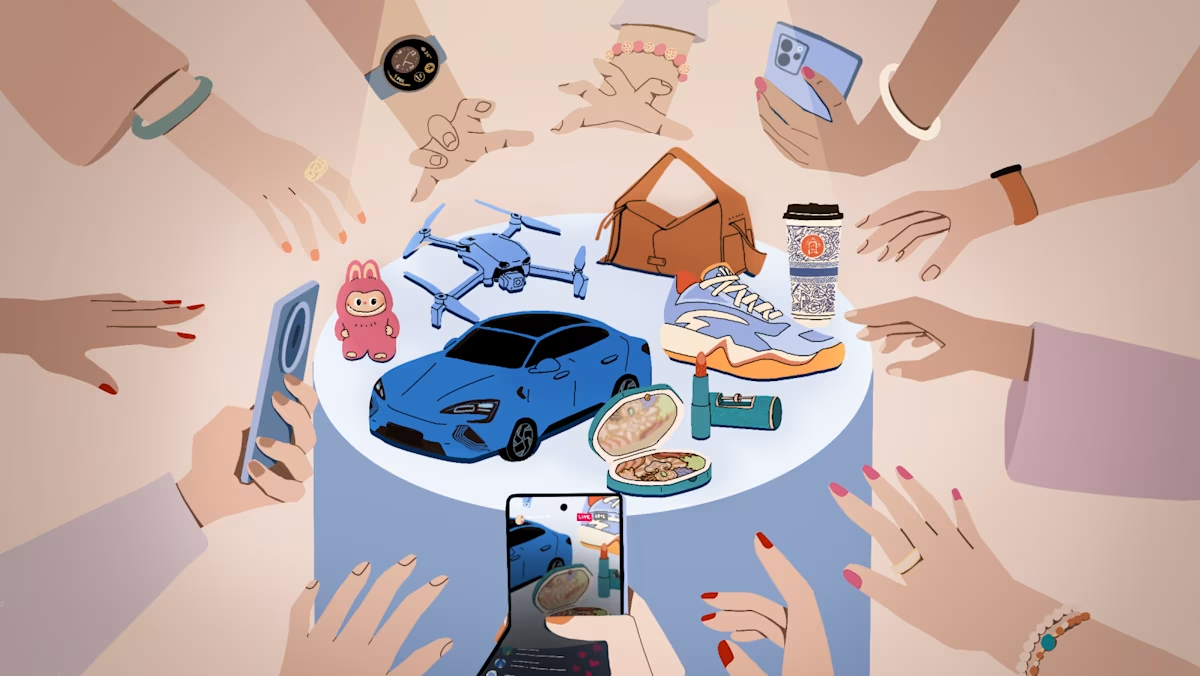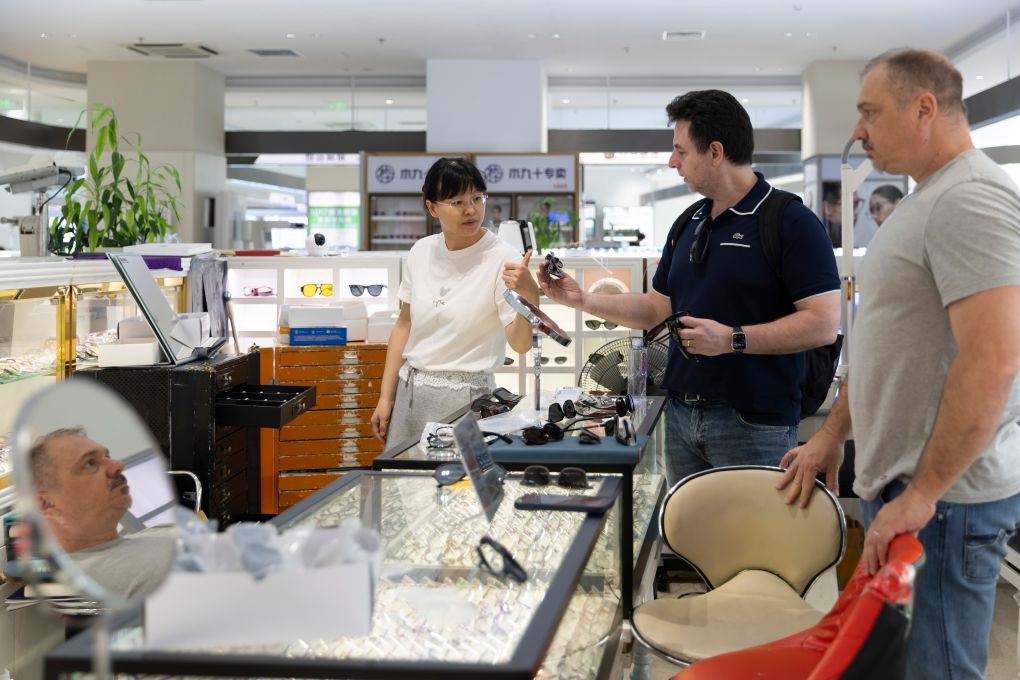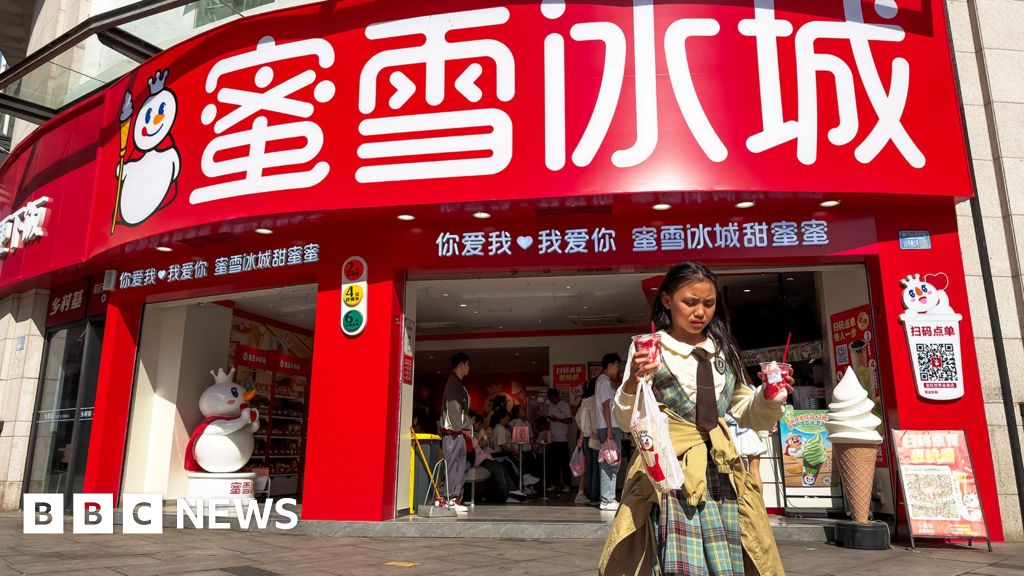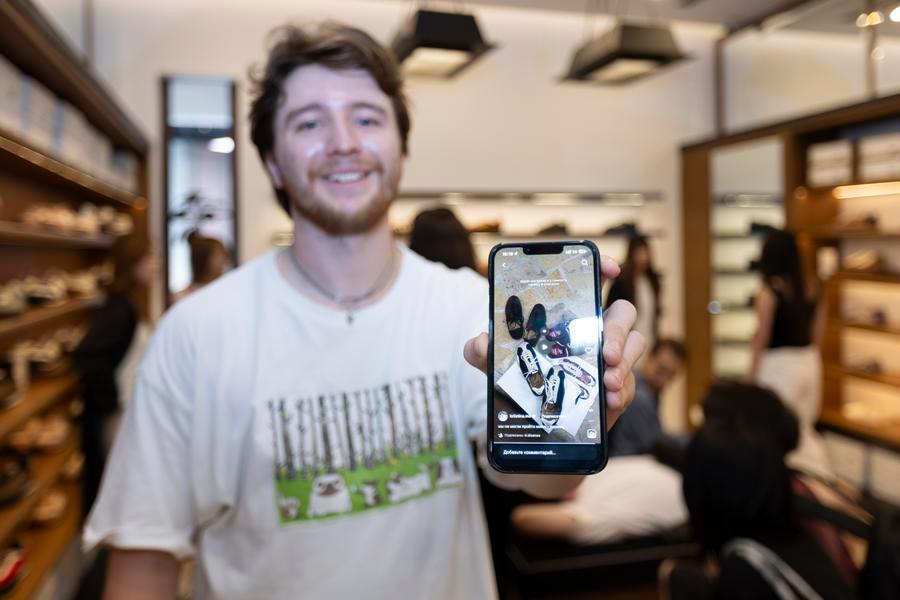
SHANGHAI, Aug. 4 (Xinhua) -- Before boarding her flight to Shanghai in east China, Saudi tourist Fay had already planned exactly where she wanted to shop.Saved on her phone was a curated list of Chinese brands she had discovered on social media. Instead of luxury boutiques, her itinerary featured homegrown brands such as handbag label MUVA, and she hoped to see the products in person before making a purchase."I came here this time specifically to shop," Fay said while browsing handbags at the Shanghai store. "I saw these Chinese brands on social media and really liked them. I wanted to check them out one by one and buy their products."Fay is among a growing number of overseas visitors arriving in China with shopping lists centered on homegrown Chinese brands.Over the past decades, the shopping baskets of international tourists in China have undergone a clear shift: once filled with traditional souvenirs like silk scarves and jasmine tea, they later gave way to budget-friendly cosmetics and digital gadgets prized for affordability and utility.Today, however, more visitors are shopping for homegrown designer handbags, oriental fragrances and handcrafted eyewear. These products carry higher price tags, with summer collections from homegrown fashion label SHUSHU/TONG retailing for more than 2,000 yuan (about 294.6 U.S. dollars), while basic shoes from PANE, a footwear brand, start at 880 yuan. Despite the higher cost, consumers are increasingly willing to pay for distinctive designs and brand value.Maksim Ermolaev, a tourist from Russia, shows shoes from a Chinese brand that he has seen on social media at a shop in Shanghai, east China, July 22, 2026. (Xinhua/Wang Xiang)Russian traveler Alexander first encountered PANE on Instagram and noted the brand's surging popularity back home. "It has built its own style and cultural identity," Alexander commented.German tourist Fanni picked up a pair of ballet flats from a local label, calling them "chic and comfortable." Great patterns, colors and solid quality justify a slight premium, she added.Analysts say this shift is closely linked to the upgrading of Chinese brands. Zhang Mengxia, director of the China Luxury Goods and Services Research Center at the University of International Business and Economics, said Chinese brands are moving beyond simply selling products toward offering design, aesthetics and creativity."Many popular Chinese brands embody a sophisticated and unique oriental aesthetic, which is highly attractive to foreign consumers," she noted.For Giovanni Pungetti, a teacher and mentor at Istituto Marangoni and former global CEO of Maison Margiela, this change reflects the maturation of China's fashion industry."Emerging Chinese brands are telling stories and offering modern products designed and created there, with strong price-to-value ratios," Pungetti said, describing the shift from "made in China" to "designed in China."Social media platforms have played a growing role in connecting Chinese brands with overseas consumers, turning online interest into offline visits. Homegrown handbag label Songmont, for example, has attracted over 600,000 followers on Instagram, helping bring international visitors to its stores.A staff member takes measurements for Martial (C), a tourist from France, at a clothing store in Shanghai, east China, July 22, 2026. (Xinhua/Wang Xiang)The manager of MUVA's TX Huaihai store in Shanghai said overseas customers account for 60 to 70 percent of total foot traffic, with many arriving after discovering the brand online.International tourists' fascination with Chinese domestic brands extends far beyond designer fashion. Trendy blind boxes from Pop Mart, alongside milk tea from local favorites like Chagee and Mixue Ice Cream & Tea, have become must-try items on inbound travel checklists. Meanwhile, jeweler Laopu Gold has seen a surge in popularity among overseas travelers.According to sales staff at Laopu Gold's IFC Mall store in Shanghai, international customers visit nearly every day, with the majority hailing from Europe and the Americas. They are particularly drawn to gold pieces featuring traditional Chinese iconography, with calabash, coin motifs and bronze decorative patterns topping the list.This consumption shift extends beyond individual fashion brands and reflects broader changes in China's inbound consumption landscape. Jiang Zhao, a researcher at the Chinese Academy of International Trade and Economic Cooperation under the Ministry of Commerce, attributed the trend to a combination of factors, including expanded visa-free policies, stronger manufacturing capabilities and more diverse consumption experiences.In addition to brand appeal, policy improvements have helped turn overseas interest into actual purchases. As China expands visa-free access for international travelers, it has continued to streamline departure tax refund procedures, making shopping more convenient for visitors.A tourist (C) from Spain applies for a tax refund at a centralized departure tax refund service center in Yuzhong District of Chongqing, southwest China, Jan. 7, 2026. (Photo by Yao Hui/Xinhua)Market metrics confirm this trend. Official data showed that in the first half of 2026, the number of overseas travelers applying for departure tax refunds soared by 366 percent year on year, while sales of tax-refund goods and refund amounts both rose by 69 percent in this period.In Shanghai alone, customs authorities completed verification for 201,000 outbound tax refund applications in the first five months of 2026, covering taxable goods sales worth 1.92 billion yuan, representing year-on-year increases of 300 percent and 62 percent, respectively.To capitalize on this momentum, experts are calling for further retail infrastructure upgrading. Zheng Chunying, vice chairman of the Shanghai Federation of Industry and Commerce, suggested creating one-stop retail zones centered around Chinese brands in key commercial districts to make shopping more convenient.As international tourists fill their suitcases with "designed-in-China" merchandise, their evolving shopping habits reflect a global perceptual upgrade of Chinese brands.For Pungetti, global expansion for Chinese brands is less about opening overseas stores, and more about building unique brand identities and communicating cross-culturally to resonate with worldwide audiences. ■
Xinhua Headlines: Chinese homegrown brands become new draw for global visitors
Xinhua Headlines: Chinese homegrown brands become new draw for global visitors-
934 words~4 min read