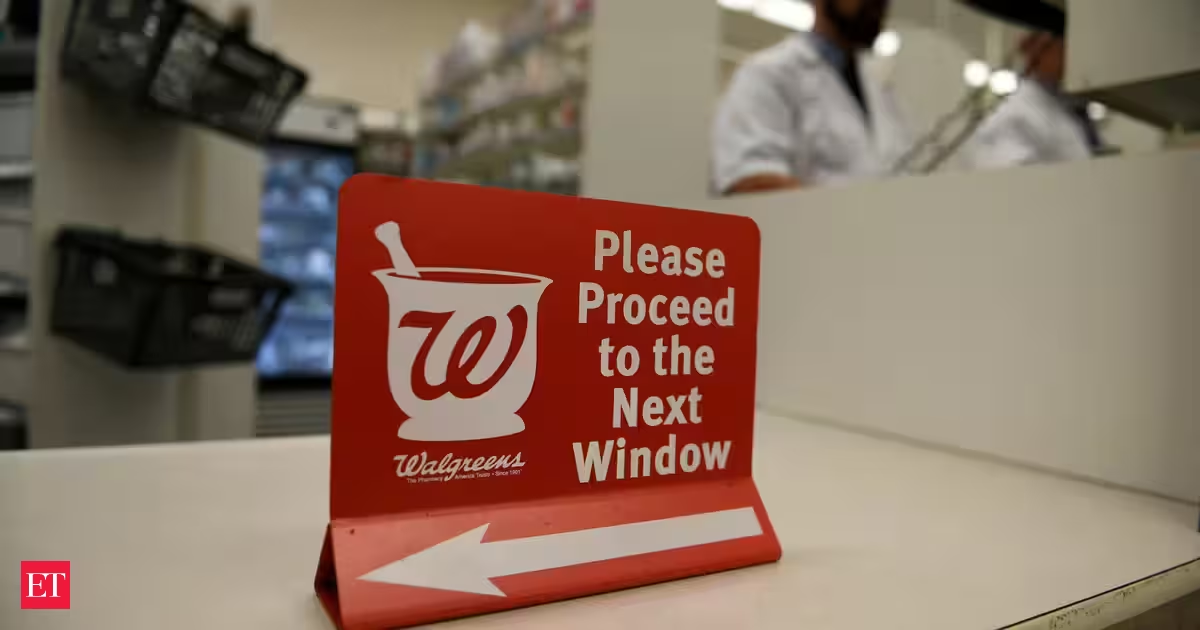
Pharmacy giant Walgreens is pressing ahead with its long-term plan to streamline operations in 2026, closing stores in more than a dozen states as it focuses on improving profitability, according to a report in Inc. The move is part of a broader restructuring strategy aimed at reducing its retail footprint and investing more heavily in locations that generate stronger sales and customer demand. The company's cost-cutting efforts extend beyond retail pharmacies.Despite the ongoing closures, Walgreens remains one of the nation's largest pharmacy chains, operating more than 8,500 stores across the United States. The company continues to maintain a significant presence in communities nationwide, even after hundreds of locations have been closed. The retailer first unveiled its restructuring plan in October 2024, announcing that about 1,200 underperforming stores would be closed over a three-year period. The company initially expected to shut down around 500 locations in 2025. Since then, Walgreens has undergone a major ownership change, becoming a privately held company in 2025. Under its new ownership, the pace of closures has slowed considerably. The company now expects to close fewer than 100 stores in 2026, a significant reduction from earlier internal estimates that projected as many as 700 closures this year.According to IBT, Walgreens' cost-cutting efforts extend beyond its retail stores. Following its acquisition, the company has also eliminated hundreds of jobs as part of a broader restructuring initiative. In addition, it permanently closed its 500,000-square-foot distribution center in Houston on June 1, 2026. Taken together, the store closures, workforce reductions, and supply chain consolidation highlight Walgreens' ongoing strategy to streamline operations, reduce costs, and focus on building a more efficient and financially sustainable business.Founded in 1901 by Charles R Walgreen, Walgreens grew from a single Chicago pharmacy into one of the world's largest drugstore chains. The business expanded rapidly during the 1920s, aided by demand for prescription whiskey during prohibition and the popularity of its soda fountains and ice cream treats. By the early 1930s, Walgreens had nearly 400 stores. Over the following decades, it expanded into markets including Puerto Rico and Mexico, diversified into beauty and personal care products, and later merged with Alliance Boots, creating the global retail pharmacy company Walgreens Boots Alliance.Here's a list of Walgreens locations that have closed in 2026 as reported by Inc.:California1301 Market Street, San Francisco, CA 94103Florida12041 Palm Beach Boulevard, Fort Myers, FL 33905Illinois2351 E 71st Street, Chicago, IL 606498628 S Cottage Grove Avenue, Chicago, IL 606195503 E State Street, Rockford, IL 61108108 Wilmot Road, Deerfield, IL 60015Missouri11404 St Charles Rock Road, Bridgeton, MO 630442202 Chambers Road, St. Louis, MO 63136New York120 Court Street, Brooklyn, NY 11201South Carolina1294 Ribaut Road, Beaufort, SC 29902Texas1805 Greens Road, Houston, TX 77032Virginia1301 S Joyce Street, Suite D3, Arlington, VA 22202Washington2400 S Jackson Street, Seattle, WA 98144Washington, DC1815 Connecticut Avenue NW, Washington, DC 20009Wisconsin2727 W North Avenue, Milwaukee, WI 53208
Walgreens to close more stores in 2026 - Check list of pharmacy giant's locations shutting down across the US
Walgreens is closing stores across many states as part of its 2026 operational streamlining plan. The company aims to improve profitability by reducing its retail footprint and focusing on high-demand locations. This strategic move follows a significant ownership change in 2025 which slowed closure rates. Walgreens also eliminated jobs and closed a distribution center as part of its cost-cutting.
474 words~2 min read