in History, Music | August 4th, 2026 Leave a Comment
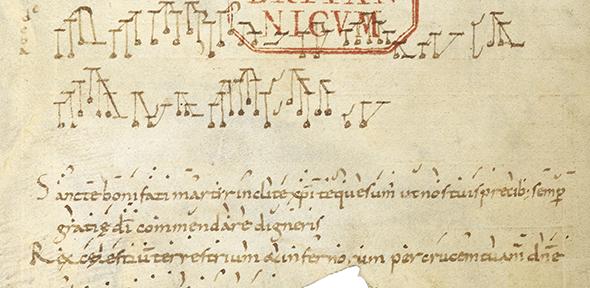
Like digging for fossils or panning for gold, the research process can be a tedious affair. But for any researcher, long days of searching and reading will eventually result in discovery. These are the moments scholars cherish. It’s the chance discovery, however rare, that makes the long hours and bleary late nights worthwhile. And some finds can change an entire field. Such was the discovery of St. John’s College PhD student, and now Associate Professor of Musicology at the University of Pavia, Giovanni Varelli, who, in 2014, found what is believed to be, writes Cambridge University, “the earliest known practical example of polyphonic music,” that is, music consisting of two or more melodic lines working together simultaneously.
You can hear the short composition—written in praise of the patron saint of Germany, Saint Boniface—performed above by St. John’s undergraduates Quintin Beer and John Clapham. Prior to Varelli’s discovery of this piece of music, the earliest polyphonic music was thought to date to the year 1000, from a collection called The Winchester Troper. Varelli’s discovery may date to 100 years earlier, around the year 900, and was found at the end of a manuscript of the Life of Bishop Maternianus of Reims. One reason musicologists have so far overlooked the piece, Varelli says, is that “we are not seeing what we expected.”