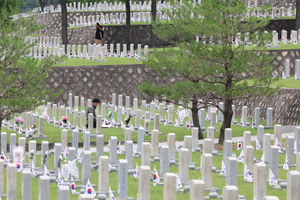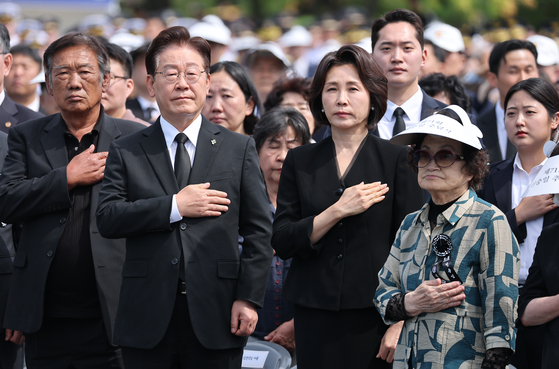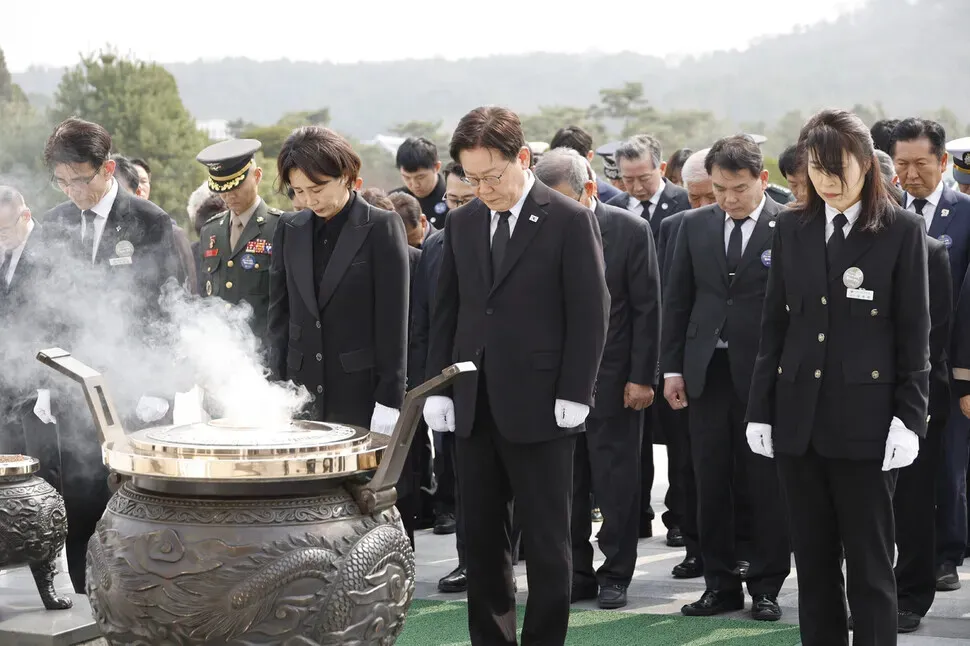
President Lee Jae Myung and first lady Kim Hea-kyung pay their respects at the Daejeon National Cemetery on March 27, 2026, which is West Sea Defense Day. (pool photo)
North Korea’s words and actions can be seen as having a dual purpose. They are at once intended for external consumption, while also having a domestic audience in mind.In South Korea, we need not put too much stock in what North Korea says and does.That said, it’s true that the harsh language used by the North Korean authorities is often infuriating. The language is simply too crass to dismiss as the swagger of a bad-tempered brother with a chip on his shoulder.The North Koreans crave dialogue with the US even while they give us the cold shoulder. And that hasn’t changed since Lee Jae Myung became president.How should we explain North Korea’s bizarre behavior? There are no doubt plenty of reasons, but I think our own actions are partly to blame.Despite being a sovereign state, South Korea does not have wartime operational control (OPCON) of its own military — that’s still held by the US.If a war were to break out, the US would control the South Korean armed forces. That’s why North Korea views us with disdain and only seeks to deal with the US.How did that come to be?When North Korean troops invaded in 1950, we lacked the strength to resist. So South Korean President Syngman Rhee wrote a letter to Douglas MacArthur, then supreme commander of UN forces in Korea, handing over “command authority over all land, sea, and air forces of the Republic of Korea during the period of the continuation of the present state of hostilities.”In effect, Rhee surrendered Korea’s military sovereignty to the US. MacArthur took Rhee’s transfer of “command authority over all [. . .] forces” to mean operational command.An armistice was reached in 1953, but Korea didn’t regain its military sovereignty. In 1954, “operational command” was reduced to “operational control (OPCON),” which was exercised by the UN Command and the ROK/US Combined Forces Command. In effect, Korea’s military sovereignty remains in American hands.Park Chung-hee, who came to power in a coup in 1961, promoted South Korea’s defense autonomy and the recovery of OPCON. One of his main reasons was the frequent military clashes with the North, including a raid by heavily armed commandos. But the US was unwilling to relinquish OPCON.In the 1987 election, Roh Tae-woo pledged on the campaign trail to regain OPCON. As it happened, the Nunn-Warner Amendment passed by the US Congress in 1989 initiated a push to reduce the US military footprint abroad.The end of the Cold War presented Korea with a perfect chance to recover OPCON. But what happened was that the US only returned peacetime OPCON without giving up wartime OPCON.